Thank you for visiting SNEWPapers!
Sign up free
The Daily Gazette
Wilmington, New Castle County, Delaware
What is this article about?
Detailed description of the Edge Moor Iron Works near Wilmington, owned by the Sellers family and Eli Garrett, highlighting innovative, efficient production of wrought iron bridge trusses using hydraulic machines, scientific furnaces, and precise tools to minimize waste and achieve high-quality output without noise or traditional hammering.
Merged-components note: Continuation of the Edge Moor Iron Works narrative, sequential reading order and adjacent bounding boxes.
Clipping
OCR Quality
Full Text
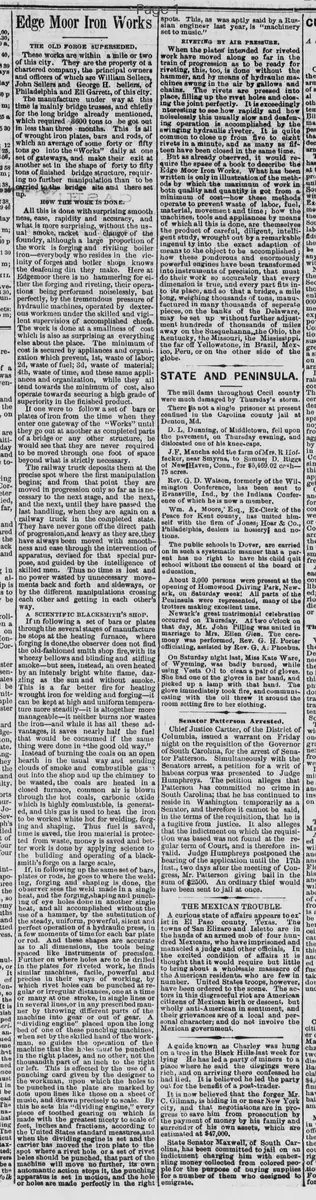
THE OLD FORGE SUPERSEDED,
These works are within a mile or two of this city. They are the property of a chartered company, the principal owners and officers of which are William Sellers, John Sellers and George H. Sellers, of Philadelphia and Eli Garrett, of this city.
The manufacture under way at this time is mainly bridge trusses, and chiefly for the long bridge already mentioned, which required 3600 tons to be got out in less than three months. This is all of wrought iron plates, bars and rods, of which an average of some forty or fifty tons go into the "Works" daily at one set of gateways, and make their exit at another set in the shape of forty to fifty tons of finished bridge structure, requiring no further manipulation than to be carried to the bridge site and there set up.
TTPAO
HOW THE WORK IS DONE.
All this is done with surprising smoothness, ease, rapidity and accuracy, and what is more surprising, without the usual smoke, racket and clangor of the foundry, although a large proportion of the work is forging and riveting boiler iron—everybody who resides in the vicinity of forges and boiler shops knows the deafening din they make. Here at Edgemoor there is no hammering for either the forging and riveting, their operations being performed noiselessly, but perfectly, by the tremendous pressure of hydraulic machines, operated by dexterous workmen under the skilled and vigilant supervision of accomplished chiefs.
The work is done at a smallness of cost which is also as surprising as everything else about the place. The minimum of cost is secured by appliances and organization which prevent, 1st, waste of labor; 2d, waste of fuel; 3d, waste of material; 4th, waste of time, and these same appliances and organization, while they all tend towards the minimum of cost, also operate towards securing a high grade of superiority in the finished product.
If one were to follow a set of bars or plates of iron from the time when they enter one gateway of the "Works" until they go out at another as completed parts of a bridge or any other structure, he would see that they are never required to be moved through one foot of space beyond what is strictly necessary.
The railway truck deposits them at the precise spot where the first manipulation begins; and from that point they are moved in progression only so far as is necessary to the next stage, and the next, and the next, until they have passed the last handling, when they are again on a railway truck in the completed state.
They have never gone off the direct path of progression, and heavy as they are, they have always been moved with smoothness and ease through the intervention of apparatus, devised for that special purpose, and guided by the intelligence of skilled men. Thus no time is lost and no power wasted by unnecessary movements back and forth and sideways, or by the different manipulations crossing each other and getting in each other's way.
A SCIENTIFIC BLACKSMITH'S SHOP.
If in following a set of bars or plates through the several stages of manufacture he stops at the heating furnace, where forging is done, the observer does not find the old-fashioned smith shop fire, with its wheezy bellows and blinding and stifling smoke—but sees, instead, an oven heated by an intensely bright white flame, dazzling as the sun and without smoke.
This is a far better fire for heating wrought iron for welding and forging—it can be kept at high and uniform temperature more steadily—it is altogether more manageable—it neither burns nor wastes the iron—and while it has all these advantages, it saves nearly half the fuel that would be consumed if the same thing were done in "the good old way."
Instead of burning the coals on an open hearth in the usual way and sending clouds of smoke and combustible gas out into the shop and up the chimney to be wasted, the coals are heated in a closed furnace, common air is blown through the hot coals, carbonic oxide which is highly combustible, is generated, and this gas is used to heat the iron to be worked white hot for welding, forging and shaping. Thus fuel is saved, time is saved, the iron material is protected from waste, money is saved and better work is done by applying science to the building and operating of a blacksmith's forge on a large scale.
If, in following up the same set of bars, plates or rods, he goes to where the welding, forging and shaping is done, the observer sees the weld made in a single heat, and the forging, shaping and punching of eye holes done in another single heat, and all accomplished without the use of a hammer, by the substitution of the steady, uniform, powerful, silent and perfect operation of a hydraulic press, in a few moments of time for each bar plate or rod. And these shapes are accurate as to all dimensions, the tools being spaced like instruments of precision.
Further on where holes are to be drilled in the plates for riveted work, he finds similar machines, facile, powerful and precise in their ways of working, by which rivet holes can be punched at regular or irregular distances, one at a time or many at one stroke, in single lines or in several lines, or in any prescribed manner by throwing different parts of the machine into gear or out of gear. A "dividing engine" placed upon the long bed of one of these punching machines, when set by the skilled hand of the workman, so guides the operation of the machine that the holes must be punched in the right places, and no other, not the thousandth part of an inch to the right or left. This is effected by the use of a punching card given by the designer to the workman, upon which the holes to be punched in the plate are marked by dots upon lines like those on a sheet of music, and drawn precisely to scale. By this he sets his "dividing engine," every piece of toothed gearing on which is made with the greatest nicety to scale of feet, inches and fractions, according to the United States standard measures, and when the dividing engine is set and the carrier has moved the iron plate to the spot where a rivet hole or a set of rivet holes should be punched, that part of the machine will move no further, its own automatic action stops it, the punching apparatus is set in motion, and the hole or holes are made perfectly in the right spots. This, as was aptly said by a Russian engineer last year, is "machinery set to music."
RIVETING BY AIR PRESSURE.
When the plates intended for riveted work have moved along so far in the train of progression as to be ready for riveting, this, too, is done without the hammer, and by means of hydraulic machines swung in the air by gallows and chains. The rivets are pressed into place, filling up the rivet holes and closing the joint perfectly. It is exceedingly interesting to see how rapidly and how noiselessly this usually slow and deafening operation is accomplished by the swinging hydraulic riveter. It is quite common to close up from five to eight rivets in a minute, and as many as fifteen have been closed in the same time.
But as already observed, it would require the space of a book to describe the Edge Moor Iron Works. What has been written is only in illustration of the methods by which the maximum of work in both quality and quantity is got from a minimum of cost—how these methods operate to prevent waste of labor, fuel, material, movement and time; how the machines, tools and appliances by means of which all this is done, are themselves the product of careful, diligent, intelligent study, wrought out by a remarkable ingenuity into the exact adaptation of means to the object to be accomplished; how these ponderous and enormously powerful engines have been transformed into instruments of precision, that must do their work so accurately that every dimension is true, and every part fits into its place, and so that a bridge, a mile long, weighing thousands of tons, manufactured in many thousands of separate pieces, on the banks of the Delaware, may be set up without further adjustment hundreds of thousands of miles away on the Susquehanna, the Ohio, the Kentucky, the Missouri, the Mississippi, the far off Yellowstone, in Brazil, Mexico, Peru, or on the other side of the globe.
What sub-type of article is it?
What themes does it cover?
What keywords are associated?
What entities or persons were involved?
Where did it happen?
Story Details
Key Persons
Location
Edge Moor Iron Works, Within A Mile Or Two Of This City
Story Details
The Edge Moor Iron Works produces bridge trusses efficiently using advanced hydraulic machines for forging and riveting without noise or waste, scientific furnaces for heating iron, precise punching with dividing engines guided by cards, and streamlined material flow to minimize costs and ensure accuracy for large-scale bridge construction.