Thank you for visiting SNEWPapers!
Sign up free
The Daily Advertiser
New York, New York County, New York
What is this article about?
An editorial urging Rhode Island to adopt the US Constitution, criticizing its paper money system and antifederalism, portraying RI's policies as a cautionary example of injustice that benefits the union by highlighting flaws to avoid. Signed by A LANDHOLDER.
Merged-components note: Merged two sequential components as they form a continuous editorial essay signed by 'A LANDHOLDER' on the topic of Rhode Island's policies and the U.S. Constitution.
Clipping
OCR Quality
Full Text
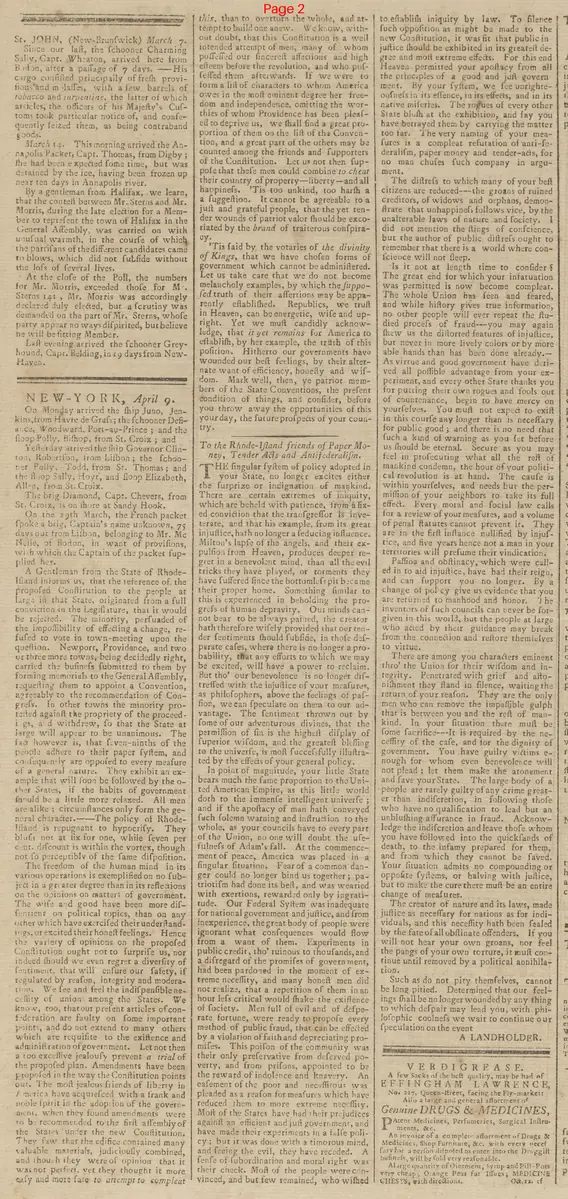
The freedom of the human mind in its various operations is exemplified on no subject in a greater degree than in its reflections on the opinions on matters of government. The wise and good have been more dissentient on political topics, than on any other which have exercised their understandings, or excited their honest feelings. Hence the variety of opinions on the proposed Constitution ought not to surprise us, nor indeed should we even regret a diversity of sentiment, that will ensure our safety, if regulated by reason, integrity and moderation. We see and feel the indispensable necessity of union among the States. We know, too, that our present articles of confederation are faulty on some important points, and do not extend to many others which are requisite to the existence and administration of government. Let not then a too excessive jealousy prevent a trial of the proposed plan. Amendments have been proposed in the way the Constitution points out. The most jealous friends of liberty in America have acquiesced with a frank and noble spirit in the adoption of the government, when they found amendments were to be recommended to the first assembly of the States under the new Constitution. They saw that the edifice contained many valuable materials, judiciously combined, and though they were of opinion that it was not perfect, yet they thought it more easy and more safe to attempt to complete this, than to overturn the whole, and attempt to build one anew. We know, without doubt, that this Constitution is a well intended attempt of men, many of whom possessed our sincerest affections and high esteem before the revolution, and who possess them afterwards. If we were to form a list of characters to whom America owes in the most eminent degree her freedom and independence, omitting the worthies of whom Providence has been pleased to deprive us, we shall find a great proportion of them on the list of the Convention, and a great part of the others may be counted among the friends and supporters of the Constitution. Let us not then suppose that these men could combine to cheat their country of property, liberty, and all happiness. 'Tis too unkind, too harsh a suggestion. It cannot be agreeable to a just and grateful people, that the yet tender wounds of patriot valor should be excoriated by the brand of traitorous conspiracy.
'Tis said by the votaries of the divinity of Kings, that we have chosen forms of government which cannot be administered. Let us take care that we do not become melancholy examples, by which the supposed truth of their assertions may be apparently established. Republics, we trust in Heaven, can be energetic, wise and upright. Yet we must candidly acknowledge, that it yet remains for America to establish, by her example, the truth of this position. Hitherto our governments have wounded our best feelings, by their alternate want of efficiency, honesty and wisdom. Mark well, then, ye patriot members of the State Conventions, the present condition of things, and consider, before you throw away the opportunities of this your day, the future prospects of your country.
To the Rhode-Island friends of Paper Money, Tender Acts and Antifederalism.
THE singular system of policy adopted in your State, no longer excites either the surprise or indignation of mankind. There are certain extremes of iniquity, which are beheld with patience, from a fixed conviction that the transgressor is incorrigible, and that his example, from its great injustice, hath no longer a seducing influence. Milton's lapse of the angels, and their expulsion from Heaven, produces deeper regret in a benevolent mind, than all the evil tricks they have played, or torments they have suffered since the bottomless pit became their proper home. Something similar to this is experienced in beholding the progress of human depravity. Our minds cannot bear to be always pained, the creator hath therefore wisely provided that our tender sentiments should subside, in those desperate cases, where there is no longer a probability, that any efforts to which we may be excited, will have a power to reclaim. But tho' our benevolence is no longer distressed with the injustice of your measures, as philosophers, above the feelings of passion, we can speculate on them to our advantage. The sentiment thrown out by some of our adventurous divines, that the permission of sin is the highest display of superior wisdom, and the greatest blessing to the universe, is most successfully illustrated by the effects of your general policy. In point of magnitude, your little State bears much the same proportion to the United American Empire, as this little world doth to the immense intelligent universe; and if the apostasy of man hath conveyed such solemn warning and instruction to the whole, as your councils have to every part of the Union, no one will doubt the usefulness of Adam's fall. At the commencement of peace, America was placed in a singular situation. Fear of a common danger could no longer bind us together; patriotism had done its best, and was wearied with exertions, rewarded only by ingratitude. Our Federal System was inadequate for national government and justice, and from inexperience, the great body of people were ignorant what consequences would flow from a want of them. Experiments in public credit, tho' ruinous to thousands, and a disregard of the promises of government, had been pardoned in the moment of extreme necessity, and many honest men did not realize, that a repetition of them in an hour less critical would shake the existence of society. Men full of evil and of desperate fortune, were ready to propose every method of public fraud, that can be effected by a violation of faith and depreciating promises. This portion of the community was their only preservative from deserved poverty, and from prisons, appointed to be the reward of indolence and knavery. An easement of the poor and necessitous was pleaded as a reason for measures which have reduced them to more extreme necessity. Most of the States have had their prejudices against an efficient and just government, and have made their experiments in a false policy; but it was done with a timorous mind, and seeing the evil, they have receded. A sense of subordination and moral right was their check. Most of the people were convinced, and but few remained, who wished to establish iniquity by law.
To silence such opposition as might be made to the new Constitution, it was fit that public injustice should be exhibited in its greatest degree and most extreme effects. For this end Heaven permitted your apostasy from all the principles of a good and just government. By your system, we see unrighteousness in its essence, in its effects, and in its native miseries. The rogues of every other State blush at the exhibition, and say you have betrayed them by carrying the matter too far. The very naming of your measures is a complete refutation of anti-federalism, paper money and tender-acts, for no man chooses such company in argument.
The distress to which many of your best citizens are reduced—the groans of ruined creditors, of widows and orphans, demonstrate that unhappiness follows vice, by the unalterable laws of nature and society. I did not mention the stings of conscience, but the author of public distress ought to remember that there is a world where conscience will not sleep.
Is it not at length time to consider? The great end for which your infatuation was permitted is now become complete. The whole Union has seen and feared, and while history gives true information, no other people will ever repeat the studied process of fraud—you may again show us the distorted features of injustice, but never in more lively colors or by more able hands than has been done already.
As virtue and good government have derived all possible advantage from your experiment, and every other State thanks you for putting their own rogues and fools out of countenance, begin to have mercy on yourselves. You must not expect to exist in this course any longer than is necessary for public good; and there is no need that such a kind of warning as you set before us should be eternal. Secure as you may feel in prosecuting what all the rest of mankind condemn, the hour of your political revolution is at hand. The cause is within yourselves, and needs but the permission of your neighbors to take its full effect. Every moral and social law calls for a review of your measures, and a volume of penal statutes cannot prevent it. They are in the first instance nullified by injustice, and five years hence not a man in your territories will presume their vindication.
Passion and obstinacy, which were called in to aid injustice, have had their reign, and can support you no longer. By a change of policy give us evidence that you are returned to manhood and honor. The inventors of such councils can never be forgiven in this world, but the people at large who acted by their guidance may break from the connection and restore themselves to virtue.
There are among you characters eminent thro' the Union for their wisdom and integrity. Penetrated with grief and astonishment they stand in silence, waiting the return of your reason. They are the only men who can remove the impassable gulph that is between you and the rest of mankind. In your situation there must be some sacrifice—It is required by the necessity of the case, and for the dignity of government. You have guilty victims enough for whom even benevolence will not plead; let them make the atonement and save your State. The large body of a people are rarely guilty of any crime greater than indiscretion, in following those who have no qualification to lead but an unblushing assurance in fraud. Acknowledge the indiscretion and leave those whom you have followed into the quicksands of death, to the infamy prepared for them, and from which they cannot be saved.
Your situation admits no compounding or opposite systems, or halving with justice, but to make the cure there must be an entire change of measures.
The creator of nature and its laws, made justice as necessary for nations as for individuals, and this necessity hath been sealed by the fate of all obstinate offenders. If you will not hear your own groans, nor feel the pangs of your own torture, it must continue until removed by a political annihilation.
Such as do not pity themselves, cannot be long pitied. Determined that our feelings shall be no longer wounded by any thing to which despair may lead you, with philosophic coolness we wait to continue our speculation on the event.
A LANDHOLDER.
What sub-type of article is it?
What keywords are associated?
What entities or persons were involved?
Editorial Details
Primary Topic
Urging Rhode Island To Adopt The Us Constitution And Abandon Paper Money And Antifederalism
Stance / Tone
Strongly Pro Constitution, Critical Of Rhode Island's Policies As Unjust And Cautionary
Key Figures
Key Arguments