Thank you for visiting SNEWPapers!
Sign up free
The Calumet News
Calumet, Houghton County, Michigan
What is this article about?
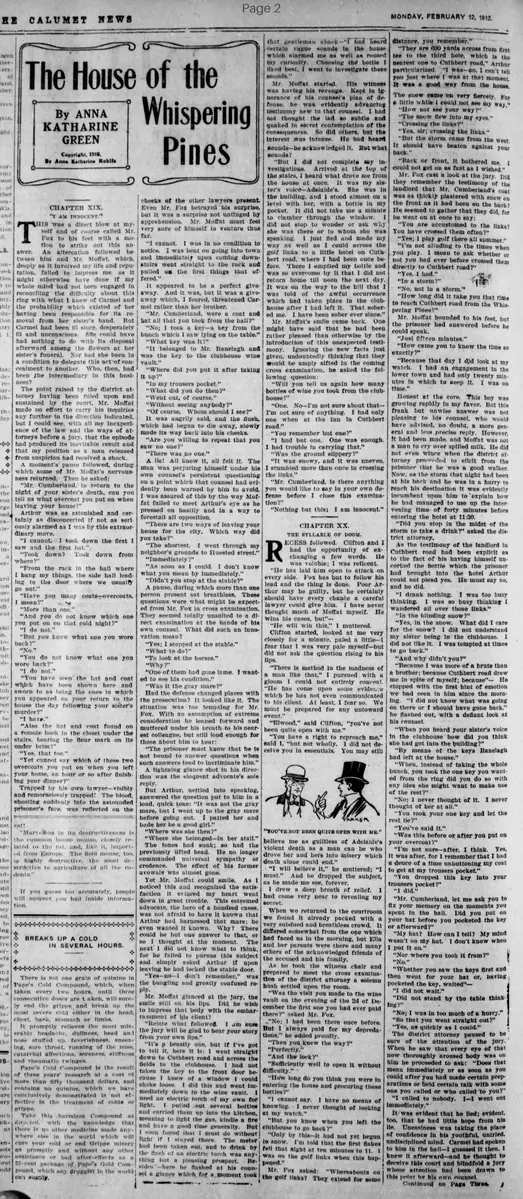
Excerpt from Anna Katharine Green's mystery novel 'The House of the Whispering Pines.' Narrates Arthur Cumberland's courtroom testimony in his trial for his sister Adelaide's murder, highlighting inconsistencies in his account of the night, interactions with his lawyer, and the narrator's observations, building suspense around potential involvement of his sister Carmel.
Merged-components note: Serialized fiction 'The House of the Whispering Pines' by Anna Katharine Green, continued across pages 2 and 3.
Clippings
1 of 2
OCR Quality
Full Text
Copyright, 1910, By Anna Katharine Rohlfs
CHAPTER XIX.
This was how at my first motion to strike out this answer. An altercation followed between him and Mr. Moffat, which deeply as it involved my life and reputation, failed to impress me, as it might otherwise have done if my whole mind had not been engaged in reconciling the difficulty about this ring with what I knew of Carmel and the probability which existed of her having been responsible for its removal from her sister's hand. But Carmel had been ill since, desperately ill and unconscious. She could have had nothing to do with its disposal afterward among the flowers at her sister's funeral. Nor had she been in a condition to delegate this act of concealment to another. Who, then, had been the intermediary in this business?
The point raised by the district attorney having been ruled upon and sustained by the court, Mr. Moffat made no effort to carry his inquiries any further in the direction indicated. But I could see, with all my inexperience of the law and the ways of attorneys before a jury, that the episode had produced its inevitable result and that my position as a man released from suspicion had received a shock.
A moment's pause followed, during which some of Mr. Moffat's nervousness returned. Then he asked:
"Mr. Cumberland, to return to the night of your sister's death, can you tell us what overcoat you put on when leaving your house?"
Arthur was as astonished and certainly as disconcerted if not as seriously alarmed as I was by this extraordinary move.
"I cannot. I took down the first I saw and the first hat."
"Took down? Took down from where?"
"From the rack in the hall where I hang my things, the side hall leading to the door where we usually go out."
"Have you many coats—overcoats, I mean?"
"More than one."
"And you do not know which one you put on on that cold night?"
"I do not."
"But you know what one you wore back?"
"No."
"You do not know what one you wore back?"
"I do not."
"You have seen the hat and coat which have been shown here and sworn to as being the ones in which you appeared on your return to the house the day following your sister's murder?"
"I have."
"Also the hat and coat found on a remote hook in the closet under the stairs, bearing the four mark on its under brim?"
"Yes, that too."
"Yet cannot say which of these two overcoats you put on when you left your home, an hour or so after finishing your dinner?"
Trapped by his own lawyer—visibly and remorselessly trapped! The blood, shooting suddenly into the astounded prisoner's face, was reflected on the cheeks of the other lawyers present. Even Mr. Fox betrayed his surprise but it was a surprise not untinged by apprehension. Mr. Moffat must feel very sure of himself to venture thus far.
"I cannot. I was in no condition to notice. I was bent on going into town and immediately upon coming down stairs went straight to the rack and pulled on the first things that offered."
It appeared to be a perfect give-away. And it was, but it was a give-away which, I feared, threatened Carmel rather than her brother.
"Mr. Cumberland, were a coat and hat all that you took from the hall?"
"No: I took a key—a key from the bunch which I saw lying on the table."
"What key was it?"
"It belonged to Mr. Ranelagh and was the key to the clubhouse wine vault."
"Where did you put it after taking it up?"
"In my trousers pocket."
"What did you do then?"
"I went out, of course."
"Without seeing anybody?"
"Of course. Whom should I see?"
It was angrily said, and the flush, which had begun to die away, slowly made its way back into his cheeks.
"Are you willing to repeat that you saw no one?"
"There was no one."
A lie! All knew it, all felt it. The man was perjuring himself under his own counsel's persistent questioning on a point which that counsel had evidently been warned by him to avoid. I was assured of this by the way Moffat failed to meet Arthur's eye as he pressed on hastily and in a way to forestall all opposition
"There are two ways of leaving your house for the city. Which way did you take?"
"The shortest. I went through my neighbor's grounds to Huested street."
"Immediately?"
"As soon as I could. I don't know what you mean by immediately."
"Didn't you stop at the stable?"
A pause, during which more than one person present sat breathless. These questions were what might be expected from Mr. Fox in cross examination. They seemed totally unsuited to a direct examination at the hands of his own counsel. What did such an innovation mean?
"Yes; I stopped at the stable."
"What to do?"
"To look at the horses."
"Why?"
"One of them had gone lame. I wanted to see his condition."
"Was it the gray mare?"
Had the defense changed places with the prosecution? It looked like it. The situation was too tempting for Mr. Fox. With an assumption of extreme consideration he leaned forward and muttered under his breath to his nearest colleague, but still loud enough for those about him to hear:
"The prisoner must know that he is not bound to answer questions when such answers tend to incriminate him."
A lightning glance shot in his direction was the eloquent advocate's sole reply.
But Arthur, nettled into speaking, answered the question put to him in a loud, quick tone: "It was not the gray mare, but I went up to the gray mare before going out. I patted her and bade her be a good girl."
"Where was she then?"
"Where she belonged—in her stall."
The tones had sunk; so had the previously lifted head. He no longer commanded universal sympathy or credence. The effect of his former avowals was almost gone.
Yet Mr. Moffat could smile. As I noticed this and recognized the satisfaction it evinced my heart went down in great trouble. This esteemed advocate, the hero of a hundred cases, was not afraid to have it known that Arthur had harnessed that mare; he even wanted it known. Why? There could be but one answer to that, or so I thought at the moment. The next I did not know what to think. For he failed to pursue this subject and simply asked Arthur if upon leaving he had locked the stable door.
"Yes—no—I don't remember." was the bungling and greatly confused reply.
Mr. Moffat glanced at the jury, the smile still on his lips. Did he wish to impress that body with the embarrassment of his client?
"Relate what followed. I am sure the jury will be glad to hear your story from your own lips."
"It's a beastly one, but if I've got to tell it, here it is: I went straight down to Cuthbert road and across the fields to the clubhouse. I had not taken the key to the front door because I knew of a window I could shake loose. I did this and went immediately down to the wine vault. I used an electric torch of my own for light. I pulled out several bottles and carried them up into the kitchen, meaning to light the gas, kindle a fire and have a good time generally. But I soon found that I must do without light if I stayed there. The meter had been taken out, and to drink by the flash of an electric torch was anything but a pleasing prospect. Besides"—here he flashed at his counsel a glance which for a moment took that gentleman aback—"I had heard certain vague sounds in the house which alarmed me as well as roused my curiosity. Choosing the bottle I liked best, I went to investigate these sounds."
Mr. Moffat started. His witness was having his revenge. Kept in ignorance of his counsel's plan of defense, he was evidently advancing testimony new to that counsel. I had not thought the lad so subtle and quaked in secret contemplation of the consequences. So did others, but the interest was intense. He had heard sounds—he acknowledged it. But what sounds?
"But I did not complete my investigations. Arrived at the top of the stairs, I heard what drove me from the house at once. It was my sister's voice—Adelaide's. She was in the building, and I stood almost on a level with her, with a bottle in my pocket. It did not take me a minute to clamber through the window. I did not stop to wonder or ask why she was there or to whom she was speaking. I just fled and made my way as well as I could across the golf links to a little hotel on Cuthbert road, where I had been once before. There I emptied my bottle and was so overcome by it that I did not return home till noon the next day. It was on the way to the hill that I was told of the awful occurrence which had taken place in the clubhouse after I had left it. That sobered me. I have been sober ever since."
Mr. Moffat's smile came back. One might have said that he had been rather pleased than otherwise by the introduction of this unexpected testimony. Ignoring the new facts just given, undoubtedly thinking that they could be amply sifted in the coming cross examination, he asked the following question:
"Will you tell us again how many bottles of wine you took from the clubhouse?"
"One. No—I'm not sure about that—I'm not sure of anything. I had only one when at the inn in Cuthbert road."
"You remember but one?"
"I had but one. One was enough. I had trouble in carrying that."
"Was the ground slippery?"
"It was snowy, and it was uneven. I stumbled more than once in crossing the links."
"Mr. Cumberland, is there anything you would like to say in your own defense before I close this examination?"
"Nothing but this: I am innocent."
CHAPTER XX.
THE SYLLABLE OF DOOM
Recess followed. Clifton and I, changing a few words. He was voluble; I was reticent.
"He has laid him open to attack on every side. Fox has but to follow his lead and the thing is done. Poor Arthur may be guilty, but he certainly should have every chance a careful lawyer could give him. I have never thought much of Moffat myself. He wins his cases, but"—
"He will win this." I muttered
Clifton started, looked at me very closely for a minute, paled a little—I fear that I was very pale myself—but did not ask the question rising to his lips.
There is method in the madness of a man like that." I pursued with a gloom I could not entirely conceal. "He has come upon some evidence which he has not even communicated to his client. At least, I fear so. We must be prepared for any untoward event."
"Elwood," said Clifton, "you've not been quite open with me."
"You have a right to reproach me," said I, "but not wholly. I did not deceive you in essentials. You may still
"YOU'VE NOT BEEN QUITE OPEN WITH ME."
believe me as guiltless of Adelaide's violent death as a man can be who drove her and hers into misery which death alone could end."
"I will believe it," he muttered: "I must." And he dropped the subject, as he made me see, forever.
I drew a deep breath of relief. I had come very near to revealing my secret.
When we returned to the courtroom we found it already packed with a very subdued and breathless crowd. It differed somewhat from the one which had faced us in the morning, but Ella and her parents were there and many others of the acknowledged friends of the accused and his family.
As he took the witness chair and prepared to meet the cross examination of the district attorney a solemn hush settled upon the room.
Was the visit you made to the wine vault on the evening of the 2d of December the first one you had ever paid there?" asked Mr. Fox.
"No; I had been there once before. But I always paid for my depredations," he added proudly.
"Then you knew the way?"
"perfectly."
"And the lock?"
"Sufficiently well to open it without difficulty."
"How long do you think you were in entering the house and procuring these bottles?"
"I cannot say. I have no means of knowing. I never thought of looking at my watch."
"But you know when you left the clubhouse to go back?"
"Only by this—it had not yet begun to snow. I'm told that the first flakes fell that night at ten minutes to 11. I was on the golf links when this happened."
Mr. Fox asked: "Whereabouts on the golf links? They extend for some distance, you remember."
"They are 600 yards across from first tee to the third hole, which is the nearest one to Cuthbert road," Arthur particularized. "I was—no. I can't tell you just where I was at that moment. It was a good way from the house."
The snow came on very fiercely. For a little while I could not see my way."
"How not see your way?"
"The snow flew into my eyes."
"Crossing the links?"
"Yes, sir; crossing the links."
"But the storm came from the west. It should have beaten against your back."
"Back or front, it bothered me. I could not get on as fast as I wished."
Mr. Fox cast a look at the jury. Did they remember the testimony of the landlord that Mr. Cumberland's coat was as thickly plastered with snow on the front as it had been on the back? He seemed to gather that they did, for he went on at once to say:
"You are accustomed to the links? You have crossed them often?"
"Yes; I play golf there all summer."
"I'm not alluding to the times when you play. I mean to ask whether or not you had ever before crossed them directly to Cuthbert road?"
"Yes, I had."
"In a storm?"
"No, not in a storm."
"How long did it take you that time to reach Cuthbert road from the Whispering Pines?"
Mr. Moffat bounded to his feet, but the prisoner had answered before he could speak.
"Just fifteen minutes."
"How came you to know the time so exactly?"
"Because that day I did look at my watch. I had an engagement in the lower town and had only twenty minutes in which to keep it. I was on time."
Honest at the core. This boy was growing rapidly in my favor. But this frank but unwise answer was not pleasing to his counsel, who would have advised, no doubt, a more general and less precise reply. However, it had been made, and Moffat was not a man to cry over spilled milk. He did not even wince when the district attorney proceeded to elicit from the prisoner that he was a good walker. Now, as the storm that night had been at his back and he was in a hurry to reach his destination it was evidently incumbent upon him to explain how he had managed to use up the intervening time of forty minutes before entering the hotel at 11:30.
"Did you stop in the midst of the storm to take a drink?" asked the district attorney.
As the testimony of the landlord in Cuthbert road had been explicit as to the fact of his having himself uncorked the bottle which the prisoner had brought into the hotel Arthur could not plead yes. He must say no, and he did.
"I drank nothing. I was too busy thinking. I was so busy thinking I wandered all over those links."
"In the blinding snow?"
"Yes, in the snow. What did I care for the snow? I did not understand my sister being in the clubhouse. I did not like it. I was tempted at times to go back."
"And why didn't you?"
"Because I was more of a brute than a brother: because Cuthbert road drew me in spite of myself: because"— He stopped with the first hint of emotion we had seen in him since the morning. "I did not know what was going on there or I should have gone back," he flashed out, with a defiant look at his counsel.
"When you heard your sister's voice in the clubhouse how did you think she had got into the building?"
"By means of the keys Ranelagh had left at the house."
"When, instead of taking the whole bunch, you took the one key you wanted from the ring did you do so with any idea she might want to make use of the rest?"
"No; I never thought of it. I never thought of her at all."
"You took your one key and let the rest lie?"
"You've said it."
"Was this before or after you put on your overcoat?"
"I'm not sure—after, I think. Yes, it was after, for I remember that I had a deuce of a time unbuttoning my coat to get at my trousers pocket."
"You dropped this key into your trousers pocket?"
"I did."
"Mr. Cumberland, let me ask you to fix your memory on the moments you spent in the hall. Did you put on your hat before you pocketed the key or afterward?"
"My hat? How can I tell? My mind wasn't on my hat. I don't know when I put it on."
"Nor where you took it from?"
"No."
"Whether you saw the keys first and then went for your hat or, having pocketed the key, waited"—
"I did not wait."
"Did not stand by the table thinking?"
"No; I was in too much of a hurry."
"So that you went straight out?"
"Yes, as quickly as I could."
The district attorney paused to be sure of the attention of the jury. When he saw that every eye of that now thoroughly aroused body was on him he proceeded to ask: "Does that mean immediately or as soon as you could after you had made certain preparations or held certain talk with some one you called or who called to you?"
"I called to nobody. I—I went out immediately."
It was evident that he lied; evident, too, that he had little hope from his lie. Uneasiness was taking the place of confidence in his youthful, untried, undisciplined mind. Carmel had spoken to him in the hall—I guessed it then. I knew it afterward—and he thought to deceive this court and blindfold a jury whose attention had been drawn to this point by his own counsel.
Continued on Page Three
The House of the Whispering Pines
By ANNA KATHARINE GREEN
Copyright, 1910, by Anna Katharine Rohlfs
Continued from Page 2.
District Attorney Fox smiled.
"How, then, did you get into the stable?"
"The stable? Oh, I had no trouble in getting into the stable."
"Was it unlocked?"
A slow flush broke over the prisoner's whole face. He saw where he had been landed and took a minute to pull himself together before he replied: "I had the key to that door too. I got it out of the kitchen."
"You have not spoken of going into the kitchen."
"I have not spoken of coming down stairs."
"You went into the kitchen?"
"Yes."
"When?"
"When I first came down."
"This is not in accordance with your direct testimony. On the contrary, you said that on coming downstairs you went straight to the rack for your overcoat. Stenographer, read what the prisoner said on this topic."
A rustling of leaves, distinctly to be heard in the deathlike silence of the room, was followed by the reading of this reply and answer:
"Yet you cannot say which of these two overcoats you put on when you left your home an hour or so after finishing your dinner?"
"I cannot. I was in no condition to notice. I was bent on going into town, and on coming downstairs I went straight to the rack and pulled on the first things that offered."
The prisoner stood immobile, but with a deepening line gathering on his brow, until the last word fell. Then he said:
"I forgot. I went for the key before I put on my overcoat. I wanted to see how the sick horse looked."
"Did you drop this key into your pocket too?"
"No: I carried it into the hall."
"What did you do with it there?"
"I don't know. Put it on the table, suppose."
"Don't you remember? There were other keys lying on this table. Don't you remember what you did with the one in your hand while you took the clubhouse key from the midst of Mr. Ranelagh's bunch?"
"I laid it on the table. I must have—there was no other place to put it."
"Laid it down by itself?"
"Yes."
"And took it up when you went out?"
"Of course."
"Carrying it straight to the stable?"
"Naturally."
"What did you do with it when you came out?"
"I left it in the stable door."
"You did? What excuse have you to give for that?"
"None. I was reckless and didn't care for anything—that's all."
"Yet you took several minutes, for all your hurry and your indifference, to get the stable key and look in at a horse that wasn't sick enough to keep your coachman home from a dance."
The prisoner was silent.
"You have no further explanation to give on this subject?"
"No. All fellows who love horses will understand."
CHAPTER XXI
"I SUMMON CARMEL CUMBERLAND."
The district attorney went on to say: "You have listened to Zadok Brown's testimony. When he returned at 3 he found the stable door locked and the key hanging up on its usual nail in the kitchen. How do you account for this?"
"There are two ways."
"Mention them, if you please."
"Zadok had been to a dance and may not have been quite clear as to what he saw, or, finding the stable door open, may have blamed himself for the fact and sought to cover up his fault with a lie."
"Have you ever caught him in a lie?"
"No. But there's always a first time."
"You would impeach his testimony then?"
"No. You have asked me how this discrepancy could be explained, and I have tried to show you."
"Mr. Cumberland, the gray mare was out that night. This has been amply proved."
"If you believe Zadok, yes"
"You have heard other testimony corroborative of this fact. She was seen on the clubhouse road that night by a person amply qualified to identify her."
"So I've been told."
The person driving this horse wore a hat identified as an old one of yours, which hat was afterward found at your house on a remote peg in a seldom used closet. If you were not this person, how can you explain the use of your horse, the use of your clothes, the locking of the stable door—which you declare yourself to have left open—and the hanging up of the key on its own nail?"
It was a crucial question—how crucial no one knew but our two selves If he answered at all he must compromise Carmel. I had no fear of his doing this, but I had great fear of what Ella might do if he let this implication stand and made no effort to exonerate himself by denying his presence in the cutter and consequent return to the Cumberland home. The quick side glances I here observed cast in her direction by both father and mother showed that she had made some impulsive demonstration visible to them, if not to others, and, fearful of the consequences if I did not make some effort to hold her in check, I kept my eyes in her direction and so lost Arthur's look and the look of his counsel as he answered, with just the word I had expected—short and dogged:
"I cannot explain."
It was my death warrant. I realized this even while I held Ella's eye with mine and smoothed my countenance to meet the anguish in hers, in the effort to hold her back for a few minutes longer till I could quite satisfy myself that Arthur's case was really lost and that I must speak or feel myself his murderer.
The gloom which followed this recognition of his inability, real or fancied, to explain away the most damning feature of the case against him, taken with his own contradictions and growing despondency, could not escape my eye, accustomed as I was to the habitual expression of most every person there. But it was not yet the impenetrable gloom presaging conviction, and, directing Ella's gaze toward Mr. Moffat, who seemed but little disturbed either by Mr. Fox's satisfaction or the prisoner's open despair, I took heart of grace and waited for the district attorney's next move. It was a fatal one. I began to recognize this very soon, simple as was the subject he now introduced.
"When you went into the kitchen, Mr. Cumberland, to get the stable door key, was the gas lit, or did you have to light it?"
"It—it was lit. I think."
"Don't you know?"
"It was lit, but turned low. I could see well enough."
"Why, then, didn't you take both keys?"
"Both keys?"
"You have said you went down town by the short cut through your neighbor's yard. That cut is guarded by a door which was locked that night. You needed the key to that door more than the one to the stable. Why didn't you take it?"
"I—I took it when I took the other."
"Are you sure?"
"Yes; they both hung on one nail. I grabbed them both at the same time."
"Which of the two hung foremost?"
"I didn't notice."
"You took both?"
"Yes, I took both."
"And went straight out with them?"
"Yes, to the stable."
"And then where?"
"Through the adjoining grounds downtown."
"You are sure you went through Mr. Fulton's grounds at this early hour in the evening?"
"I am positive."
"Was it not at a later hour, much later, a little before 11 instead of a little before 9?"
"No, sir. I was on the golf links then."
"But some one drove into the stable."
"So you say."
"Unharnessed the horse, drew up the cutter, locked the stable door and, entering the house, hung up the key where it belonged."
No answer this time.
"Mr. Cumberland, you admitted in your direct examination that you took with you out of the clubhouse only one bottle of the especial brand you favored, although you carried up two into the kitchen?"
"No: I said that I only had one when I got to Cuthbert road. I don't remember anything about the other."
"But you know where the other—or, rather, remnants of the other—was found?"
"In my own stable, taken there by my man Zadok Brown, who says he picked it out of one of our waste barrels."
"This is the part of bottle referred to. Do you recognize the label still adhering to it as similar to the one to be found on the bottle you emptied in Cuthbert road?"
"It is like that one."
"Had you carried that other bottle off, and had it been broken as this has been broken, would it not have presented an exactly similar appearance to this?"
"Possibly."
"Only possibly?"
"It would have looked the same; I cannot deny it. What's the use fooling?"
In her direction by both father and mother showed that she had made some impulsive demonstration visible to them, if not to others, and, fearful of the consequences if I did not make some effort to hold her in check, I kept my eyes in her direction and so lost Arthur's look and the look of his counsel as he answered, with just the word I had expected—short and dogged:
"I cannot explain."
It was my death warrant. I realized
To be continued
So many people want their own way that there is less harmony than the politicians intimate.
What sub-type of article is it?
What themes does it cover?
What keywords are associated?
What entities or persons were involved?
Literary Details
Title
The House Of The Whispering Pines
Author
By Anna Katharine Green
Subject
Arthur Cumberland's Testimony In Murder Trial
Form / Style
Mystery Novel Chapters
Key Lines