Thank you for visiting SNEWPapers!
Sign up free
Editorial
August 22, 1771
The Virginia Gazette
Richmond, Williamsburg, Richmond County, Virginia
What is this article about?
An essay praising the moral virtues and benevolence expected of great men in high stations, contrasting true dignity with meanness, illustrated by a true story from early 18th century near Shrewsbury where the Earl of Bradford aids a poor widow after learning of her hardships from her son.
Clipping
OCR Quality
98%
Excellent
Full Text
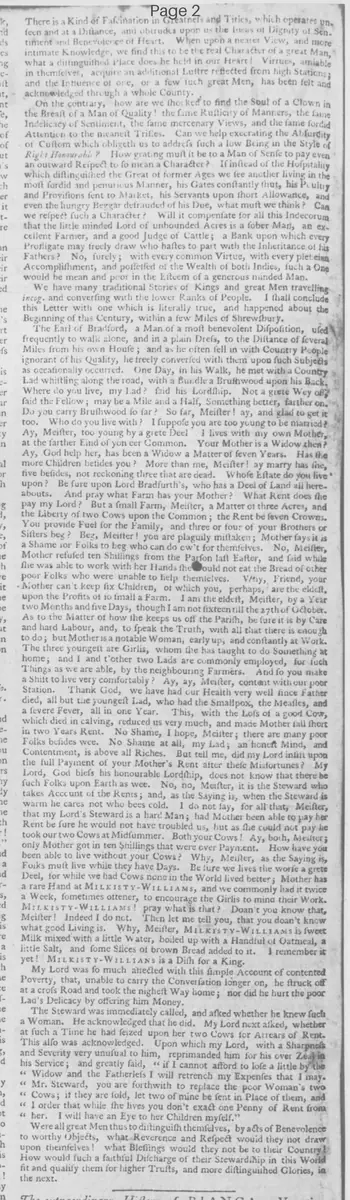
There is a Kind of Fascination in Greatness and Titles, which operates unseen and at a Distance, and obtrudes upon us the Ideas of Dignity of Sentiment and Benevolence of Heart. When upon a nearer View, and more intimate Knowledge, we find this to be the real Character of a great Man, what distinguished Place does he hold in our Heart! Virtues, amiable in themselves, acquire an additional Lustre reflected from high Stations; and the Influence of one, or a few such great Men, has been felt and acknowledged through a whole County.
On the contrary, how are we shocked to find the Soul of a Clown in the Breast of a Man of Quality! the same Rusticity of Manners, the same Indelicacy of Sentiment, the same mercenary Views, and the same sordid Attention to the meanest Trifles. Can we help execrating the Absurdity of Custom which obligeth us to address such a low Being in the Style of Right Honourable? How grating must it be to a Man of Sense to pay even an outward Respect to so mean a Character? If instead of the Hospitality which distinguished the Great of former Ages we see another living in the most sordid and penurious Manner, his Gates constantly shut, his Poultry and Provisions sent to Market, his Servants upon short Allowance, and even the hungry Beggar defrauded of his Due, what must we think? Can we respect such a Character? Will it compensate for all this Indecorum that the little minded Lord of unbounded Acres is a sober Man, an excellent Farmer, and a good Judge of Cattle; a Bank upon which every Profligate may freely draw who hastes to part with the Inheritance of his Fathers? No, surely; with every common Virtue, with every plebeian Accomplishment, and possessed of the Wealth of both Indies, such a One would be mean and poor in the Esteem of a generous minded Man.
We have many traditional Stories of Kings and great Men travelling incog. and conversing with the lower Ranks of People. I shall conclude this Letter with one which is literally true, and happened about the Beginning of this Century, within a few Miles of Shrewsbury.
The Earl of Bradford, a Man of a most benevolent Disposition, used frequently to walk alone, and in a plain Dress, to the Distance of several Miles from his own House; and as he often fell in with Country People ignorant of his Quality, he freely conversed with them upon such Subjects as occasionally occurred. One Day, in his Walk, he met with a Country Lad whistling along the road, with a Burdle of Brushwood upon his Back.
"Where do you live, my Lad?" said his Lordship. "Not a great Way off," said the Fellow; "may be a Mile and a Half, Something better, farther on."
"Do you carry Brushwood so far?" "So far, Master! ay, and glad to get it too."
"Who do you live with? I suppose you are too young to be married?"
"Ay, Master, too young by a great Deal. I live with my own Mother, at the farther End of yon great Common."
"Your Mother is a Widow then?"
"Ay, God help her, has been a Widow a Matter of seven Years."
"Has she more Children besides you?"
"More than me, Master! ay marry has she, five besides, not reckoning three that are dead."
"Whose Estate do you live upon?"
"Be sure upon Lord Bradford's, who has a Deal of Land all hereabouts."
"And pray what Farm has your Mother? What Rent does she pay my Lord?"
"But a small Farm, Master, a Matter of three Acres, and the Liberty of two Cows upon the Common; the Rent be seven Crowns."
"You provide Fuel for the Family, and three or four of your Brothers or Sisters beg?"
"Beg, Master! you are plaguyly mistaken; Mother says it is a Shame for Folks to beg who can do for themselves. No, Master, Mother refused ten Shillings from the Parson last Easter, and said while she was able to work with her Hands she would not eat the Bread of other poor Folks who were unable to help themselves."
"Why, Friend, your Mother can't keep six Children, of which you, perhaps, are the eldest, upon the Profits of so small a Farm."
"I am the eldest, Master, by a Year two Months and five Days, though I am not sixteen till the 27th of October."
"As to the Matter of how she keeps us off the Parish, be sure it is by Care and hard Labour, and, to speak the Truth, with all that there is enough to do; but Mother is a notable Woman, early up, and constantly at Work. The three youngest are Girls, whom she has taught to do Something at home; and I and t'other two Lads are commonly employed, for such Things as we are able, by the neighbouring Farmers."
"And so you make a Shift to live very comfortably?"
"Ay, ay, Master, content with our poor Station. Thank God, we have had our Health very well since Father died, all but the youngest Lad, who had the Smallpox, the Measles, and a severe Fever, all in one Year. This, with the Loss of a good Cow, which died in calving, reduced us very much, and made Mother fall short in two Years Rent."
"No Shame, I hope, Master; there are many poor Folks besides we."
"No Shame at all, my Lad; an honest Mind, and Contentment, is above all Riches. But tell me, did my Lord insist upon the full Payment of your Mother's Rent after these Misfortunes?"
"My Lord, God bless his honourable Lordship, does not know that there be such Folks upon Earth as we. No, no, Master, it is the Steward who takes Account of the Rents; and, as the Saying is, when the Steward is warm he cares not who freezes cold. I do not say, for all that, Master, that my Lord's Steward is a hard Man; had Mother been able to pay her Rent be sure he would not have troubled us, but as she could not pay he took our two Cows at Midsummer."
"Both your Cows!"
"Ay, both, Master; only Mother got in ten Shillings that were over Payment."
"How have you been able to live without your Cows?"
"Why, Master, as the Saying is, Folks must live while they have Days. Be sure we live the worse a great Deal, for while we had Cows none in the World lived better; Mother has a rare Hand at MILKISTY-WILLIAMS, and we commonly had it twice a Week, sometimes oftener, to encourage the Girls to mind their Work."
"MILKISTY-WILLIAMS! pray what is that?"
"Doan't you know that, Master! Indeed I do not."
"Then let me tell you, that you doan't know what good Living is. Why, Master, MILKISTY-WILLIAMS is sweet Milk mixed with a little Water, boiled up with a Handful of Oatmeal, a little Salt, and some Slices of brown Bread added to it. I remember it yet! MILKISTY-WILLIAMS is a Dish for a King."
My Lord was so much affected with this simple Account of contented Poverty, that, unable to carry the Conversation longer on, he struck off at a cross Road and took the nearest Way home; nor did he hurt the poor Lad's Delicacy by offering him Money.
The Steward was immediately called, and asked whether he knew such a Woman. He acknowledged that he did. My Lord next asked, whether at such a Time he had seized upon her two Cows for Arrears of Rent. This also was acknowledged. Upon which my Lord, with a Sharpness and Severity very unusual to him, reprimanded him for his over Zeal in his Service; and greatly added, "if I cannot afford to lose a little by the Widow and the Fatherless I will retrench my Expenses that I may. Mr. Steward, you are forthwith to replace the poor Woman's two Cows; if they are sold, let two of mine be sent in Place of them, and I order that while she lives you don't exact one Penny of Rent from her. I will have an Eye to her Children myself."
Were all great Men thus to distinguish themselves, by Acts of Benevolence to worthy Objects, what Reverence and Respect would they not draw upon themselves! what Blessings would they not be to their Country! How would such a faithful Discharge of their Stewardship in this World fit and qualify them for higher Trusts, and more distinguished Glories, in the next.
On the contrary, how are we shocked to find the Soul of a Clown in the Breast of a Man of Quality! the same Rusticity of Manners, the same Indelicacy of Sentiment, the same mercenary Views, and the same sordid Attention to the meanest Trifles. Can we help execrating the Absurdity of Custom which obligeth us to address such a low Being in the Style of Right Honourable? How grating must it be to a Man of Sense to pay even an outward Respect to so mean a Character? If instead of the Hospitality which distinguished the Great of former Ages we see another living in the most sordid and penurious Manner, his Gates constantly shut, his Poultry and Provisions sent to Market, his Servants upon short Allowance, and even the hungry Beggar defrauded of his Due, what must we think? Can we respect such a Character? Will it compensate for all this Indecorum that the little minded Lord of unbounded Acres is a sober Man, an excellent Farmer, and a good Judge of Cattle; a Bank upon which every Profligate may freely draw who hastes to part with the Inheritance of his Fathers? No, surely; with every common Virtue, with every plebeian Accomplishment, and possessed of the Wealth of both Indies, such a One would be mean and poor in the Esteem of a generous minded Man.
We have many traditional Stories of Kings and great Men travelling incog. and conversing with the lower Ranks of People. I shall conclude this Letter with one which is literally true, and happened about the Beginning of this Century, within a few Miles of Shrewsbury.
The Earl of Bradford, a Man of a most benevolent Disposition, used frequently to walk alone, and in a plain Dress, to the Distance of several Miles from his own House; and as he often fell in with Country People ignorant of his Quality, he freely conversed with them upon such Subjects as occasionally occurred. One Day, in his Walk, he met with a Country Lad whistling along the road, with a Burdle of Brushwood upon his Back.
"Where do you live, my Lad?" said his Lordship. "Not a great Way off," said the Fellow; "may be a Mile and a Half, Something better, farther on."
"Do you carry Brushwood so far?" "So far, Master! ay, and glad to get it too."
"Who do you live with? I suppose you are too young to be married?"
"Ay, Master, too young by a great Deal. I live with my own Mother, at the farther End of yon great Common."
"Your Mother is a Widow then?"
"Ay, God help her, has been a Widow a Matter of seven Years."
"Has she more Children besides you?"
"More than me, Master! ay marry has she, five besides, not reckoning three that are dead."
"Whose Estate do you live upon?"
"Be sure upon Lord Bradford's, who has a Deal of Land all hereabouts."
"And pray what Farm has your Mother? What Rent does she pay my Lord?"
"But a small Farm, Master, a Matter of three Acres, and the Liberty of two Cows upon the Common; the Rent be seven Crowns."
"You provide Fuel for the Family, and three or four of your Brothers or Sisters beg?"
"Beg, Master! you are plaguyly mistaken; Mother says it is a Shame for Folks to beg who can do for themselves. No, Master, Mother refused ten Shillings from the Parson last Easter, and said while she was able to work with her Hands she would not eat the Bread of other poor Folks who were unable to help themselves."
"Why, Friend, your Mother can't keep six Children, of which you, perhaps, are the eldest, upon the Profits of so small a Farm."
"I am the eldest, Master, by a Year two Months and five Days, though I am not sixteen till the 27th of October."
"As to the Matter of how she keeps us off the Parish, be sure it is by Care and hard Labour, and, to speak the Truth, with all that there is enough to do; but Mother is a notable Woman, early up, and constantly at Work. The three youngest are Girls, whom she has taught to do Something at home; and I and t'other two Lads are commonly employed, for such Things as we are able, by the neighbouring Farmers."
"And so you make a Shift to live very comfortably?"
"Ay, ay, Master, content with our poor Station. Thank God, we have had our Health very well since Father died, all but the youngest Lad, who had the Smallpox, the Measles, and a severe Fever, all in one Year. This, with the Loss of a good Cow, which died in calving, reduced us very much, and made Mother fall short in two Years Rent."
"No Shame, I hope, Master; there are many poor Folks besides we."
"No Shame at all, my Lad; an honest Mind, and Contentment, is above all Riches. But tell me, did my Lord insist upon the full Payment of your Mother's Rent after these Misfortunes?"
"My Lord, God bless his honourable Lordship, does not know that there be such Folks upon Earth as we. No, no, Master, it is the Steward who takes Account of the Rents; and, as the Saying is, when the Steward is warm he cares not who freezes cold. I do not say, for all that, Master, that my Lord's Steward is a hard Man; had Mother been able to pay her Rent be sure he would not have troubled us, but as she could not pay he took our two Cows at Midsummer."
"Both your Cows!"
"Ay, both, Master; only Mother got in ten Shillings that were over Payment."
"How have you been able to live without your Cows?"
"Why, Master, as the Saying is, Folks must live while they have Days. Be sure we live the worse a great Deal, for while we had Cows none in the World lived better; Mother has a rare Hand at MILKISTY-WILLIAMS, and we commonly had it twice a Week, sometimes oftener, to encourage the Girls to mind their Work."
"MILKISTY-WILLIAMS! pray what is that?"
"Doan't you know that, Master! Indeed I do not."
"Then let me tell you, that you doan't know what good Living is. Why, Master, MILKISTY-WILLIAMS is sweet Milk mixed with a little Water, boiled up with a Handful of Oatmeal, a little Salt, and some Slices of brown Bread added to it. I remember it yet! MILKISTY-WILLIAMS is a Dish for a King."
My Lord was so much affected with this simple Account of contented Poverty, that, unable to carry the Conversation longer on, he struck off at a cross Road and took the nearest Way home; nor did he hurt the poor Lad's Delicacy by offering him Money.
The Steward was immediately called, and asked whether he knew such a Woman. He acknowledged that he did. My Lord next asked, whether at such a Time he had seized upon her two Cows for Arrears of Rent. This also was acknowledged. Upon which my Lord, with a Sharpness and Severity very unusual to him, reprimanded him for his over Zeal in his Service; and greatly added, "if I cannot afford to lose a little by the Widow and the Fatherless I will retrench my Expenses that I may. Mr. Steward, you are forthwith to replace the poor Woman's two Cows; if they are sold, let two of mine be sent in Place of them, and I order that while she lives you don't exact one Penny of Rent from her. I will have an Eye to her Children myself."
Were all great Men thus to distinguish themselves, by Acts of Benevolence to worthy Objects, what Reverence and Respect would they not draw upon themselves! what Blessings would they not be to their Country! How would such a faithful Discharge of their Stewardship in this World fit and qualify them for higher Trusts, and more distinguished Glories, in the next.
What sub-type of article is it?
Moral Or Religious
Social Reform
What keywords are associated?
Benevolence
Great Men
Nobility
Poverty
Virtue
Morality
Widow
Steward
What entities or persons were involved?
Earl Of Bradford
The Widow
The Steward
Editorial Details
Primary Topic
Benevolence And Virtue In Great Men
Stance / Tone
Praising True Benevolence In Nobility And Condemning Meanness
Key Figures
Earl Of Bradford
The Widow
The Steward
Key Arguments
Greatness And Titles Inspire Ideas Of Dignity And Benevolence
True Virtues In High Stations Earn Deep Respect
Meanness In Nobility Shocks And Deserves No Respect
Story Of Earl Of Bradford Aiding A Poor Widow Exemplifies Benevolence
Great Men Should Act With Benevolence To The Poor
Such Acts Bring Reverence And Blessings To The Country