Thank you for visiting SNEWPapers!
Sign up free
Morning Star
Limerick, York County, Maine
What is this article about?
In an 1832 letter to the Boston Courier, Dr. Benjamin Waterhouse discusses personal predisposition to cholera, citing a friend's symptoms and warning against exciting causes like shellfish, cucumbers, and indigestible corn. He suggests cauterization for severe cases and reflects on the epidemic's uncontrollable atmospheric origins.
Clipping
OCR Quality
Full Text
Dr. Waterhouse on Cholera,
No. III.
To the Editors of the Boston Courier.
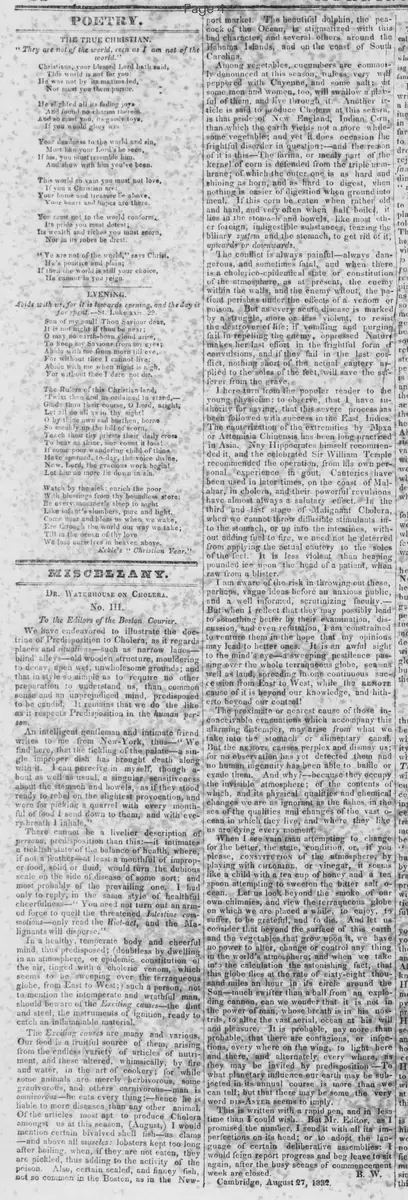
We have endeavored to illustrate the doctrine of Predisposition to Cholera, as it regards places and situations—such as narrow lanes, blind alleys—old wooden structures, mouldering to decay, upon wet, unwholesome grounds; and that in a style so simple as to require no other preparation to understand us, than common sense and an unprejudiced mind, predisposed to be candid. It remains that we do the like as it respects Predisposition in the human person.
An intelligent gentleman and intimate friend writes to me from New-York, thus—“We find here, that the tickling of the palate—a single improper dish has brought death along with it. I can perceive in myself, though about as well as usual, a singular sensitiveness about the stomach and bowels, as if they stood ready to rebel on the slightest provocation, and were for picking a quarrel with every mouthful of food I send down to them, and with every breath I inhale.”
There cannot be a livelier description of personal predisposition than this:—it intimates a ticklish state of the balance of health, where, if not a feather—at least a mouthful of improper food, solid or fluid, would turn the dubious scale on the side of disease of some sort; and most probably of the prevailing one. I had only to reply, in the same style of healthful cheerfulness—“You need not turn out an armed force to quell the threatened Intestinal commotions—only read the Riot-act, and the Malignants will disperse.”
In a healthy, temperate body and cheerful mind, thus predisposed; (doubtless by dwelling in an atmosphere, or epidemic constitution of the air, tinged with a choleric venom, which seems to be sweeping over the terraqueous globe, from East to West;) such a person, not to mention the intemperate and wrathful man, should beware of the Exciting causes—the flint and steel, the instruments of ignition, ready to catch an inflammable material.
The Exciting causes are many and various. Our food is a fruitful source of them, arising from the endless variety of articles of nutriment, and these altered, whimsically, by fire and water, in the art of cookery; for while some animals are merely herbivorous, some granivorous, and others carnivorous—man is omnivorous—he eats every thing;—hence he is liable to more diseases than any other animal.
Of the articles most apt to produce Cholera amongst us at this season, (August,) I would mention certain bivalved shell fish—as clams—and above all mussels: lobsters kept too long after boiling, when, if they are not eaten, they are pickled, thus adding to the activity of the poison. Also, certain scaled, and finny fish, not so common in the Boston, as in the New-port market. The beautiful dolphin, the pea-cock of the Ocean, is stigmatized with this bad character, and several others around the Bahama Islands, and on the coast of South Carolina.
Among vegetables, cucumbers are commonly denounced at this season, unless very well peppered with Cayenne, and some salt; yet some men and women, too, will swallow a plateful of them, and live through it. Another article is said to produce Cholera at this season, is that pride of New England, Indian Corn, than which the earth yields not a more wholesome vegetable; and yet it does occasion the frightful disorder in question;—and the reason of it is this—The farina, or mealy part of the kernel of corn is defended from the triple membrane; of which the outer one is as hard and shining as horn. and as hard to digest, when nothing is easier of digestion when ground into meal. If this corn be eaten when rather old and hard, and very often when half boiled. it lies in the stomach and bowels. like most other foreign, indigestible substances, teazing the biliary system and the stomach, to get rid of it, upwards or downwards.
The conflict is always painful—always dangerous, and sometimes fatal, and when there is a cholerico-epidemical state or constitution of the atmosphere, as at present, the enemy within the walls, and the enemy without, the patient perishes under the effects of a venom or poison. But as every acute disease is marked by a struggle, more or less violent, to resist the destroyer of life; if vomiting and purging fail in repelling the enemy, oppressed Nature makes her last effort in the frightful form of convulsions, and if they fail in the last conflict, nothing short of the actual cautery applied to the soles of the feet, will save the sufferer from the grave.
I here turn from the popular reader to the young physician; to observe, that I have authority for saying, that this severe process has been followed with success in the East Indies. The cauterization of the extremities by Moxa or Artemisia Chinensis has been long practiced in Asia. Nay Hippocrates himself recommended it, and the celebrated Sir William Temple recommended the operation, from his own personal experience in gout. Cauteries have been used in later times, on the coast of Malabar, in cholera, and their powerful revulsions have almost always a salutary effect. In the third and last stage of Malignant Cholera, when we cannot throw diffusible stimulants into the stomach, or up into the intestines, without adding fuel to fire, we need not be deterred from applying the actual cautery to the soles of the feet. It is less violent than heaping pounded ice upon the head of a patient, when raw from a blister.
I am aware of the risk in throwing out these, perhaps, vague ideas before an anxious public, and a well informed, scrutinizing faculty.—But when I reflect that they may possibly lead to something better by their examination, discussion, and even refutation, I am constrained to venture them in the hope that my opinions may lead to better ones. It is an awful sight to the mind's eye—a sweeping pestilence passing over the whole terraqueous globe, sea as well as land, spreading in one continuous succession from East to West, while the Remote cause of it is beyond our knowledge, and hitherto beyond our control!
The proximate or nearest cause of those inconceivable evacuations which accompany this alarming distemper, may arise from what we take into the stomach or alimentary canal. But the Remote causes perplex and dismay us; for no observation has yet detected them and no human ingenuity has been able to baffle or evade them. And why?—because they occupy the invisible atmosphere; of the contents of which, and its physical qualities and chemical changes we are as ignorant as the fishes in the sea of the qualities and changes of the vast ocean in which they live. and where they like us are dying every moment.
When I see vain man attempting to change for the better. the state, condition, or, if you please, constitution of the atmosphere, by playing with Chlorine, or vinegar, it seems like a child with a tea cup of honey and a tea spoon attempting to sweeten the bitter salt ocean. Let us look beyond the smoke of our own chimneys, and view the terraqueous globe on which we are placed a while, to enjoy, to suffer, to be grateful, and to die. And let us consider that beyond the surface of this earth and the vegetables that grow upon it, we have no power to alter, change or control any thing in the world's atmosphere; and when we take into the calculation the astonishing fact, that this globe flies at the rate of sixty-eight thousand miles an hour in its circle around the Sun—much swifter than a ball from an exploding cannon, can we wonder that it is not in the power of man. whose breath is in his nostrils, to alter the vast aerial, ocean at his will and pleasure. It is probable, nay more than probable, that there are contagions, or infections, every where on the wing, to light here and there, and alternately every where, as they may be invited by predisposition.—To what planetary influence our earth may be subjected in its annual course is more than we can tell; but that there may be some the very word Dis-Aster seems to imply.
This is written with a rapid pen, and in less time than I could wish. But Mr. Editor. as I promised the number, I send it with all its imperfections on its head; or to adopt the language of certain deliberative assemblies: I would feign report progress and beg leave to sit again, after the busy scenes of commencement week are closed.
B. W.
Cambridge, August 27, 1832.
What sub-type of article is it?
What themes does it cover?
What keywords are associated?
What entities or persons were involved?
Where did it happen?
Story Details
Key Persons
Location
Boston, Cambridge, New York
Event Date
August 27, 1832
Story Details
Dr. Waterhouse explains personal predisposition to cholera through a friend's account of digestive sensitivity, warns of exciting causes in foods like shellfish, cucumbers, and indigestible corn, describes disease progression, recommends cauterization of feet in severe cases based on historical practices, and philosophizes on the epidemic's remote atmospheric causes beyond human control.