Thank you for visiting SNEWPapers!
Sign up free
Domestic News
March 1, 1879
St. Landry Democrat
Opelousas, Saint Landry County, Louisiana
What is this article about?
An English writer attributes increased blindness in horses compared to other domesticated animals to high hayracks causing dust and particles to fall into their eyes, plus ammonia gases in poorly ventilated stalls, cross-lights in stabling, and blinders altering natural vision.
Clipping
OCR Quality
100%
Excellent
Full Text
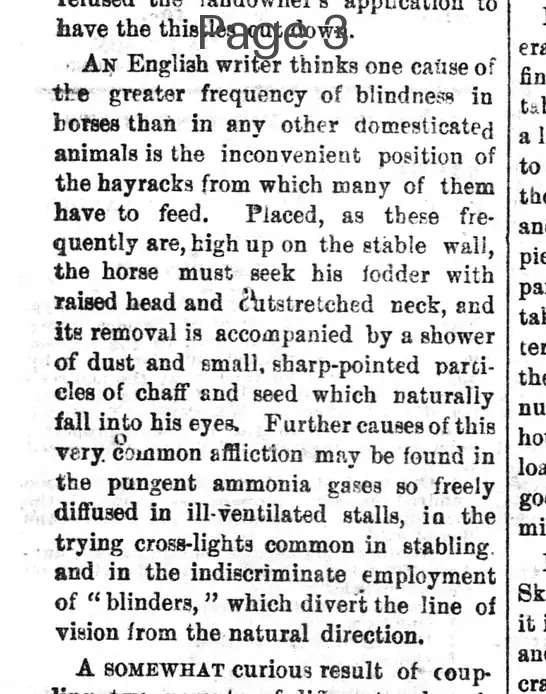
An English writer thinks one cause of the greater frequency of blindness in horses than in any other domesticated animals is the inconvenient position of the hayracks from which many of them have to feed. Placed, as these frequently are, high up on the stable wall, the horse must seek his fodder with raised head and outstretched neck, and its removal is accompanied by a shower of dust and small, sharp-pointed particles of chaff and seed which naturally fall into his eyes. Further causes of this very common affliction may be found in the pungent ammonia gases so freely diffused in ill-ventilated stalls, in the trying cross-lights common in stabling and in the indiscriminate employment of "blinders," which divert the line of vision from the natural direction.
What sub-type of article is it?
Agriculture
What keywords are associated?
Horse Blindness
Hayracks
Stable Ventilation
Ammonia Gases
Blinders
Domestic News Details
Event Details
An English writer identifies causes of frequent blindness in horses: high hayracks leading to dust and chaff in eyes during feeding; ammonia gases in ill-ventilated stalls; cross-lights in stabling; and blinders diverting natural vision.