Thank you for visiting SNEWPapers!
Sign up free
Arkansas State Gazette
Little Rock, Pulaski County, Arkansas
What is this article about?
In Venice, Marcolini is falsely accused of murdering Senator Renaldi after finding the killer's scabbard, leading to his execution and his fiancée's madness. The true culprit later confesses, inspiring a custom of caution in judgments and a nightly mass for the innocent.
Clipping
OCR Quality
Full Text
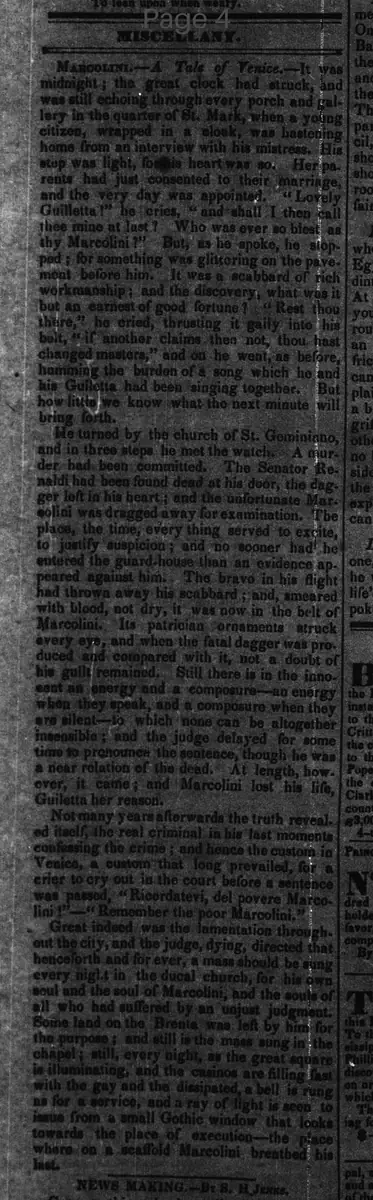
Marcolini; or Venice.
It was midnight; the great clock had struck, and was still echoing through every porch and gallery in the quarter of St. Mark, when a young citizen wrapped in a cloak, was hastening home from an interview with his mistress. His step was light, for his heart was so. Her parents had just consented to their marriage, and the very day was appointed. 'O Lovel! Guilletta! how shall I then call thee mine at last? Who was ever so blest as thy Marcolini?' But, as he spoke, he stopped, for something was glittering on the pavement before him. It was a scabbard of rich workmanship; and the discovery—what was it but an earnest of good fortune? 'Rest thou there?' he cried, thrusting it partly into his belt, 'for another claims thee not; thou hast changed masters,' and on he went as before, humming the burden of a song which he and his Guilletta had been singing together. But how little we know what the next minute will bring forth.
He turned by the church of St. Geminiano, and in three steps he met the watch. A murder had been committed. The Senator Renaldi had been found dead at his door, the dagger left in his heart; and the unfortunate Marcolini was dragged away for examination. The place, the time, every thing served to excite, to justify suspicion; and no sooner had he entered the guard-house than an evidence appeared against him. The bravo in his flight had thrown away his scabbard, and smeared with blood, not dry, it was now in the belt of Marcolini. Its patrician ornaments struck every eye, and when the fatal dagger was produced and compared with it, not a doubt of his guilt remained. Still there is in the innocent an energy and a composure—an energy when they speak, and a composure when they are silent, to which none can be altogether insensible: and the judge delayed for some time to pronounce the sentence, though he was a near relation of the dead. At length, however, it came, and Marcolini lost his life, Guilletta her reason.
Not many years afterwards the truth revealed itself, the real criminal in his last moments confessing the crime; and hence the custom in Venice, a custom that long prevailed—for a crier to cry out in the court before a sentence was passed, 'Ricordate, del povere Marcolini! Remember the poor Marcolini!'
Great indeed was the lamentation throughout the city; and the judge, dying, directed that henceforth and forever, a mass should be sung every night in the ducal church, for his own soul and the soul of Marcolini, and the souls of all who had suffered by an unjust judgment. Some land on the Brenta was left by him for the purpose, and still is the mass sung in the chapel; still, every night, as the great square is illuminating, and the casinos are filling fast with the gay and the dissipated, a bell is rung as for a service, and a ray of light is seen to issue from a small Gothic window that looks towards the place of execution, the place where on a scaffold Marcolini breathed his last.
What sub-type of article is it?
What themes does it cover?
What keywords are associated?
What entities or persons were involved?
Where did it happen?
Story Details
Key Persons
Location
Venice
Story Details
Young Marcolini, joyful after his betrothal, finds a bloodied scabbard and is wrongly accused of murdering Senator Renaldi when the watch finds it on him. He is convicted and executed despite his innocence; Guilletta loses her reason. Years later, the real criminal confesses, leading to a Venetian custom of warning before sentences and a perpetual mass for the unjustly judged.