Thank you for visiting SNEWPapers!
Sign up free
Rutland Herald
Rutland, Rutland County, Vermont
What is this article about?
New Jersey legislative committee reports in favor of state purchasing Camden & Amboy Rail Road and Delaware & Raritan Canal for $7,650,000 at 5% interest, and leasing them to Philadelphia & Trenton Rail Road Co. and Trenton & New Brunswick Turnpike Co. for 36 years at 6%, yielding annual profit and funding state expenses without taxes.
Clipping
OCR Quality
Full Text
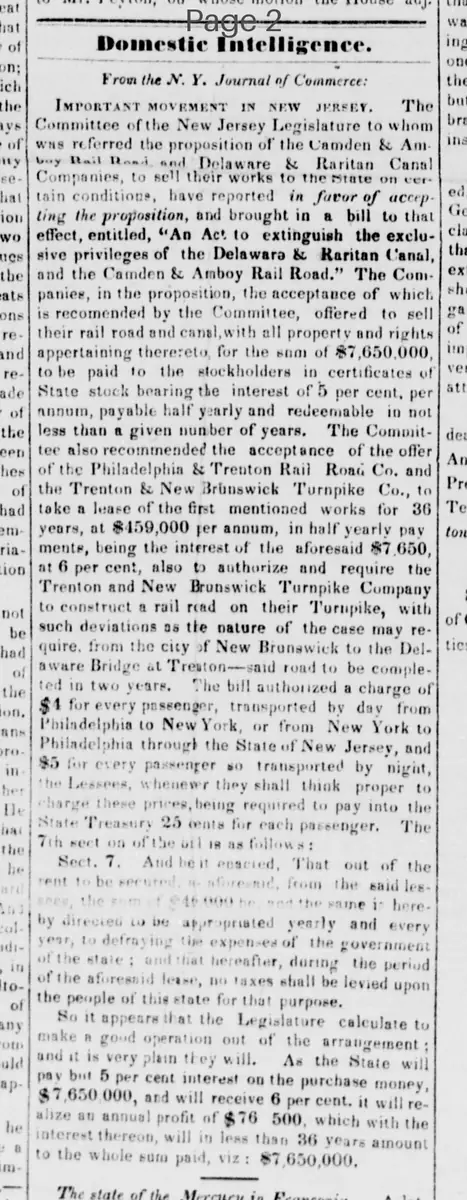
From the N. Y. Journal of Commerce:
Important Movement in New Jersey.
The Committee of the New Jersey Legislature to whom was referred the proposition of the Camden & Amboy Rail Road and Delaware & Raritan Canal Companies, to sell their works to the State on certain conditions, have reported in favor of accepting the proposition, and brought in a bill to that effect, entitled, "An Act to extinguish the exclusive privileges of the Delaware & Raritan Canal, and the Camden & Amboy Rail Road." The Companies, in the proposition, the acceptance of which is recommended by the Committee, offered to sell their rail road and canal, with all property and rights appertaining thereto, for the sum of $7,650,000, to be paid to the stockholders in certificates of State stock bearing the interest of 5 per cent, per annum, payable half yearly and redeemable in not less than a given number of years. The Committee also recommended the acceptance of the offer of the Philadelphia & Trenton Rail Road Co. and the Trenton & New Brunswick Turnpike Co., to take a lease of the first mentioned works for 36 years, at $459,000 per annum, in half yearly payments, being the interest of the aforesaid $7,650, at 6 per cent, also to authorize and require the Trenton and New Brunswick Turnpike Company to construct a rail road on their Turnpike, with such deviations as the nature of the case may require, from the city of New Brunswick to the Delaware Bridge at Trenton--said road to be completed in two years. The bill authorized a charge of $4 for every passenger, transported by day from Philadelphia to New York, or from New York to Philadelphia through the State of New Jersey, and $5 for every passenger so transported by night, the Lessees, whenever they shall think proper to charge these prices, being required to pay into the State Treasury 25 cents for each passenger. The 7th section of the bill is as follows:
Sect. 7. And be it enacted, That out of the rent to be secured as aforesaid and, from the said lessee we authorize hereby direction to be appropriated yearly and every year, to defraying the expenses of the government of the state ; and that hereafter, during the period of the aforesaid lease, no taxes shall be levied upon the people of this state for that purpose.
So it appears that the Legislature calculate to make a good operation out of the arrangement; and it is very plain they will. As the State will pay but 5 per cent interest on the purchase money, $7,650,000, and will receive 6 per cent. it will receive on annual profit of $76,500, which with the interest thereon, will in less than 36 years amount to the whole sum paid, viz : $7,650,000.
What sub-type of article is it?
What keywords are associated?
Where did it happen?
Domestic News Details
Primary Location
New Jersey
Outcome
state purchases works for $7,650,000 at 5% interest; leases for 36 years at $459,000 annually (6% interest), yielding $76,500 annual profit; funds state government expenses without taxes during lease period.
Event Details
New Jersey Legislature's committee recommends accepting proposition from Camden & Amboy Rail Road and Delaware & Raritan Canal Companies to sell their works to the state for $7,650,000 in 5% state stock certificates; also recommends accepting lease offer from Philadelphia & Trenton Rail Road Co. and Trenton & New Brunswick Turnpike Co. for 36 years at $459,000 per year; requires construction of rail road from New Brunswick to Trenton Delaware Bridge in two years; bill sets passenger charges of $4 day/$5 night with 25 cents per passenger to state treasury; Section 7 directs rent appropriation to state expenses, eliminating taxes during lease.