Thank you for visiting SNEWPapers!
Sign up free
Editorial
May 27, 1815
Alexandria Gazette, Commercial And Political
Alexandria, Virginia
What is this article about?
Editorial from Baltimore Telegraph reflects on War of 1812, crediting divine providence for averting disasters from administration's errors, like ignored repeal of British orders in council and unexpected Ghent peace, contrasting past war horrors with current commercial revival in Baltimore.
Clipping
OCR Quality
70%
Good
Full Text
From the Baltimore Telegraph.
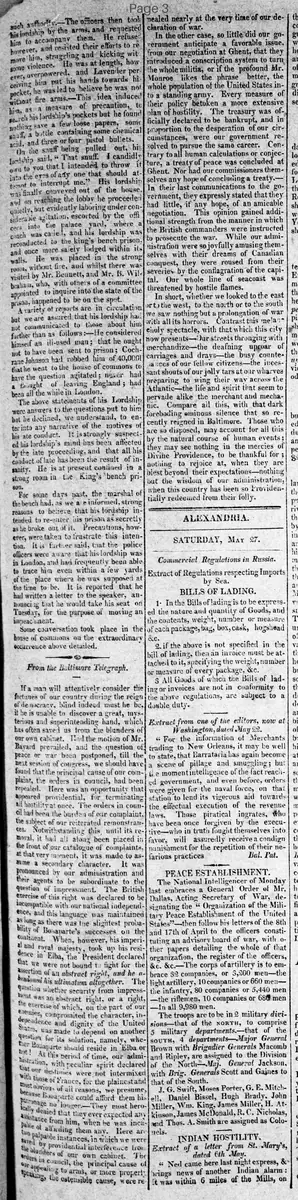
If a man will attentively consider the fortunes of our country during the reign of democracy, blind indeed must he be, if he is unable to discover a great, mysterious and superintending hand, which has often saved us from the blunders of our own cabinet. Had the motion of Mr. Bayard prevailed, and the question of peace or war been postponed, till the next session of congress, we should have found that the principal cause of our complaint, the orders in council, had been repealed. Here was an opportunity that appeared providential, for terminating all hostilities at once. The orders in council had been the burden of our complaint, the subject of our reiterated remonstrances. Notwithstanding this, until its removal, it had all along been placed in the front of our catalogue of complaints, at that very moment, it was made to assume a secondary character. It was pronounced by our administration and their agents to be subordinate to the question of impressment. The British exercise of this right was declared to be incompatible with our national independence, and this language was maintained as long as there was the slightest probability of Bonaparte's successes on the continent. When, however, his imperial and royal majesty, took up his residence in Elba the President declared that we were not bound to fight for the assertion of an abstract right, and he abandoned his ultimatum altogether. The question whether security from impressment was an abstract right or the exercise of which, on the part of our enemies, compromised the independence and dignity of the United States, was made to depend on another question for its solution, namely, whether Bonaparte should reside in Elba or not. At this period of time our administration, with peculiar spirit declared that our destinies were not with those of France, for the plainest and most obvious of all reasons we because Bonaparte could afford them his patronage no longer. They most heroically denied that they ever expected any assistance from him when he was two palpable of a providential rding of instances our own interference in any which cabinet Here we trom were Tne orders in council, the principal cause of our appealing to arms or more peaking, the ostensible cause, were repealed nearly at the very time of our declaration of war. In the other case, so little did our government anticipate a favorable issue from our negotiation at Ghent, that they introduced a conscription system to turn the whole militia, or if the profound Mr. Monroe likes the phrase better, the whole population of the United States into a standing army. Every measure of their policy betoken a more extensive plan of hostility. The treasury was officially declared to be bankrupt, and in proportion to the desperation of our circumstances, were our government resolved to pursue the same career. Contrary to all human calculations or conjecture, a treaty of peace was concluded at Ghent. Nor had our commissioners themselves any hope of concluding a treaty. In their last communications to the government, they expressly stated that they had little, if any hope, of an amicable negotiation. This opinion gained additional strength from the manner in which the British commanders were instructed to prosecute the war. While our administration were so joyfully amusing themselves with their dreams of Canadian conquest, they were roused from their severies by the conflagration of the capital. Our whole line of seacoast was threatened by hostile flames. In short, whether we looked to the east or to the west, to the north or to the south we saw nothing but a prolongation of war with all its horrors. Contrast this melancholy spectacle, with that which this city now presents—Our streets thronging with merchandize—the deafening uproar of carriages and drays—the busy countenances of our fellow citizens—the incessant shouts of our jolly tars at our wharves preparing to wing their way across the Atlantic—the life and spirit that seem to pervade alike the merchant and mechanic. Compare all this, with that dark foreboding ominous silence that so recently reigned in Baltimore. Those who are so disposed, may account for all this by the natural course of human events: they may see nothing in the mercies of Divine Providence, to be thankful for; nothing to rejoice at, when they are blest beyond their expectations—nothing but the wisdom of our administration, when this country has been so Providentially redeemed from their folly.
If a man will attentively consider the fortunes of our country during the reign of democracy, blind indeed must he be, if he is unable to discover a great, mysterious and superintending hand, which has often saved us from the blunders of our own cabinet. Had the motion of Mr. Bayard prevailed, and the question of peace or war been postponed, till the next session of congress, we should have found that the principal cause of our complaint, the orders in council, had been repealed. Here was an opportunity that appeared providential, for terminating all hostilities at once. The orders in council had been the burden of our complaint, the subject of our reiterated remonstrances. Notwithstanding this, until its removal, it had all along been placed in the front of our catalogue of complaints, at that very moment, it was made to assume a secondary character. It was pronounced by our administration and their agents to be subordinate to the question of impressment. The British exercise of this right was declared to be incompatible with our national independence, and this language was maintained as long as there was the slightest probability of Bonaparte's successes on the continent. When, however, his imperial and royal majesty, took up his residence in Elba the President declared that we were not bound to fight for the assertion of an abstract right, and he abandoned his ultimatum altogether. The question whether security from impressment was an abstract right or the exercise of which, on the part of our enemies, compromised the independence and dignity of the United States, was made to depend on another question for its solution, namely, whether Bonaparte should reside in Elba or not. At this period of time our administration, with peculiar spirit declared that our destinies were not with those of France, for the plainest and most obvious of all reasons we because Bonaparte could afford them his patronage no longer. They most heroically denied that they ever expected any assistance from him when he was two palpable of a providential rding of instances our own interference in any which cabinet Here we trom were Tne orders in council, the principal cause of our appealing to arms or more peaking, the ostensible cause, were repealed nearly at the very time of our declaration of war. In the other case, so little did our government anticipate a favorable issue from our negotiation at Ghent, that they introduced a conscription system to turn the whole militia, or if the profound Mr. Monroe likes the phrase better, the whole population of the United States into a standing army. Every measure of their policy betoken a more extensive plan of hostility. The treasury was officially declared to be bankrupt, and in proportion to the desperation of our circumstances, were our government resolved to pursue the same career. Contrary to all human calculations or conjecture, a treaty of peace was concluded at Ghent. Nor had our commissioners themselves any hope of concluding a treaty. In their last communications to the government, they expressly stated that they had little, if any hope, of an amicable negotiation. This opinion gained additional strength from the manner in which the British commanders were instructed to prosecute the war. While our administration were so joyfully amusing themselves with their dreams of Canadian conquest, they were roused from their severies by the conflagration of the capital. Our whole line of seacoast was threatened by hostile flames. In short, whether we looked to the east or to the west, to the north or to the south we saw nothing but a prolongation of war with all its horrors. Contrast this melancholy spectacle, with that which this city now presents—Our streets thronging with merchandize—the deafening uproar of carriages and drays—the busy countenances of our fellow citizens—the incessant shouts of our jolly tars at our wharves preparing to wing their way across the Atlantic—the life and spirit that seem to pervade alike the merchant and mechanic. Compare all this, with that dark foreboding ominous silence that so recently reigned in Baltimore. Those who are so disposed, may account for all this by the natural course of human events: they may see nothing in the mercies of Divine Providence, to be thankful for; nothing to rejoice at, when they are blest beyond their expectations—nothing but the wisdom of our administration, when this country has been so Providentially redeemed from their folly.
What sub-type of article is it?
Foreign Affairs
Partisan Politics
Moral Or Religious
What keywords are associated?
War Of 1812
Divine Providence
Orders In Council
Ghent Treaty
Impressment
Bonaparte
Baltimore Prosperity
What entities or persons were involved?
Mr. Bayard
Bonaparte
President
Mr. Monroe
British Commanders
Commissioners At Ghent
Editorial Details
Primary Topic
Providential Intervention During The War Of 1812
Stance / Tone
Critical Of Administration, Grateful For Divine Providence
Key Figures
Mr. Bayard
Bonaparte
President
Mr. Monroe
British Commanders
Commissioners At Ghent
Key Arguments
Divine Hand Saved Us From Cabinet Blunders
Orders In Council Repealed Just After War Declaration
Impressment Prioritized Over Orders Due To Bonaparte's Fall
Administration Abandoned Ultimatum On Impressment
Unexpected Peace Treaty At Ghent Despite Low Hopes
Conscription Planned Amid Expected Prolonged War
Contrast Of Wartime Despair With Postwar Prosperity In Baltimore