Thank you for visiting SNEWPapers!
Sign up free
Story
November 12, 1849
Lynchburg Virginian
Lynchburg, Virginia
What is this article about?
The Memphis Convention, reported via New Orleans Picayune, debated a transcontinental railroad. Lt. Maury presided; resolutions favored government surveys, funding via public lands, military posts, and southern route to San Diego, adopted despite opposition.
Clipping
OCR Quality
85%
Good
Full Text
MEMPHIS CONVENTION.
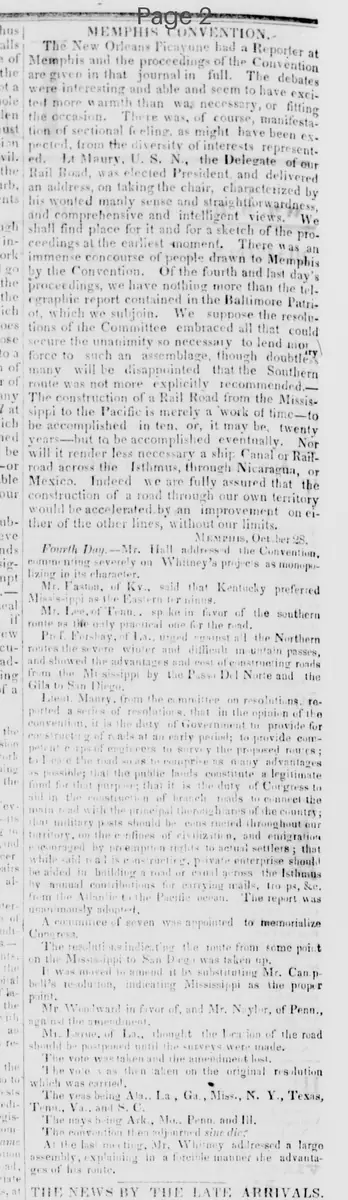
The New Orleans Picayune had a Reporter at Memphis and the proceedings of the Convention are given in that journal in full. The debates were interesting and able and seem to have excited more warmth than was necessary, or fitting the occasion. There was, of course, manifestation of sectional feeling, as might have been expected, from the diversity of interests represented. Lt. Maury, U. S. N., the Delegate of our Rail Road, was elected President and delivered an address, on taking the chair, characterized by his wonted manly sense and straightforwardness, and comprehensive and intelligent views. We shall find place for it and for a sketch of the proceedings at the earliest moment. There was an immense concourse of people drawn to Memphis by the Convention. Of the fourth and last day's proceedings, we have nothing more than the telegraphic report contained in the Baltimore Patriot, which we subjoin. We suppose the resolutions of the Committee embraced all that could secure the unanimity so necessary to lend more force to such an assemblage, though doubtless many will be disappointed that the Southern route was not more explicitly recommended.— The construction of a Rail Road from the Mississippi to the Pacific is merely a work of time—to be accomplished in ten, or, it may be, twenty years—but to be accomplished eventually. Nor will it render less necessary a ship Canal or Railroad across the Isthmus, through Nicaragua, or Mexico. Indeed we are fully assured that the construction of a road through our own territory would be accelerated by an improvement on either of the other lines, without our limits.
Memphis, October 28.
Fourth Day.—Mr. Hall addressed the Convention, commenting severely on Whitney's project as monopolizing in its character.
Mr. Easton, of Ky., said that Kentucky preferred Mississippi as Eastern terminus.
Mr. Lee, of Tenn., spoke in favor of the southern route as the only practical one for the road.
Dr. C. Forshay, La., urged against all the Northern routes the sovereign winter and difficult mountain passes, and showed the advantages and cost of constructing roads from the Mississippi by the Pass, Del Norte and the Gila to San Diego,
Lt. Maury, from the committee on resolutions, reported a series of resolutions, that in the opinion of the convention, it is the duty of Government to provide for constructing of roads at an early period; to provide competent corps of engineers to survey the proposed routes; to locate roads where they present many advantages possible; that the public lands constitute a legitimate fund for that purpose; that it is the duty of Congress to aid in the construction of such roads to connect the most read with the principal thoroughfares of the country; that military posts should be established throughout our territory, on the confines of civilization, and emigration encouraged by preemption rights to actual settlers; that while aid railroads uniting, private enterprise should be aided in building a road or canal across the Isthmus by annual contributions for carrying mails, troops, &c., from the Atlantic to the Pacific ocean. The report was quasimanimously adopted.
A committee of seven was appointed to memorialize Congress.
The resolutions indicating the route from some point in the Mississippi to San Diego was taken up.
It was moved to amend it by substituting Mr. Campbell's resolution, indicating Mississippi as the proper point.
Mr. Woodward in favor of, and Mr. Naylor, of Penn., against the amendment.
Mr. Ianne, of Ill., thought the location of the road should be postponed until surveys were made.
The vote was taken and the amendment lost.
The vote was then taken on the original resolution which was carried.
The yeas being Ala., La., Ga., Miss., N. Y., Texas, Tenn., Va., and S. C.
The nays being Ark., Mo., Penn. and Ill.
The convention adjourned sine die.
A large meeting. Mr. Whitney addressed a large assembly, explaining in a friendly manner the advantages of his route.
The New Orleans Picayune had a Reporter at Memphis and the proceedings of the Convention are given in that journal in full. The debates were interesting and able and seem to have excited more warmth than was necessary, or fitting the occasion. There was, of course, manifestation of sectional feeling, as might have been expected, from the diversity of interests represented. Lt. Maury, U. S. N., the Delegate of our Rail Road, was elected President and delivered an address, on taking the chair, characterized by his wonted manly sense and straightforwardness, and comprehensive and intelligent views. We shall find place for it and for a sketch of the proceedings at the earliest moment. There was an immense concourse of people drawn to Memphis by the Convention. Of the fourth and last day's proceedings, we have nothing more than the telegraphic report contained in the Baltimore Patriot, which we subjoin. We suppose the resolutions of the Committee embraced all that could secure the unanimity so necessary to lend more force to such an assemblage, though doubtless many will be disappointed that the Southern route was not more explicitly recommended.— The construction of a Rail Road from the Mississippi to the Pacific is merely a work of time—to be accomplished in ten, or, it may be, twenty years—but to be accomplished eventually. Nor will it render less necessary a ship Canal or Railroad across the Isthmus, through Nicaragua, or Mexico. Indeed we are fully assured that the construction of a road through our own territory would be accelerated by an improvement on either of the other lines, without our limits.
Memphis, October 28.
Fourth Day.—Mr. Hall addressed the Convention, commenting severely on Whitney's project as monopolizing in its character.
Mr. Easton, of Ky., said that Kentucky preferred Mississippi as Eastern terminus.
Mr. Lee, of Tenn., spoke in favor of the southern route as the only practical one for the road.
Dr. C. Forshay, La., urged against all the Northern routes the sovereign winter and difficult mountain passes, and showed the advantages and cost of constructing roads from the Mississippi by the Pass, Del Norte and the Gila to San Diego,
Lt. Maury, from the committee on resolutions, reported a series of resolutions, that in the opinion of the convention, it is the duty of Government to provide for constructing of roads at an early period; to provide competent corps of engineers to survey the proposed routes; to locate roads where they present many advantages possible; that the public lands constitute a legitimate fund for that purpose; that it is the duty of Congress to aid in the construction of such roads to connect the most read with the principal thoroughfares of the country; that military posts should be established throughout our territory, on the confines of civilization, and emigration encouraged by preemption rights to actual settlers; that while aid railroads uniting, private enterprise should be aided in building a road or canal across the Isthmus by annual contributions for carrying mails, troops, &c., from the Atlantic to the Pacific ocean. The report was quasimanimously adopted.
A committee of seven was appointed to memorialize Congress.
The resolutions indicating the route from some point in the Mississippi to San Diego was taken up.
It was moved to amend it by substituting Mr. Campbell's resolution, indicating Mississippi as the proper point.
Mr. Woodward in favor of, and Mr. Naylor, of Penn., against the amendment.
Mr. Ianne, of Ill., thought the location of the road should be postponed until surveys were made.
The vote was taken and the amendment lost.
The vote was then taken on the original resolution which was carried.
The yeas being Ala., La., Ga., Miss., N. Y., Texas, Tenn., Va., and S. C.
The nays being Ark., Mo., Penn. and Ill.
The convention adjourned sine die.
A large meeting. Mr. Whitney addressed a large assembly, explaining in a friendly manner the advantages of his route.
What sub-type of article is it?
Historical Event
What themes does it cover?
Exploration
What keywords are associated?
Memphis Convention
Railroad Pacific
Southern Route
Government Aid
Isthmus Canal
What entities or persons were involved?
Lt. Maury
Mr. Hall
Mr. Easton
Mr. Lee
Dr. C. Forshay
Mr. Whitney
Mr. Campbell
Mr. Woodward
Mr. Naylor
Mr. Ianne
Where did it happen?
Memphis
Story Details
Key Persons
Lt. Maury
Mr. Hall
Mr. Easton
Mr. Lee
Dr. C. Forshay
Mr. Whitney
Mr. Campbell
Mr. Woodward
Mr. Naylor
Mr. Ianne
Location
Memphis
Event Date
October 28
Story Details
The Memphis Convention discussed building a railroad from the Mississippi to the Pacific, with debates on routes. Lt. Maury was elected president. Resolutions urged government to survey and fund routes, establish military posts, and aid isthmus projects. The southern route to San Diego was adopted.