Thank you for visiting SNEWPapers!
Sign up free
The Morning Star And Catholic Messenger
New Orleans, Orleans County, Louisiana
What is this article about?
Synopsis of Rev. Abram J. Ryan's 1876 Fourth of July speech in Mobile, Alabama, praising Southern roles in American independence, critiquing contemporary America, honoring immigrant contributions, and defending Catholic patriotism amid centennial celebrations.
Clipping
OCR Quality
Full Text
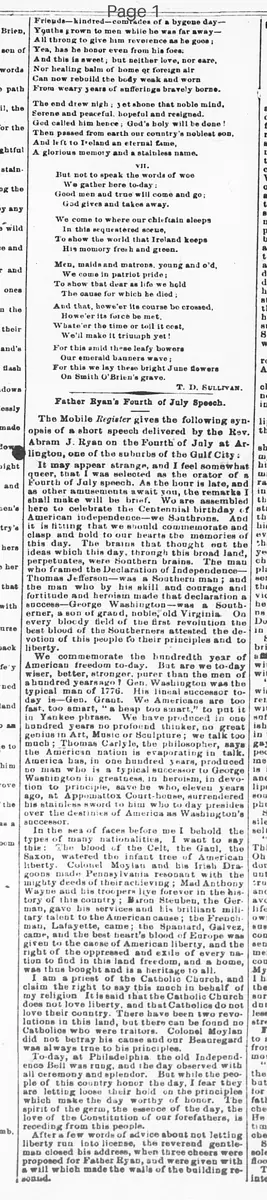
The Mobile Register gives the following synopsis of a short speech delivered by the Rev. Abram J. Ryan on the Fourth of July at Arlington, one of the suburbs of the Gulf City:
It may appear strange, and I feel somewhat queer, that I was selected as the orator of a Fourth of July speech. As the hour is late, and as other amusements await you, the remarks I shall make will be brief. We are assembled here to celebrate the Centennial birthday of American independence—we Southerners. And it is fitting that we should commemorate and clasp and hold to our hearts the memories of this day. The brains that thought out the ideas which this day, through this broad land, perpetuates, were Southern brains. The man who framed the Declaration of Independence—Thomas Jefferson—was a Southern man; and the man who by his skill and courage and fortitude and heroism made that declaration a success—George Washington—was a Southerner, a son of grand, noble, old Virginia. On every bloody field of the first revolution the best blood of the Southerners attested the devotion of this people to their principles and to liberty.
We commemorate the hundredth year of American freedom to-day. But are we to-day wiser, better, stronger, purer than the men of a hundred years ago? Gen. Washington was the typical man of 1776. His lineal successor to-day is—Gen. Grant. We Americans are too fast, too smart, 'a heap too smart,' to put it in Yankee phrase. We have produced in one hundred years no profound thinker, no great genius in Art, Music or Sculpture; we talk too much; Thomas Carlyle, the philosopher, says the American nation is evaporating in talk. America has, in one hundred years, produced no man who is a typical successor to George Washington in greatness, in heroism, in devotion to principle, save he who, eleven years ago, at Appomattox Court-house, surrendered his stainless sword to him who to-day presides over the destinies of America as Washington's successor.
In the sea of faces before me I behold the types of many nationalities. I want to say this: The blood of the Celt, the Gaul, the Saxon, watered the infant tree of American liberty. Colonel Moylan and his Irish Dragoons made Pennsylvania resonant with the mighty deeds of their achieving; Mad Anthony Wayne and his troopers live forever in the history of this country: Baron Steuben, the German, gave his services and his brilliant military talent to the American cause: the Frenchman, Lafayette, came; the Spaniard, Galvez, came, and the best heart's blood of Europe was given to the cause of American liberty, and the right of the oppressed and exile of every nation to find in this land freedom, and a home, was thus bought and is a heritage to all.
I am a priest of the Catholic Church, and claim the right to say this much in behalf of my religion. It is said that the Catholic Church does not love liberty, and that Catholics do not love their country. There have been two revolutions in this land, but there can be found no Catholics who were traitors. Colonel Moylan did not betray his cause and our Beauregard was always true to his principles.
To-day, at Philadelphia the old Independence Bell was rung, and the day observed with all ceremony and splendor. But while the people of this country honor the day, I fear they are letting loose their hold on the principles which make the day worthy of honor. The spirit of the germ, the essence of the day, the love of the Constitution of our forefathers, is receding from this people.
After a few words of advice about not letting liberty run into license, the reverend gentleman closed his address, when three cheers were proposed for Father Ryan, and were given with a will which made the walls of the building resound.
What sub-type of article is it?
What themes does it cover?
What keywords are associated?
What entities or persons were involved?
Where did it happen?
Story Details
Key Persons
Location
Arlington, Suburb Of The Gulf City (Mobile)
Event Date
Fourth Of July, 1876
Story Details
Rev. Abram J. Ryan delivers a brief speech celebrating the centennial of American independence, highlighting Southern contributions through Jefferson and Washington, critiquing modern America compared to revolutionary heroes, acknowledging European immigrants' roles, defending Catholic loyalty in American revolutions, and warning against letting liberty become license.