Thank you for visiting SNEWPapers!
Sign up free
The Nome Nugget
Nome, Nome County, Alaska
What is this article about?
President Eisenhower announced the Soviet Union's resumption of nuclear tests, possibly including a hydrogen blast, on last Friday, revealing the test site in southwest Siberia north of India. The disclosure challenges Soviet secrecy and emphasizes the need for international atomic energy control, countering Russian propaganda on U.S. tests.
Clipping
OCR Quality
Full Text
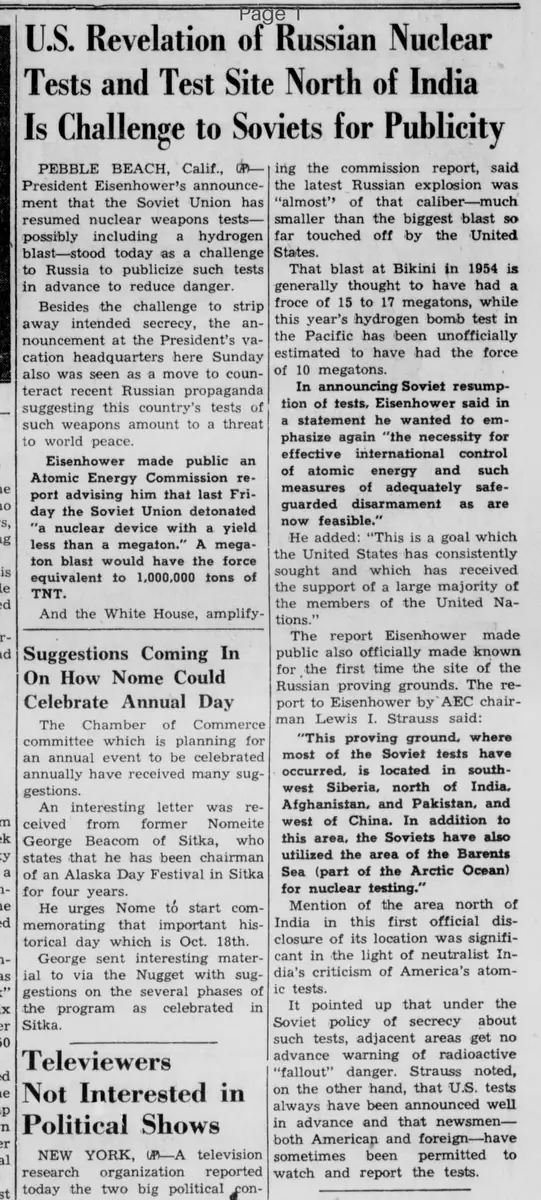
PEBBLE BEACH, Calif. (A)—President Eisenhower's announcement that the Soviet Union has resumed nuclear weapons tests—possibly including a hydrogen blast—stood today as a challenge to Russia to publicize such tests in advance to reduce danger.
Besides the challenge to strip away intended secrecy, the announcement at the President's vacation headquarters here Sunday also was seen as a move to counteract recent Russian propaganda suggesting this country's tests of such weapons amount to a threat to world peace.
Eisenhower made public an Atomic Energy Commission report advising him that last Friday the Soviet Union detonated "a nuclear device with a yield less than a megaton." A megaton blast would have the force equivalent to 1,000,000 tons of TNT.
And the White House, amplifying the commission report, said the latest Russian explosion was "almost" of that caliber—much smaller than the biggest blast so far touched off by the United States.
That blast at Bikini in 1954 is generally thought to have had a force of 15 to 17 megatons, while this year's hydrogen bomb test in the Pacific has been unofficially estimated to have had the force of 10 megatons.
In announcing Soviet resumption of tests, Eisenhower said in a statement he wanted to emphasize again "the necessity for effective international control of atomic energy and such measures of adequately safeguarded disarmament as are now feasible."
He added: "This is a goal which the United States has consistently sought and which has received the support of a large majority of the members of the United Nations."
The report Eisenhower made public also officially made known for the first time the site of the Russian proving grounds. The report to Eisenhower by AEC chairman Lewis L. Strauss said:
"This proving ground, where most of the Soviet tests have occurred, is located in southwest Siberia, north of India, Afghanistan, and Pakistan, and west of China. In addition to this area, the Soviets have also utilized the area of the Barents Sea (part of the Arctic Ocean) for nuclear testing."
Mention of the area north of India in this first official disclosure of its location was significant in the light of neutralist India's criticism of America's atomic tests.
It pointed up that under the Soviet policy of secrecy about such tests, adjacent areas get no advance warning of radioactive "fallout" danger. Strauss noted, on the other hand, that U.S. tests always have been announced well in advance and that newsmen—both American and foreign—have sometimes been permitted to watch and report the tests.
What sub-type of article is it?
What keywords are associated?
What entities or persons were involved?
Where did it happen?
Foreign News Details
Primary Location
Southwest Siberia
Event Date
Last Friday
Key Persons
Outcome
soviet nuclear device detonated with yield less than a megaton, almost megaton caliber; u.s. challenges soviet secrecy and emphasizes international control of atomic energy
Event Details
President Eisenhower announced Soviet resumption of nuclear tests last Friday, possibly a hydrogen blast, based on Atomic Energy Commission report; revealed test site in southwest Siberia north of India, Afghanistan, Pakistan, west of China, and Barents Sea; contrasts with U.S. advance announcements to reduce fallout danger and counter Soviet propaganda