Thank you for visiting SNEWPapers!
Sign up free
Literary
May 9, 1860
The Hillsborough Recorder
Hillsboro, Orange County, North Carolina
What is this article about?
Extract from Gen. Haskell's lecture comparing Henry Clay, John C. Calhoun, and Daniel Webster across 20 points, likening their traits in social life, debate, governance, war, religion, and more to historical figures, natural elements, and celestial bodies, emphasizing their roles in American politics.
Clipping
OCR Quality
95%
Excellent
Full Text
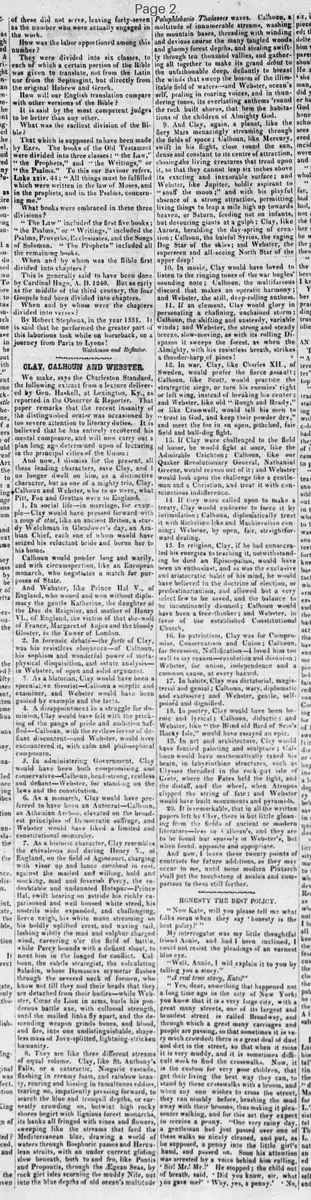
CLAY, CALHOUN AND WEBSTER
We make, says the Charleston Standard, the following extract from a lecture delivered by Gen. Haskell, at Lexington, Ky., as reported in the Observer & Reporter. That paper remarks that the recent insanity of the distinguished orator was occasioned by too severe attention to literary duties. It is believed that he has entirely recovered his mental composure, and will now carry out a plan long ago determined upon of lecturing in the principal cities of the Union:
And now, I dismiss for the present, all these leading characters, save Clay, and I no longer dwell on him, as a distinctive character, but as one of a mighty trio, Clay, Calhoun and Webster, who to us were, what Pitt, Fox and Grattan were to England.
1. In social life—in marriage, for example—Clay would have pressed forward with a coup d'etat, like an ancient Briton, a sturdy Welshman in Glendower's day, an Arabian Chief, each one of whom would have seized his reluctant bride and borne her to his home.
Calhoun would ponder long and warily, and with circumspection, like an European monarch, who negotiates a match for purposes of State.
And Webster, like Prince Hal V., of England, who wooed and won without diplomacy the gentle Katherine, the daughter of the Duc de Reignier, and mother of Henry VI., of England, the victim of that she-wolf of France, Margaret of Anjou and the bloody Gloster, in the Tower of London.
2. In forensic debate—the forte of Clay, was his resistless eloquence—of Calhoun, his sophism and wonderful power of metaphysical disquisition, and astute analysis—in Webster, of open and solid argument.
3. As a historian, Clay would have been a speculative theorist—Calhoun a sceptic and examiner, and Webster would have been guided by example and the facts.
4. A disappointment in a struggle for dominion, Clay would have felt with the pricking of the pangs of pride and ambition baffled—Calhoun, with the restless fervor of defiant discontent—and Webster, would have encountered it, with calm and philosophical composure.
5. In administering Government, Clay would have been both compromising and conservative—Calhoun, head-strong, restless and defiant—Webster, for standing on the laws and the constitution.
6. As a monarch, Clay would have preferred to have been an Autocrat—Calhoun, an Athenian Archon, elevated on the broadest principles of Democratic suffrage, and Webster would have liked a limited and constitutional monarchy.
7. As a historic character, Clay resembles the chivalrous and daring Henry V., of England, on the field of Agincourt, charging with visor up and lance couchant in rest, against the mailed and willing, bold and mocking, mad and feverish Percy, the redoubtable and undaunted Hotspur—Prince Hal, swift bearing on astride his richly caparisoned and well housed white steed, his nostrils wide expanded, and challenging fierce neigh, his white mane streaming on his boldly uplifted crest, and waving tail, lashing wildly the mad and sulphur charged wind, careering o'er the field of battle, while Percy bounds with a defiant shout, to meet him in the longed for conflict. Calhoun, the subtle strategist, the calculating Saladin, whose Damascus scimetar flashes through the severed neck of foemen, who know not till they nod their heads that they are detached from their bodies—while Webster, Coeur de Lion in arms, hurls his ponderous battle axe, with colossal strength, until the mailed links fly apart, and the descending weapon grinds bones, and blood, and fire, into one undistinguishable, shapeless mass of Jove-splitted, lightning-stricken humanity.
8. They are like three different streams of equal volume. Clay, like St. Anthony's Falls, or a cataractic, Niagaric cascade, flashing in creamy foam, and rainbow beauty, roaring and hissing in tumultuous eddies, tearing on, impatiently pressing forward, to search the blue and tranquil depths, or earnestly crowding on, betwixt high rocky shores begirt with ligneous forest monarchs, its banks all fringed with vines and flowers, sweeping like the streams that feed the Mediterranean blue, drawing a world of waters through Bosphoric passes and Herculean straits, with an under current gliding slow beneath, both to and fro, like Pontus and Propontis, through the Aegean Seas, by rock girt isles scorning the muddy Nile, out into the blue depths of old ocean's multitude Poiuphloboscio Thalasses waves. Calhoun, a multitude of innumerable streams, washing the mountain bases, threading with winding and devious course the many tangled woods and gloomy forest depths, and stealing swiftly through ten thousand valleys, and gathering all together to make its grand debut to the unfathomable deep, defiantly to breast the winds that sweep the bosom of the illimitable field of waters—and Webster, ocean's self, pealing in roaring voices, and in thundering tones, its everlasting anthems 'round the rock built shores, that hem the habitations of the children of Almighty God.
9. And Clay, again, a planet, like the fiery Mars menacingly streaming through the fields of space; Calhoun, like Mercury, swift in his flight, close round the sun, dense and constant to its centre of attraction, chasing the living creatures that tread upon it, so that they cannot leap six inches above its exacting and inexorable surface; and Webster, like Jupiter, boldly aspirant to "snuff the moon;" and with his playful absence of a strong attraction, permitting living things to leap a mile high up towards heaven, or Saturn, feeding not on infants, but devouring giants at a gulp; Clay, like Aurora, heralding the day-spring of creation; Calhoun, the baleful Sirius, the raging Dog Star of the skies; and Webster, the superseen and all-seeing North Star of the upper deep!
10. In music, Clay would have loved to listen to the ringing tones of the war bugles' sounding note; Calhoun, the multifarious discord that makes an operatic harmony; and Webster, the still, deep-rolling anthem.
11. If an element, Clay would glory in personating a chafing, unchained storm; Calhoun, the shifting and unsteady, variable winds; and Webster, the strong and steady breeze, slow-moving, as with its rolling Diapason it sweeps the forest, as when the Almighty, with his resistless breath, strikes a thunder-harp of pines!
12. In war, Clay, like Charles XII., of Sweden, would prefer the fierce assault; Calhoun, like Scott, would practice the strategic siege, or turn his enemies' right or left wing, instead of breaking his center; and Webster, like old "Rough and Ready," or like Cromwell, would tell his men to "trust in God, and keep their powder dry," and meet the foe in an open, pitched, fair field and bull-dog fight.
13. If Clay were challenged to the field of honor, he would fight at once, like the Admirable Crichton; Calhoun, like our Quaker Revolutionary General, Nathaniel Greene, would reason out of it: and Webster would look upon the challenge like a gentleman and a Christian, and treat it with conscientious indifference.
14. If they were called upon to make a treaty, Clay would endeavor to force it by intimidation; Calhoun, diplomatically treat it with Richelieu-like and Machiavellian cunning: Webster, by open, fair, straightforward dealing.
15. In religion, Clay, if he had consecrated his energies to teaching it, notwithstanding he died an Episcopalian, would have been an enthusiast, and as was the exclusive and aristocratic habit of his mind, he would have believed in the doctrine of election, or predestinarianism, and allowed but a very select few to be saved, and the balance to be incontinently damned: Calhoun would have been a free-thinker: and Webster, in favor of the established Constitutional Church.
16. In patriotism, Clay was for Compromise, Conservatism and Union; Calhoun, for Secession, Nullification—I loved him too well to say reason—revolution and disunion; Webster, for union, independence and a common cause, at every hazard.
17. In habits, Clay was dictatorial, magisterial and genial: Calhoun, wary, diplomatic and exclusive; and Webster, gentle, self-poised and dignified.
18. In poetry, Clay would have been heroic and lyrical: Calhoun, didactic: and Webster, like "the Blind old Bard of Scio's rocky Isle," would have essayed an epic.
19. In art and architecture, Clay would have fancied painting and sculpture: Calhoun would have mathematically taxed his brain, in labyrinthine structures, such as Ulysses threaded in the rock-girt isle of Crete, where the Fates held the light, and the distaff, and the wheel, when Atropos clipped the string of fate: and Webster would have built monuments and pyramids.
20. It is remarkable, that in all the written papers left by Clay, there is but little gleaning from the fields of ancient or modern literature—less, than Calhoun's, and they are to be found but sparsely in Webster's, but when found, apposite and appropriate.
And now, I leave these twenty points of contrasts for future additions, as they may occur to me, until some modern Plutarch shall put the touchstone of analysis and comparison to them still further.
We make, says the Charleston Standard, the following extract from a lecture delivered by Gen. Haskell, at Lexington, Ky., as reported in the Observer & Reporter. That paper remarks that the recent insanity of the distinguished orator was occasioned by too severe attention to literary duties. It is believed that he has entirely recovered his mental composure, and will now carry out a plan long ago determined upon of lecturing in the principal cities of the Union:
And now, I dismiss for the present, all these leading characters, save Clay, and I no longer dwell on him, as a distinctive character, but as one of a mighty trio, Clay, Calhoun and Webster, who to us were, what Pitt, Fox and Grattan were to England.
1. In social life—in marriage, for example—Clay would have pressed forward with a coup d'etat, like an ancient Briton, a sturdy Welshman in Glendower's day, an Arabian Chief, each one of whom would have seized his reluctant bride and borne her to his home.
Calhoun would ponder long and warily, and with circumspection, like an European monarch, who negotiates a match for purposes of State.
And Webster, like Prince Hal V., of England, who wooed and won without diplomacy the gentle Katherine, the daughter of the Duc de Reignier, and mother of Henry VI., of England, the victim of that she-wolf of France, Margaret of Anjou and the bloody Gloster, in the Tower of London.
2. In forensic debate—the forte of Clay, was his resistless eloquence—of Calhoun, his sophism and wonderful power of metaphysical disquisition, and astute analysis—in Webster, of open and solid argument.
3. As a historian, Clay would have been a speculative theorist—Calhoun a sceptic and examiner, and Webster would have been guided by example and the facts.
4. A disappointment in a struggle for dominion, Clay would have felt with the pricking of the pangs of pride and ambition baffled—Calhoun, with the restless fervor of defiant discontent—and Webster, would have encountered it, with calm and philosophical composure.
5. In administering Government, Clay would have been both compromising and conservative—Calhoun, head-strong, restless and defiant—Webster, for standing on the laws and the constitution.
6. As a monarch, Clay would have preferred to have been an Autocrat—Calhoun, an Athenian Archon, elevated on the broadest principles of Democratic suffrage, and Webster would have liked a limited and constitutional monarchy.
7. As a historic character, Clay resembles the chivalrous and daring Henry V., of England, on the field of Agincourt, charging with visor up and lance couchant in rest, against the mailed and willing, bold and mocking, mad and feverish Percy, the redoubtable and undaunted Hotspur—Prince Hal, swift bearing on astride his richly caparisoned and well housed white steed, his nostrils wide expanded, and challenging fierce neigh, his white mane streaming on his boldly uplifted crest, and waving tail, lashing wildly the mad and sulphur charged wind, careering o'er the field of battle, while Percy bounds with a defiant shout, to meet him in the longed for conflict. Calhoun, the subtle strategist, the calculating Saladin, whose Damascus scimetar flashes through the severed neck of foemen, who know not till they nod their heads that they are detached from their bodies—while Webster, Coeur de Lion in arms, hurls his ponderous battle axe, with colossal strength, until the mailed links fly apart, and the descending weapon grinds bones, and blood, and fire, into one undistinguishable, shapeless mass of Jove-splitted, lightning-stricken humanity.
8. They are like three different streams of equal volume. Clay, like St. Anthony's Falls, or a cataractic, Niagaric cascade, flashing in creamy foam, and rainbow beauty, roaring and hissing in tumultuous eddies, tearing on, impatiently pressing forward, to search the blue and tranquil depths, or earnestly crowding on, betwixt high rocky shores begirt with ligneous forest monarchs, its banks all fringed with vines and flowers, sweeping like the streams that feed the Mediterranean blue, drawing a world of waters through Bosphoric passes and Herculean straits, with an under current gliding slow beneath, both to and fro, like Pontus and Propontis, through the Aegean Seas, by rock girt isles scorning the muddy Nile, out into the blue depths of old ocean's multitude Poiuphloboscio Thalasses waves. Calhoun, a multitude of innumerable streams, washing the mountain bases, threading with winding and devious course the many tangled woods and gloomy forest depths, and stealing swiftly through ten thousand valleys, and gathering all together to make its grand debut to the unfathomable deep, defiantly to breast the winds that sweep the bosom of the illimitable field of waters—and Webster, ocean's self, pealing in roaring voices, and in thundering tones, its everlasting anthems 'round the rock built shores, that hem the habitations of the children of Almighty God.
9. And Clay, again, a planet, like the fiery Mars menacingly streaming through the fields of space; Calhoun, like Mercury, swift in his flight, close round the sun, dense and constant to its centre of attraction, chasing the living creatures that tread upon it, so that they cannot leap six inches above its exacting and inexorable surface; and Webster, like Jupiter, boldly aspirant to "snuff the moon;" and with his playful absence of a strong attraction, permitting living things to leap a mile high up towards heaven, or Saturn, feeding not on infants, but devouring giants at a gulp; Clay, like Aurora, heralding the day-spring of creation; Calhoun, the baleful Sirius, the raging Dog Star of the skies; and Webster, the superseen and all-seeing North Star of the upper deep!
10. In music, Clay would have loved to listen to the ringing tones of the war bugles' sounding note; Calhoun, the multifarious discord that makes an operatic harmony; and Webster, the still, deep-rolling anthem.
11. If an element, Clay would glory in personating a chafing, unchained storm; Calhoun, the shifting and unsteady, variable winds; and Webster, the strong and steady breeze, slow-moving, as with its rolling Diapason it sweeps the forest, as when the Almighty, with his resistless breath, strikes a thunder-harp of pines!
12. In war, Clay, like Charles XII., of Sweden, would prefer the fierce assault; Calhoun, like Scott, would practice the strategic siege, or turn his enemies' right or left wing, instead of breaking his center; and Webster, like old "Rough and Ready," or like Cromwell, would tell his men to "trust in God, and keep their powder dry," and meet the foe in an open, pitched, fair field and bull-dog fight.
13. If Clay were challenged to the field of honor, he would fight at once, like the Admirable Crichton; Calhoun, like our Quaker Revolutionary General, Nathaniel Greene, would reason out of it: and Webster would look upon the challenge like a gentleman and a Christian, and treat it with conscientious indifference.
14. If they were called upon to make a treaty, Clay would endeavor to force it by intimidation; Calhoun, diplomatically treat it with Richelieu-like and Machiavellian cunning: Webster, by open, fair, straightforward dealing.
15. In religion, Clay, if he had consecrated his energies to teaching it, notwithstanding he died an Episcopalian, would have been an enthusiast, and as was the exclusive and aristocratic habit of his mind, he would have believed in the doctrine of election, or predestinarianism, and allowed but a very select few to be saved, and the balance to be incontinently damned: Calhoun would have been a free-thinker: and Webster, in favor of the established Constitutional Church.
16. In patriotism, Clay was for Compromise, Conservatism and Union; Calhoun, for Secession, Nullification—I loved him too well to say reason—revolution and disunion; Webster, for union, independence and a common cause, at every hazard.
17. In habits, Clay was dictatorial, magisterial and genial: Calhoun, wary, diplomatic and exclusive; and Webster, gentle, self-poised and dignified.
18. In poetry, Clay would have been heroic and lyrical: Calhoun, didactic: and Webster, like "the Blind old Bard of Scio's rocky Isle," would have essayed an epic.
19. In art and architecture, Clay would have fancied painting and sculpture: Calhoun would have mathematically taxed his brain, in labyrinthine structures, such as Ulysses threaded in the rock-girt isle of Crete, where the Fates held the light, and the distaff, and the wheel, when Atropos clipped the string of fate: and Webster would have built monuments and pyramids.
20. It is remarkable, that in all the written papers left by Clay, there is but little gleaning from the fields of ancient or modern literature—less, than Calhoun's, and they are to be found but sparsely in Webster's, but when found, apposite and appropriate.
And now, I leave these twenty points of contrasts for future additions, as they may occur to me, until some modern Plutarch shall put the touchstone of analysis and comparison to them still further.
What sub-type of article is it?
Essay
What themes does it cover?
Political
Patriotism
Liberty Freedom
What keywords are associated?
Clay Calhoun Webster
Comparative Analysis
American Politics
Historical Figures
Patriotism
Union Secession
What entities or persons were involved?
Gen. Haskell
Literary Details
Title
Clay, Calhoun And Webster
Author
Gen. Haskell
Subject
Comparative Analysis Of Clay, Calhoun, And Webster
Key Lines
And Now, I Dismiss For The Present, All These Leading Characters, Save Clay, And I No Longer Dwell On Him, As A Distinctive Character, But As One Of A Mighty Trio, Clay, Calhoun And Webster, Who To Us Were, What Pitt, Fox And Grattan Were To England.
In Patriotism, Clay Was For Compromise, Conservatism And Union; Calhoun, For Secession, Nullification—I Loved Him Too Well To Say Reason—Revolution And Disunion; Webster, For Union, Independence And A Common Cause, At Every Hazard.
And Now, I Leave These Twenty Points Of Contrasts For Future Additions, As They May Occur To Me, Until Some Modern Plutarch Shall Put The Touchstone Of Analysis And Comparison To Them Still Further.