Thank you for visiting SNEWPapers!
Sign up free
Editorial
December 10, 1937
The Times News
Hendersonville, Henderson County, North Carolina
What is this article about?
Charles F. Kettering argues that inventions create more jobs than they displace, distinguishing labor-saving from labor-creating types. He highlights growth in industries like automobiles and chemicals since 1900, creating 10 million jobs, and calls for more technological advancement to combat depression and unemployment.
Clipping
OCR Quality
98%
Excellent
Full Text
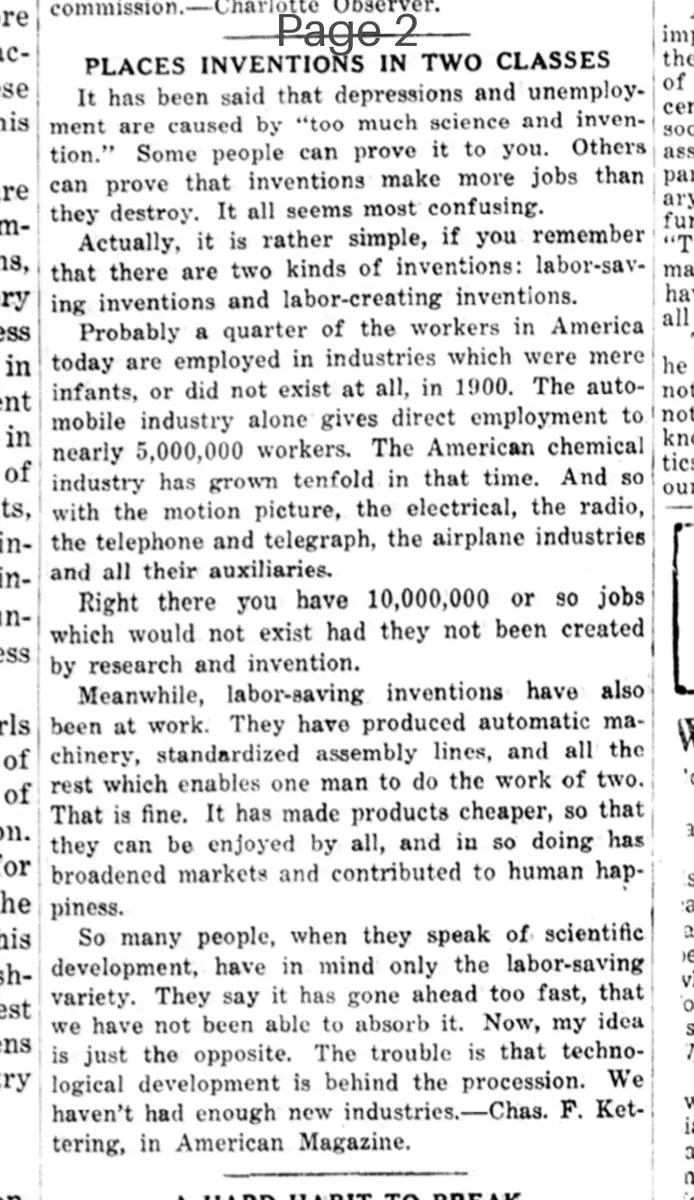
PLACES INVENTIONS IN TWO CLASSES
It has been said that depressions and unemployment are caused by "too much science and invention." Some people can prove it to you. Others can prove that inventions make more jobs than they destroy. It all seems most confusing.
Actually, it is rather simple, if you remember that there are two kinds of inventions: labor-saving inventions and labor-creating inventions.
Probably a quarter of the workers in America today are employed in industries which were mere infants, or did not exist at all, in 1900. The automobile industry alone gives direct employment to nearly 5,000,000 workers. The American chemical industry has grown tenfold in that time. And so with the motion picture, the electrical, the radio, the telephone and telegraph, the airplane industries and all their auxiliaries.
Right there you have 10,000,000 or so jobs which would not exist had they not been created by research and invention.
Meanwhile, labor-saving inventions have also been at work. They have produced automatic machinery, standardized assembly lines, and all the rest which enables one man to do the work of two.
That is fine. It has made products cheaper, so that they can be enjoyed by all, and in so doing has broadened markets and contributed to human happiness.
So many people, when they speak of scientific development, have in mind only the labor-saving variety. They say it has gone ahead too fast, that we have not been able to absorb it. Now, my idea is just the opposite. The trouble is that technological development is behind the procession. We haven't had enough new industries.-Chas. F. Kettering, in American Magazine.
It has been said that depressions and unemployment are caused by "too much science and invention." Some people can prove it to you. Others can prove that inventions make more jobs than they destroy. It all seems most confusing.
Actually, it is rather simple, if you remember that there are two kinds of inventions: labor-saving inventions and labor-creating inventions.
Probably a quarter of the workers in America today are employed in industries which were mere infants, or did not exist at all, in 1900. The automobile industry alone gives direct employment to nearly 5,000,000 workers. The American chemical industry has grown tenfold in that time. And so with the motion picture, the electrical, the radio, the telephone and telegraph, the airplane industries and all their auxiliaries.
Right there you have 10,000,000 or so jobs which would not exist had they not been created by research and invention.
Meanwhile, labor-saving inventions have also been at work. They have produced automatic machinery, standardized assembly lines, and all the rest which enables one man to do the work of two.
That is fine. It has made products cheaper, so that they can be enjoyed by all, and in so doing has broadened markets and contributed to human happiness.
So many people, when they speak of scientific development, have in mind only the labor-saving variety. They say it has gone ahead too fast, that we have not been able to absorb it. Now, my idea is just the opposite. The trouble is that technological development is behind the procession. We haven't had enough new industries.-Chas. F. Kettering, in American Magazine.
What sub-type of article is it?
Economic Policy
Science Or Medicine
Labor
What keywords are associated?
Inventions
Employment
Unemployment
Labor Saving
Labor Creating
Scientific Progress
New Industries
Research
What entities or persons were involved?
Chas. F. Kettering
Automobile Industry
American Chemical Industry
Motion Picture Industry
Electrical Industry
Radio Industry
Telephone And Telegraph Industry
Airplane Industry
Editorial Details
Primary Topic
Impact Of Inventions On Employment And Unemployment
Stance / Tone
Supportive Of Technological Progress And Invention
Key Figures
Chas. F. Kettering
Automobile Industry
American Chemical Industry
Motion Picture Industry
Electrical Industry
Radio Industry
Telephone And Telegraph Industry
Airplane Industry
Key Arguments
Inventions Are Divided Into Labor Saving And Labor Creating Types
Labor Creating Inventions Have Generated Millions Of New Jobs In Emerging Industries Since 1900
Labor Saving Inventions Increase Efficiency, Lower Costs, Broaden Markets, And Enhance Happiness
The Real Issue Is Insufficient Technological Development, Not Too Much
More Research And Invention Are Needed To Create New Industries