Thank you for visiting SNEWPapers!
Sign up free
Gazette Of The United States
New York, New York County, New York
What is this article about?
In August 1791, Lt. Col. James Wilkinson led a Kentucky volunteer force from Fort Washington on an expedition against Native American villages on the Wabash River. They destroyed towns at L'Anguille (Kenapacomaqua), a Kickapoo village, and Ouiattanon, burned over 430 acres of corn, took 34 prisoners, and killed several warriors with only two losses.
Merged-components note: The 'talk' is explicitly referenced as enclosed in the Wilkinson's expedition report, forming a single coherent story.
Clippings
1 of 2
OCR Quality
Full Text
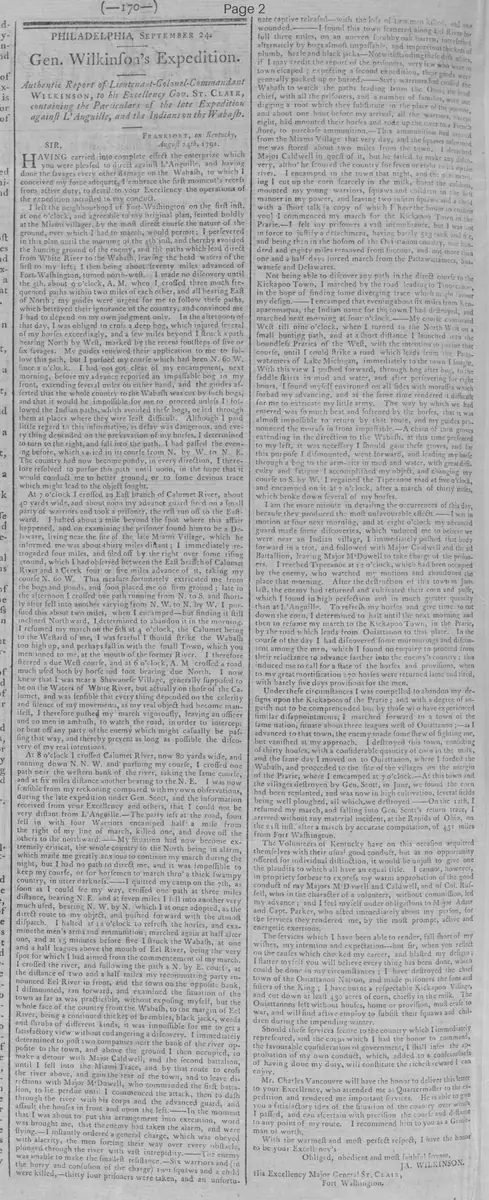
Gen. Wilkinson's Expedition.
Authentic Report of Lieutenant-Colonel-Commandant WILKINSON, to his Excellency Gov. ST. CLAIR, containing the Particulars of the late Expedition against L'Anguille, and the Indians on the Wabash.
FRANKFORT, on Kentucky,
SIR,
August 24th, 1791.
HAVING carried into complete effect the enterprize which you were pleased to direct against L'Anguille, and having done the savages every other damage on the Wabash, to which I conceived my force adequate. I embrace the first moment's recess from active duty, to detail to your Excellency the operations of the expedition intrusted to my conduct.
I left the neighbourhood of Fort-Washington on the first inst. at one o'clock, and agreeable to my original plan, feinted boldly at the Miami villages, by the most direct course the nature of the ground, over which I had to march, would permit; I persevered in this plan until the morning of the 4th inst. and thereby avoided the hunting ground of the enemy, and the paths which lead direct from White River to the Wabash, leaving the head waters of the first to my left; I then being about seventy miles advanced of Fort-Washington, turned north-west. I made no discovery until the 5th, about 9 o'clock, A. M. when I crossed three much frequented paths within two miles of each other, and all bearing East of North; my guides were urgent for me to follow these paths, which betrayed their ignorance of the country, and convinced me I had to depend on my own judgment only. In the afternoon of that day, I was obliged to cross a deep bog, which injured several of my horses exceedingly, and a few miles beyond I struck a path bearing North by West, marked by the recent footsteps of five or six savages. My guides renewed their application to me to follow this path, but I pursued my course which had been N. 60 W. since 2 o'clock. I had not got clear of my encampment, next morning, before my advance reported an impassable bog in my front, extending several miles on either hand, and the guides asserted that the whole country to the Wabash was cut by such bogs, and that it would be impossible for me to proceed unless I followed the Indian paths, which avoided these bogs, or led through them at places where they were least difficult. Although I paid little regard to this information, as delay was dangerous, and every thing depended on the preservation of my horses, I determined to turn to the right, and fall into the path, I had passed the evening before, which varied in its course from N. by W. to N. E. The country had now become pondy, in every direction, I therefore resolved to pursue this path until noon, in the hope that it would conduct me to better ground, or to some devious trace which might lead to the object sought.
At 7 o'clock I crossed an East branch of Calumet River, about 40 yards wide, and about noon my advance guard fired on a small party of warriors and took a prisoner, the rest run off to the Eastward. I halted about a mile beyond the spot where this affair happened, and on examining the prisoner found him to be a Delaware, living near the site of the late Miami Village, which he informed me was about thirty miles distant; I immediately retrograded four miles, and filed off by the right over some rising ground, which I had observed between the East branch of Calumet River and a Creek four or five miles advance of it, taking my course N. 60 W. This measure fortunately extricated me from the bogs and ponds, and soon placed me on firm ground; late in the afternoon I crossed one path running from N. to S. and shortly after fell into another varying from N. W. to N. by W. I pursued this about two miles, when I encamped—but finding it still inclined Northward, I determined to abandon it in the morning.
I resumed my march on the 6th at 4 o'clock, the Calumet being to the Westward of me, I was fearful I should strike the Wabash too high up, and perhaps fall in with the small Town, which you mentioned to me, at the mouth of the former River. I therefore steered a due West course, and at 6 o'clock, A. M crossed a road much used both by horse and foot bearing due North. I now knew that I was near a Shawanee Village, generally supposed to be on the Waters of White River, but actually on those of the Calumet, and was sensible that every thing depended on the celerity and silence of my movements, as my real object had become manifest, I therefore pushed my march vigorously, leaving an officer and 20 men in ambuscade, to watch the road, in order to intercept or beat off any party of the enemy which might casually be passing that way, and thereby prevent as long as possible the discovery of my real intentions.
At 8 o'clock I crossed Calumet River, now 80 yards wide, and running down N. N. W. and pursuing my course, I crossed one path near the western bank of the river, taking the same course, and at six miles distance another bearing to the N. E. I was now sensible from my reckoning compared with my own observations, during the late expedition under Gen. Scott, and the information received from your Excellency and others, that I could not be very distant from L'Anguille.—The party left at the road, soon fell in with four Warriors encamped half a mile from the right of my line of march, killed one, and drove off the others to the northward.—My situation had now become extremely critical, the whole country to the North being in alarm, which made me greatly anxious to continue my march during the night, but I had no path to direct me, and it was impossible to keep my course, or for horsemen to march thro' a thick swampy country, in utter darkness.—I quitted my camp on the 7th, as soon as I could see my way, crossed one path at three miles distance, bearing N. E. and at seven miles I fell into another very much used, bearing N. W. by N. which I at once adopted, as the direct route to my object, and pushed forward with the utmost dispatch. I halted at 12 o'clock to refresh the horses, and examine the men's arms and ammunition; marched again at half after one, and at 15 minutes before five I struck the Wabash, at one and a half leagues above the mouth of Eel River, being the very spot for which I had aimed from the commencement of my march.
I crossed the river, and following the path a N. by E. course, at the distance of two and a half miles my reconnoitring party announced Eel River in front, and the town on the opposite bank, I dismounted, ran forward, and examined the situation of the town as far as was practicable, without exposing myself, but the whole face of the country from the Wabash, to the margin of Eel River, being a continued thicket of brambles, black jacks, weeds and shrubs of different kinds, it was impossible for me to get a satisfactory view without endangering a discovery. I immediately determined to post two companies near the bank of the river opposite to the town, and above the ground I then occupied, to make a detour with Major Caldwell, and the second battalion, until I fell into the Miami Trace, and by that route to cross the river above, and gain the rear of the town, and to leave directions with Major M'Dowell, who commanded the first battalion, to lie perdue until I commenced the attack, then to dash through the river with his corps and the advanced guard, and assault the houses in front and upon the left.—In the moment that I was about to put this arrangement into execution, word was brought me, that the enemy had taken the alarm, and were flying.-I instantly ordered a general charge, which was obeyed with alacrity, the men forcing their way over every obstacle, plunged through the river with vast intrepidity.—The enemy was unable to make the smallest resistance.—Six warriors and (in the hurry and confusion of the charge) two squaws and a child were killed,-thirty four prisoners were taken, and an unfortunate captive released—with the loss of two men killed, and one wounded.—I found this town scattered along Eel River for full three miles on an uneven scrubby oak barren alternately by bogs almost impassable and impervious thickets of plum hazel and black jacks. Notwithstanding these difficulties the town escaped with little injury; I posted a watch expecting an attack up the river or by the buried paths a party of the second leading the prisoners. Sixty from the expedition warriors very few of their Ohio had who goods crossed the head were the chief with all the prisoners and a number of families were out and eight digging about a root mounted one hour which their before they horses substitute my arrival and rode in all the up the place of the warriors river to a potatoe French store, to purchase ammunition.—This ammunition had arrived from the Miami Village that very day, and the squaws informed me was stored about two miles from the town. I detached Major Caldwell in quest of it, but he failed to make any discovery although he scoured the country for seven or eight miles up the river. I encamped in the town that night and the next morning I cut up the corn scarcely in the milk burnt the cabins mounted my young warriors quaws and children in the best manner in my power, and leaving two infirm squaws and a child with a short talk (a copy of which I have the honor to enclose you) I commenced my march for the Kickapoo Town in the Prairie.—I felt my prisoners a vast incumbrance, but I was not in force to justify a detachment, having barely 523 rank and file, and being then in the bosom of the Ouiatanon country, one hundred and eighty miles removed from succour, and not more than one and a half days forced march from the Pattawattamees, Shawanese and Delawares.
Not being able to discover any path in the direct course to the Kickapoo Town, I marched by the road leading to Tippecanoe, in the hope of finding some diverging trace which might favour my design.—I encamped that evening about six miles from Kenapacomaqua, the Indian name for the town I had destroyed, and marched next morning at four o'clock.— —My course continued West till nine o'clock, when I turned to the North West on a small hunting path, and at a short distance I launched into the boundless Prairies of the West, with the intention to pursue that course, until I could strike a road which leads from the Pattawattamees of Lake Michigan, immediately to the town I sought.
With this view I pushed forward, through bog after bog, to the saddle skirts in mud and water, and after persevering for eight hours. I found myself environed on all sides with morasses which forbade my advancing, and at the same time rendered it difficult for me to extricate my little army. The way by which we had entered was so much beat and softened by the horses, that it was almost impossible to return by that route, and my guides pronounced the morass in front impassable.—A chain of thin groves extending in the direction to the Wabash, at this time presented to my left, it was necessary I should gain these groves, and for this purpose I dismounted, went forward, and leading my horse through a bog to the arm-pits in mud and water, with great difficulty and fatigue I accomplished my object, and changing my course to S. by W. I regained the Tippecanoe road at five o'clock, and encamped on it at 7 o'clock, after a march of thirty miles, which broke down several of my horses.
I am the more minute in detailing the occurrences of this day, because they produced the most unfavourable effect. — —I was in motion at four next morning, and at eight o'clock my advanced guard made some discoveries, which induced me to believe we were near an Indian village, I immediately pushed that body forward in a trot, and followed with Major Caldwell and the 2d Battalion, leaving Major M'Dowell to take charge of the prisoners. I reached Tippecanoe at 12 o'clock, which had been occupied by the enemy, who watched my motions and abandoned the place that morning. After the destruction of this town in June last, the enemy had returned and cultivated their corn and pulse, which I found in high perfection and in much greater quantity than at L'Anguille. To refresh my horses and give time to cut down the corn, I determined to halt until the next morning and then to resume my march to the Kickapoo Town, in the Prairie, by the road which leads from Ouiattanon to that place. In the course of the day I had discovered some murmurings and discontent among the men, which I found on enquiry to proceed from their reluctance to advance farther into the enemy's country; this induced me to call for a state of the horses and provisions, when to my great mortification 270 horses were returned lame and tired, with barely five days provisions for the men.
Under these circumstances I was compelled to abandon my designs upon the Kickapoos of the Prairie; and with a degree of anguish not to be comprehended but by those who have experienced similar disappointments, I marched forward to a town of the same nation, situate about three leagues west of Ouiattanon;—as I advanced to that town, the enemy made some shew of fighting me, but vanished at my approach. I destroyed this town, consisting of thirty houses, with a considerable quantity of corn in the milk, and the same day I moved on to Ouiattanon, where I forded the Wabash, and proceeded to the site of the villages on the margin of the Prairie, where I encamped at 7 o'clock.—At this town and the villages destroyed by Gen. Scott, in June, we found the corn had been replanted, and was now in high cultivation, several fields being well ploughed, all which we destroyed -On the 12th, I resumed my march, and falling into Gen. Scott's return trace, I arrived without any material incident, at the Rapids of Ohio, on the 21st inst. after a march by accurate computation, of 451 miles from Fort Washington.
The Volunteers of Kentucky have on this occasion acquitted themselves with their usual good conduct, but as no opportunity offered for individual distinction, it would be unjust to give one the plaudits to which all have an equal title. I cannot, however, in propriety forbear to express my warm approbation of the good conduct of my Majors M'Dowell and Caldwell, and of Col. Russell, who in the character of a volunteer, without commission, led my advance; and I feel myself under obligations to Major Adair and Capt. Parker, who acted immediately about my person, for the services they rendered me, by the most prompt, active and energetic exertions.
The services which I have been able to render, fall short of my wishes, my intention and expectation---but sir, when you reflect on the causes which checked my career, and blasted my designs; I flatter myself you will believe every thing has been done, which could be done in my circumstances have destroyed the chief town of the Ouattanon Nation, and made prisoners the sons and sisters of the King; I have burnt a respectable Kickapoo Village, and cut down at least 430 acres of corn, chiefly in the milk. The Ouiattanons left without houses, home or provision, must cease to war, and will find active employ to subsist their quaws and children during the impending winter.
Should these services secure to the country which I immediately represented, and the corps which I had the honor to command, the favourable consideration of government, I shall infer the approbation of my own conduct, which, added to a consciousness of having done my duty, will constitute the richest reward I can enjoy.
Mr. Charles Vancouvre will have the honor to deliver this letter to your Excellency, who attended me as Quartermaster to the expedition and rendered me important services. He is able to give you a satisfactory idea of the situation of the country over which I passed, and can ascertain with precision the course and distance to any point of my route. I recommend him to you as a Gentleman of worth.
With the warmest and most perfect respect, I have the honor to be your Excellency's
Obliged, obedient and most faithful servant,
JA. WILKINSON.
His Excellency Major General ST. CLAIR,
Fort Washington.
A TALK,
From Lieutenant-Colonel-Commandant JAMES WILKINSON, to the Indian Nations living on the River Wabash, &c. 9th August, 1791.
To the Indian Nations living on the River Wabash, and its Waters.
THE arms of the United States are again exerted against you, and again your towns are in flames, and your wives and children made captives: Again you are cautioned to listen to the voice of reason, to sue for peace, and submit to the protection of the United States, who are willing to become your friends and fathers; but, at the same time, are determined to punish you for every injury you may offer to their children. Regard not those evil counsellors, who, to secure to themselves the benefits of your trade, advise you to measures which involve you, your women and children, in trouble and distress.--The United States wish to give you peace; because it is good in the eyes of the Great Spirit, that all his children should unite and live like brothers: But if you foolishly prefer war, their warriors are ready to meet you in battle, and will not be the first to lay down the hatchet. You may find your squaws and your children under the protection of our great chief and warrior General ST. CLAIR, at Fort-Washington, to him you will make all applications, for an exchange of prisoners, or for peace.
Given under my hand and seal, at Kenapacomaqua, the 9th day of August, 1791.
JAMES WILKINSON, Lieut. Col. Comdt.
What sub-type of article is it?
What themes does it cover?
What keywords are associated?
What entities or persons were involved?
Where did it happen?
Story Details
Key Persons
Location
Wabash River, L'anguille, Eel River, Calumet River, Fort Washington, Kentucky
Event Date
August 1 21, 1791
Story Details
Lt. Col. Wilkinson leads 523 Kentucky volunteers on a 451-mile march from Fort Washington, feints toward Miami villages, navigates bogs and paths to surprise and destroy the Ouiatanon town at L'Anguille, killing 6 warriors and taking 34 prisoners; destroys Tippecanoe and a Kickapoo village, burns 430 acres of corn; returns after horse and supply issues prevent further advance.