Thank you for visiting SNEWPapers!
Sign up free
Editorial
December 29, 1961
Minneapolis Spokesman
Minneapolis, Hennepin County, Minnesota
What is this article about?
Year-end editorial reflecting on 1961 as a year of rapid crises, including international events like Berlin, Cuba, and India's Goa invasion, and domestic focus on Kennedy's 'New Frontier' administration and the civil rights movement through Freedom Rides and sit-ins challenging segregation.
Clipping
OCR Quality
98%
Excellent
Full Text
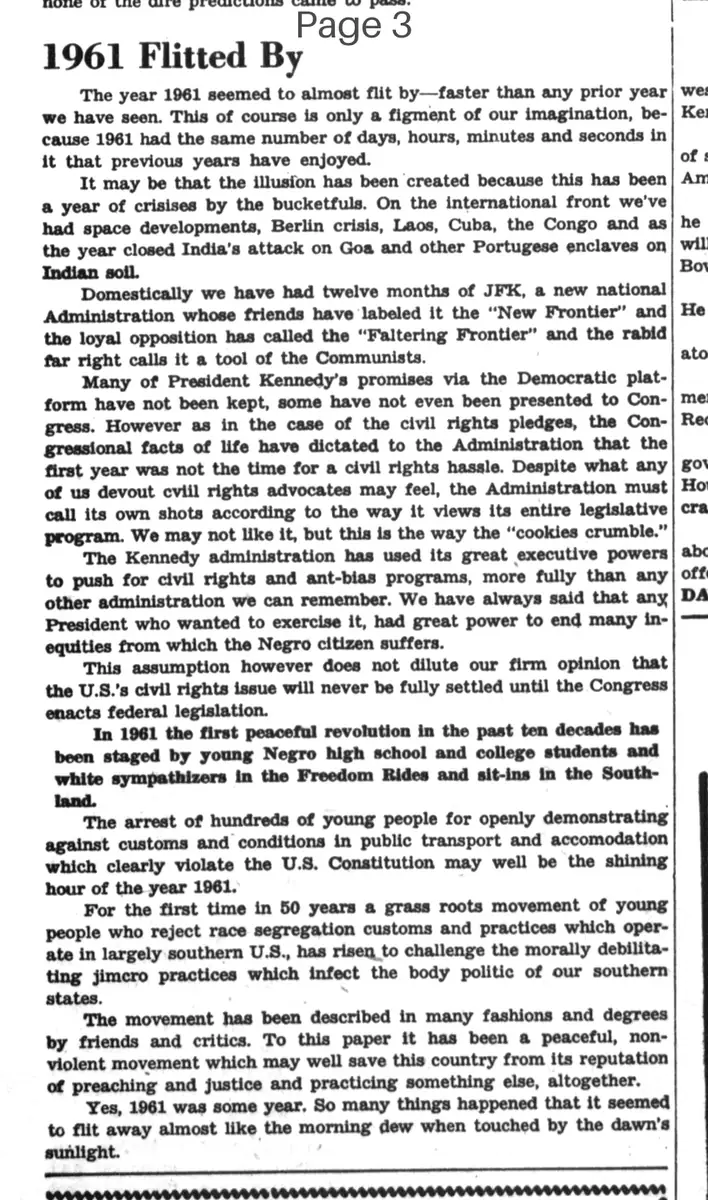
1961 Flitted By
The year 1961 seemed to almost flit by—faster than any prior year we have seen. This of course is only a figment of our imagination, because 1961 had the same number of days, hours, minutes and seconds in it that previous years have enjoyed.
It may be that the illusion has been created because this has been a year of crises by the bucketfuls. On the international front we've had space developments, Berlin crisis, Laos, Cuba, the Congo and as the year closed India's attack on Goa and other Portuguese enclaves on Indian soil.
Domestically we have had twelve months of JFK, a new national Administration whose friends have labeled it the "New Frontier" and the loyal opposition has called the "Faltering Frontier" and the rabid far right calls it a tool of the Communists.
Many of President Kennedy's promises via the Democratic platform have not been kept, some have not even been presented to Congress. However as in the case of the civil rights pledges, the Congressional facts of life have dictated to the Administration that the first year was not the time for a civil rights hassle. Despite what any of us devout civil rights advocates may feel, the Administration must call its own shots according to the way it views its entire legislative program. We may not like it, but this is the way the "cookies crumble."
The Kennedy administration has used its great executive powers to push for civil rights and ant-bias programs, more fully than any other administration we can remember. We have always said that any President who wanted to exercise it, had great power to end many inequities from which the Negro citizen suffers.
This assumption however does not dilute our firm opinion that the U.S.'s civil rights issue will never be fully settled until the Congress enacts federal legislation.
In 1961 the first peaceful revolution in the past ten decades has been staged by young Negro high school and college students and white sympathizers in the Freedom Rides and sit-ins in the Southland.
The arrest of hundreds of young people for openly demonstrating against customs and conditions in public transport and accommodation which clearly violate the U.S. Constitution may well be the shining hour of the year 1961.
For the first time in 50 years a grass roots movement of young people who reject race segregation customs and practices which operate in largely southern U.S., has risen to challenge the morally debilitating jim crow practices which infect the body politic of our southern states.
The movement has been described in many fashions and degrees by friends and critics. To this paper it has been a peaceful, non-violent movement which may well save this country from its reputation of preaching one thing and practicing something else, altogether.
Yes, 1961 was some year. So many things happened that it seemed to flit away almost like the morning dew when touched by the dawn's sunlight.
The year 1961 seemed to almost flit by—faster than any prior year we have seen. This of course is only a figment of our imagination, because 1961 had the same number of days, hours, minutes and seconds in it that previous years have enjoyed.
It may be that the illusion has been created because this has been a year of crises by the bucketfuls. On the international front we've had space developments, Berlin crisis, Laos, Cuba, the Congo and as the year closed India's attack on Goa and other Portuguese enclaves on Indian soil.
Domestically we have had twelve months of JFK, a new national Administration whose friends have labeled it the "New Frontier" and the loyal opposition has called the "Faltering Frontier" and the rabid far right calls it a tool of the Communists.
Many of President Kennedy's promises via the Democratic platform have not been kept, some have not even been presented to Congress. However as in the case of the civil rights pledges, the Congressional facts of life have dictated to the Administration that the first year was not the time for a civil rights hassle. Despite what any of us devout civil rights advocates may feel, the Administration must call its own shots according to the way it views its entire legislative program. We may not like it, but this is the way the "cookies crumble."
The Kennedy administration has used its great executive powers to push for civil rights and ant-bias programs, more fully than any other administration we can remember. We have always said that any President who wanted to exercise it, had great power to end many inequities from which the Negro citizen suffers.
This assumption however does not dilute our firm opinion that the U.S.'s civil rights issue will never be fully settled until the Congress enacts federal legislation.
In 1961 the first peaceful revolution in the past ten decades has been staged by young Negro high school and college students and white sympathizers in the Freedom Rides and sit-ins in the Southland.
The arrest of hundreds of young people for openly demonstrating against customs and conditions in public transport and accommodation which clearly violate the U.S. Constitution may well be the shining hour of the year 1961.
For the first time in 50 years a grass roots movement of young people who reject race segregation customs and practices which operate in largely southern U.S., has risen to challenge the morally debilitating jim crow practices which infect the body politic of our southern states.
The movement has been described in many fashions and degrees by friends and critics. To this paper it has been a peaceful, non-violent movement which may well save this country from its reputation of preaching one thing and practicing something else, altogether.
Yes, 1961 was some year. So many things happened that it seemed to flit away almost like the morning dew when touched by the dawn's sunlight.
What sub-type of article is it?
Social Reform
Foreign Affairs
Partisan Politics
What keywords are associated?
1961 Review
Civil Rights
Kennedy Administration
Freedom Rides
Sit Ins
International Crises
Segregation
New Frontier
What entities or persons were involved?
President Kennedy
Jfk
Negro Citizens
Young Students
Congress
Democratic Platform
Editorial Details
Primary Topic
Review Of 1961 Crises And Civil Rights Advancements
Stance / Tone
Supportive Of Civil Rights Movement And Reflective On Kennedy Administration
Key Figures
President Kennedy
Jfk
Negro Citizens
Young Students
Congress
Democratic Platform
Key Arguments
1961 Felt Faster Due To Numerous Crises
International Crises Included Space Developments, Berlin, Laos, Cuba, Congo, India's Goa Attack
Kennedy's Promises Partially Unfulfilled Due To Congressional Realities
Executive Actions Advanced Civil Rights More Than Prior Administrations
Federal Legislation Needed To Fully Settle Civil Rights
Freedom Rides And Sit Ins As Peaceful Revolution Against Segregation
Arrests Of Demonstrators Highlight Constitutional Violations
Grassroots Movement Challenges Jim Crow Practices