Thank you for visiting SNEWPapers!
Sign up free
The Theocrat
Zion, Lake County County, Illinois
What is this article about?
British scientist Dr. Harold J. Plenderleith at the British Museum is deciphering blackened ancient Hebrew Old Testament scrolls from a Dead Sea cave in Jordan, discovered two years ago by an Arab boy. After three months, he has separated about 100 pieces for experts to read.
Clipping
OCR Quality
Full Text
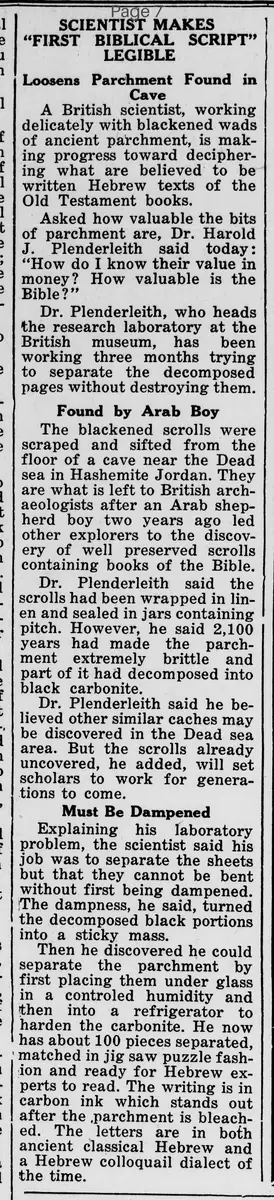
Loosens Parchment Found in Cave
A British scientist, working delicately with blackened wads of ancient parchment, is making progress toward deciphering what are believed to be written Hebrew texts of the Old Testament books.
Asked how valuable the bits of parchment are, Dr. Harold J. Plenderleith said today:
"How do I know their value in money? How valuable is the Bible?"
Dr. Plenderleith, who heads the research laboratory at the British museum, has been working three months trying to separate the decomposed pages without destroying them.
Found by Arab Boy
The blackened scrolls were scraped and sifted from the floor of a cave near the Dead Sea in Hashemite Jordan. They are what is left to British archaeologists after an Arab shepherd boy two years ago led other explorers to the discovery of well preserved scrolls containing books of the Bible.
Dr. Plenderleith said the scrolls had been wrapped in linen and sealed in jars containing pitch. However, he said 2,100 years had made the parchment extremely brittle and part of it had decomposed into black carbonite.
Dr. Plenderleith said he believed other similar caches may be discovered in the Dead Sea area. But the scrolls already uncovered, he added, will set scholars to work for generations to come.
Must Be Dampened
Explaining his laboratory problem, the scientist said his job was to separate the sheets but that they cannot be bent without first being dampened.
The dampness, he said, turned the decomposed black portions into a sticky mass.
Then he discovered he could separate the parchment by first placing them under glass in a controlled humidity and then into a refrigerator to harden the carbonite. He now has about 100 pieces separated, matched in jig saw puzzle fashion and ready for Hebrew experts to read. The writing is in carbon ink which stands out after the parchment is bleached. The letters are in both ancient classical Hebrew and a Hebrew colloquial dialect of the time.
What sub-type of article is it?
What keywords are associated?
What entities or persons were involved?
Where did it happen?
Foreign News Details
Primary Location
Cave Near The Dead Sea In Hashemite Jordan
Event Date
Two Years Ago For Discovery; Three Months Of Work As Of Today
Key Persons
Outcome
about 100 pieces separated, matched in jig saw puzzle fashion and ready for hebrew experts to read
Event Details
A British scientist, Dr. Harold J. Plenderleith, heads the research laboratory at the British Museum and has been working three months to separate decomposed pages of blackened ancient parchment scrolls without destroying them. The scrolls, believed to be written Hebrew texts of Old Testament books, were scraped from a cave floor near the Dead Sea in Hashemite Jordan. They were found two years ago by an Arab shepherd boy who led explorers to well-preserved scrolls. The blackened scrolls were wrapped in linen and sealed in jars with pitch, but 2,100 years made the parchment brittle and partly decomposed into black carbonite. Dr. Plenderleith separates sheets by dampening, controlling humidity under glass, and refrigerating to harden carbonite. The writing is in carbon ink on bleached parchment, in ancient classical Hebrew and a Hebrew colloquial dialect.