Thank you for visiting SNEWPapers!
Sign up free
Norfolk Gazette And Publick Ledger
Norfolk, Virginia
What is this article about?
In 1813, a Norfolk County freeholder writes to the Ledger editor, denouncing the French Emperor's claim that the U.S. is at war to enforce free ships make free goods, citing historical treaties showing U.S. rejection of this principle. He criticizes U.S. policies as French-influenced and ruinous, calling for new representatives to prevent national disaster.
Merged-components note: Continuation of the same letter to the editor from 'A Norfolk County Freeholder'; split by OCR across components.
Clippings
1 of 2
OCR Quality
Full Text
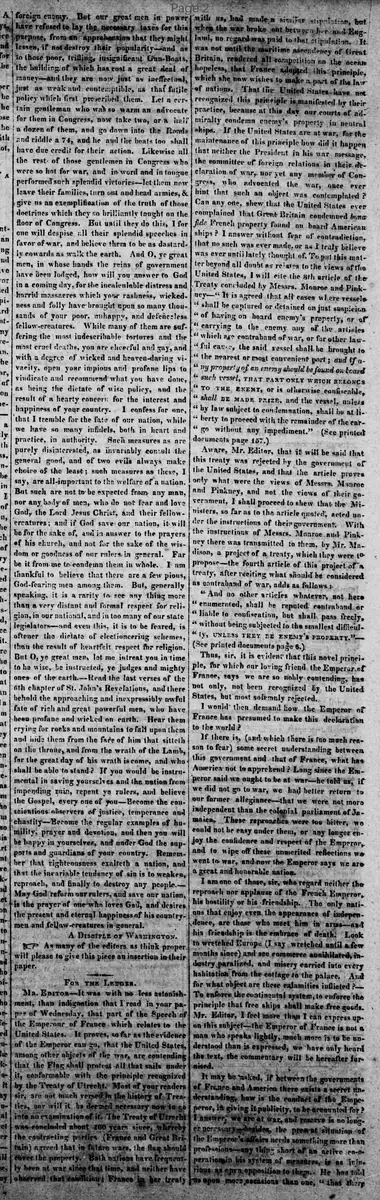
Mr. Editor It was with no less astonishment, than indignation that I read in your paper of Wednesday, that part of the Speech of the Emperor of France which relates to the United States. It proves, so far as the evidence of the Emperor can go, that the United States, among other objects of the war, are contending that the Flag shall protect all that sails under it, conformable with the principle recognized by the Treaty of Utrecht Most of your readers sir, are not much versed in the history of Treaties, nor will it be deemed necessary now to go into an examination of it- The Treaty of Utrecht was concluded about 100 years since, whereby the contracting parties (France and Great Britain) agreed that in future wars, the Flag should cover the property. Both nations have frequently been at war since that time, and neither have observed that condition; France in her treaty with us, had made a similar stipulation, but when the war broke out between her and England, no regard was paid to that stipulation. It was not until the maritime ascendency of Great Britain, rendered all competition on the ocean hopeless, that France adopted this principle, which she now wishes to make a part of the law of nations. That the United States have not recognized this principle is manifested by their practice, because at this day our courts of admiralty condemn enemy's property in neutral ships.. If the United States are at war for the maintenance of this principle how did it happen that neither the President in his war message, the committee of foreign relations in their declaration of war, nor yet any member of Congress, who advocated the war, once ever hint that such an object was contemplated ?
Can any one, shew that the United States ever complained that Great Britain condemned bona fide French property found on board American ships ? I answer without fear of contradiction, that no such was ever made, or as I truly believe was ever until lately thought of. To put this matter beyond all doubt as relates to the views of the United States, I will cite the 8th article of the Treaty concluded by Messrs. Monroe and Pinkney-" It is agreed that all cases where vessels shall be captured or detained on just suspicion " of having on board enemy's property, or of " carrying to the enemy any of the articles " which are contraband of war, or for other law- " ful cause, the said vessel shall be brought to " the nearest or most convenient port; and if any " property of an enemy should be found on board " SUCH VESSEL, THAT PART ONLY WHICH BELONGS " TO THE ENEMY, or is otherwise contraband or " liable to condemnation, " shall BE MADE prize, and the vessel, unless " by law subject to condemnation, shall be at li- " berty to proceed with the remainder of the car- " go without any impediment." (See printed documents page 157.)
Aware, Mr. Editor, that it will be said that this treaty was rejected by the government of the United States, and that the article proves only what were the views of Messrs. Monroe and Pinkney, and not the views of their government, I shall proceed to shew that the Ministers, so far as to the article quoted, acted under the instructions of their government. With the instructions of Messrs. Monroe and Pinkney there was transmitted to them, by Mr. Madison, a project of a treaty, which they were to propose-the fourth article of this project of a treaty, after reciting what should be considered as contraband of war, adds as follows : "And no other articles whatever, not here " enumerated, shall be reputed contraband or " liable to confiscation, but shall pass freely, " without being subjected to the smallest difficul- " ty, UNLESS THEY BE ENEMY'S PROPERTY."
(See printed documents page 6.)
Thus, sir, it is evident that this novel principle, for which our loving friend the Emperor of France, says we are so nobly contending, has not only, not been recognized by the United States, but most solemnly rejected..
I would then demand how the Emperor of France has presumed to make this declaration to the world ?
470
If there is, (and which there is too much reason to fear) some secret understanding between this government and that of France, what has America not to apprehend ? Long since the Emperor said we ought to be at war he told us, if we did not go to war, we had better return to our former allegiance--that we were not more independent than the colonial parliament of Jamaica. These reproaches were too bitter, we could not be easy under them, or any longer en- joy the confidence and respect of the Emperor, and to wipe off these unmerited reflections we went to war, and now the Emperor says we are a great and honorable nation.
I am one of those, sir, who regard neither the reproach nor applause of the French Emperor, his hostility or his friendship.. The only nations that enjoy even the appearance of independence, are those who meet him in arms and his friendship is the embrace of death. Look to wretched Europe (I say wretched until a few months since) and see commerce annihilated, industry paralyzed, and misery carried into every habitation from the cottage to the palace. And for what object are these calamities inflicted ?- To enforce the continental system, to enforce the principle that free ships shall make free goods.
Mr. Editor, I feel more than I can express upon this subject-the Emperor of France is not a man who speaks lightly, much more is to be understood than is expressed, we have only heard the text, the commentary will be hereafter furnished.
It may be asked, if between the governments of France and America there exists a secret understanding, how is the conduct of the Emperor, in giving it publicity. to be accounted for? I answer we are at war and reserve is no longer necessary besides, the present situation of The Emperor of affairs needs something more than protestations- any thing short of an active co-operation in his system of measures, is as injurious as clear opposition to them He has told upon more occasions than one, " that there
There could be no neutrals. His situation is desperate and he must subdue or be subdued but God forbid that the destiny of America should hang upon the fate of Bonaparte.
When a dispassionate view is taken of most of the leading measures of our government for the last six years, beginning with non-importation, embargo, non-intercourse, and finally war, we look in vain for sufficient visible causes for measures, that all now agree have produced ruin and discontent, without a single advantage. The three first have been abandoned by their advocates, but not until experience had demonstrated their mischievous effects, and so will our present rulers abandon this war, but I fear not until they have brought the nation to the verge of ruin—then justly alarmed, they will endeavor to preserve a remnant of character and security to themselves, by a disgraceful peace.
Experience has proven that they who most rashly enter upon war, prosecute it with imbecility, and conclude it with disgrace.
To avoid the dangers with which the country is threatened, the people must change their representatives; their voice thus expressed will shew to the executive their sense of past measures, and suggest what their future expectations are. When I attend an election ground, I hear it said "Let us support our government in this hour of trial."—So say I. But I will not give my confidence to the men who have proved themselves unequal to the duties of their stations, men who have brought this country from the most enviable to the most miserable condition.
It is very convenient for men in power to have it understood that they and the government are one and the same; judging from what we see and feel, I am inclined to think they consider them as one and the same; as their measures promote only their own views, and the fortunes of those who enjoy posts under them.
I wish Mr. Editor to reflect upon no particular man, or set of men, and I can very well believe that a man of honor and patriotism can hold a post under government, and act with independence, but while man is man, it were next to folly to expect to hear a member of this government, or one of its dependents, censure its measures.
In the choice of a representative, the people it is to be hoped, will endeavor to select a man of sound good understanding, a fair and honest private reputation, one who has not mingled in those political controversies, that have distracted our country for so many years past, and which in despite of the best intentions, but too often mislead the judgment. To make choice of a man, who has participated in no ordinary degree in all the measures of which we complain, is to act against our interests and our reason. But the pride of party, and that rancorous spirit which it produces, is appealed to; Republicanism and Federalism are the watch words, and the interests of the nation are sacrificed on the altar of prejudice.
A Norfolk County Freeholder.
April 15th, 1813.
What sub-type of article is it?
What themes does it cover?
What keywords are associated?
What entities or persons were involved?
Letter to Editor Details
Author
A Norfolk County Freeholder
Recipient
Mr. Editor
Main Argument
the united states is not fighting the war to uphold the principle that the flag protects all property under it, as claimed by the french emperor; this principle has been rejected in u.s. treaties and practice. the author criticizes government measures leading to war as misguided and influenced by france, urging voters to elect new representatives to avoid ruin.
Notable Details