Thank you for visiting SNEWPapers!
Sign up free
Literary
August 10, 1822
Alexandria Gazette & Advertiser
Alexandria, Virginia
What is this article about?
Descriptive sketches from 'Notices of East Florida' detail Silver Spring's crystal-clear waters on Lake George, surrounding forests, fish, and the region's abundant lakes, ponds, and savannas, noting unique topographical features and conjectured underground water connections.
Clipping
OCR Quality
95%
Excellent
Full Text
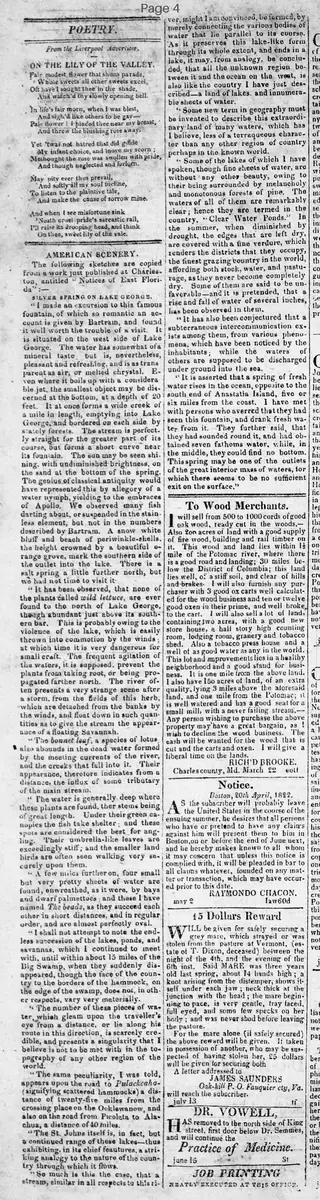
AMERICAN SCENERY.
The following sketches are copied from a work just published at Charleston, entitled "Notices of East Florida":—
SILVER SPRING ON LAKE GEORGE.
"I made an excursion to this famous fountain, of which so romantic an account is given by Bartram, and found it well worth the trouble of a visit. It is situated on the west side of Lake George. The water has somewhat of a mineral taste but is, nevertheless, pleasant and refreshing, and is as transparent as air, or melted crystal. Even where it boils up with a considerable jet, the smallest object may be discerned at the bottom, at a depth of 20 feet. It at once forms a wide creek of a mile in length, emptying into Lake George, and bordered on each side by stately forests. The stream is perfectly straight for the greater part of its course, but forms a short curve near its fountain. The sun may be seen shining with undiminished brightness, on the sand at the bottom of the spring. The genius of classical antiquity would have represented this by allegory of a water nymph, yielding to the embraces of Apollo. We observed many fish darting about, or suspended in the stainless element, but not in the numbers described by Bartram. A snow white bluff and beach of periwinkle-shells, the height crowned by a beautiful orange grove, mark the southern side of the outlet into the lake. There is a salt spring a little further north, but we had not time to visit it:
"It has been observed, that none of the plants called wild lettuce, are ever found to the north of Lake George, though abundant just above its southern bar. This is probably owing to the violence of the lake, which is easily thrown into commotion by the winds: at which time it is very dangerous for small craft. The frequent agitation of the waters, it is supposed, prevent the plants from taking root, or being propagated farther north. The river often presents a very strange scene after a storm, from the fields of this herb, which are detached from the banks by the winds, and float down in such quantities as to give the stream the appearance of a floating Savannah.
"The bonnet leaf, a species of lotus also abounds in the dead water formed by the meeting currents of the river, and the creeks that fall into it. Their appearance, therefore indicates from a distance, the influx of some tributary of the main stream.
"The water is generally deep where these plants are found, their stems being of great length. Under their green canopies the fish take shelter: and these spots are considered the best for angling. Their umbrella-like leaves are exceedingly stiff; and the smaller land birds are often seen walking very securely upon them.
"A few miles further on, four small but very pretty sheets of water are found, enwreathed, as it were, by bays and dwarf palmettoes: and these I have named The Beads, as they succeed each other in short distances, and in regular order, and are almost perfectly oval.
"I shall not attempt to note the endless succession of the lakes, ponds, and savannas, which I continued to meet with, until within about 15 miles of the Big Swamp, when they suddenly disappeared, though the face of the country to the borders of the hammock, on the edge of the swamp, does not, in other respects, vary very materially.
"The number of these pieces of water which gleam upon the traveller's eye from a distance, or lie along his route in this direction, is scarcely credible, and presents a singularity that I believe is not to be met with in the topography of any other region of the world.
"The same peculiarity, I was told, appears upon the road to Pcolata (signifying scattered hammocks) a distance of twenty-five miles from the crossing place on the Ocklawaha, and also on the road from Picolata to Alachua, a distance of 40 miles.
"The St. Johns itself is, in fact, but a continued range of those lakes—thus exhibiting, in its chief features, a striking analogy to the nature of the country through which it flows.
"So much is this the case, that a stream, similar in all respects to this river, might, I am convinced, be formed, by merely connecting the various bodies of water that lie parallel to its course. As it preserves this lake-like form through its whole extent, and ends in a lake, it may, from analogy, be concluded: that all the unknown region between it and the ocean on the west, is also like the country I have just described a land of lakes, and innumerable sheets of water.
"Some new term in geography must be invented to describe this extraordinary land of many waters, which has, I believe, less of a terraqueous character than any other region of country perhaps in the known world.
"Some of the lakes of which I have spoken, though fine sheets of water, are without any other beauty, owing to their being surrounded by melancholy and monotonous forests of pine. The waters of all of them are remarkably clear: hence they are termed in the country, "Clear Water Ponds." In the summer, when diminished by drought, the edges that are left dry, are covered with a fine verdure, which renders the districts that they occupy, the finest grazing country in the world, affording both stock, water, and pasture, as they never become completely dry. Some of them are said to be unfathomable—and it is pretended, that a rise and fall of water of several inches, has been observed in them,
"It has also been conjectured that a subterraneous intercommunication exists among them, from various phenomena, which have been noticed by the inhabitants: while the waters of others are supposed to be discharged under ground into the sea.
"It is asserted that a spring of fresh water rises in the ocean, opposite to the south end of Anastasia Island, five or six miles from the coast. I have met with persons who averred that they had seen this fountain, and drank fresh water from it. They further said, that they had sounded round it, and had obtained seven fathoms water, while, in the middle, they could find no bottom. This spring may be one of the outlets of the great interior mass of waters, for which there seems to be no sufficient exit on the surface."
The following sketches are copied from a work just published at Charleston, entitled "Notices of East Florida":—
SILVER SPRING ON LAKE GEORGE.
"I made an excursion to this famous fountain, of which so romantic an account is given by Bartram, and found it well worth the trouble of a visit. It is situated on the west side of Lake George. The water has somewhat of a mineral taste but is, nevertheless, pleasant and refreshing, and is as transparent as air, or melted crystal. Even where it boils up with a considerable jet, the smallest object may be discerned at the bottom, at a depth of 20 feet. It at once forms a wide creek of a mile in length, emptying into Lake George, and bordered on each side by stately forests. The stream is perfectly straight for the greater part of its course, but forms a short curve near its fountain. The sun may be seen shining with undiminished brightness, on the sand at the bottom of the spring. The genius of classical antiquity would have represented this by allegory of a water nymph, yielding to the embraces of Apollo. We observed many fish darting about, or suspended in the stainless element, but not in the numbers described by Bartram. A snow white bluff and beach of periwinkle-shells, the height crowned by a beautiful orange grove, mark the southern side of the outlet into the lake. There is a salt spring a little further north, but we had not time to visit it:
"It has been observed, that none of the plants called wild lettuce, are ever found to the north of Lake George, though abundant just above its southern bar. This is probably owing to the violence of the lake, which is easily thrown into commotion by the winds: at which time it is very dangerous for small craft. The frequent agitation of the waters, it is supposed, prevent the plants from taking root, or being propagated farther north. The river often presents a very strange scene after a storm, from the fields of this herb, which are detached from the banks by the winds, and float down in such quantities as to give the stream the appearance of a floating Savannah.
"The bonnet leaf, a species of lotus also abounds in the dead water formed by the meeting currents of the river, and the creeks that fall into it. Their appearance, therefore indicates from a distance, the influx of some tributary of the main stream.
"The water is generally deep where these plants are found, their stems being of great length. Under their green canopies the fish take shelter: and these spots are considered the best for angling. Their umbrella-like leaves are exceedingly stiff; and the smaller land birds are often seen walking very securely upon them.
"A few miles further on, four small but very pretty sheets of water are found, enwreathed, as it were, by bays and dwarf palmettoes: and these I have named The Beads, as they succeed each other in short distances, and in regular order, and are almost perfectly oval.
"I shall not attempt to note the endless succession of the lakes, ponds, and savannas, which I continued to meet with, until within about 15 miles of the Big Swamp, when they suddenly disappeared, though the face of the country to the borders of the hammock, on the edge of the swamp, does not, in other respects, vary very materially.
"The number of these pieces of water which gleam upon the traveller's eye from a distance, or lie along his route in this direction, is scarcely credible, and presents a singularity that I believe is not to be met with in the topography of any other region of the world.
"The same peculiarity, I was told, appears upon the road to Pcolata (signifying scattered hammocks) a distance of twenty-five miles from the crossing place on the Ocklawaha, and also on the road from Picolata to Alachua, a distance of 40 miles.
"The St. Johns itself is, in fact, but a continued range of those lakes—thus exhibiting, in its chief features, a striking analogy to the nature of the country through which it flows.
"So much is this the case, that a stream, similar in all respects to this river, might, I am convinced, be formed, by merely connecting the various bodies of water that lie parallel to its course. As it preserves this lake-like form through its whole extent, and ends in a lake, it may, from analogy, be concluded: that all the unknown region between it and the ocean on the west, is also like the country I have just described a land of lakes, and innumerable sheets of water.
"Some new term in geography must be invented to describe this extraordinary land of many waters, which has, I believe, less of a terraqueous character than any other region of country perhaps in the known world.
"Some of the lakes of which I have spoken, though fine sheets of water, are without any other beauty, owing to their being surrounded by melancholy and monotonous forests of pine. The waters of all of them are remarkably clear: hence they are termed in the country, "Clear Water Ponds." In the summer, when diminished by drought, the edges that are left dry, are covered with a fine verdure, which renders the districts that they occupy, the finest grazing country in the world, affording both stock, water, and pasture, as they never become completely dry. Some of them are said to be unfathomable—and it is pretended, that a rise and fall of water of several inches, has been observed in them,
"It has also been conjectured that a subterraneous intercommunication exists among them, from various phenomena, which have been noticed by the inhabitants: while the waters of others are supposed to be discharged under ground into the sea.
"It is asserted that a spring of fresh water rises in the ocean, opposite to the south end of Anastasia Island, five or six miles from the coast. I have met with persons who averred that they had seen this fountain, and drank fresh water from it. They further said, that they had sounded round it, and had obtained seven fathoms water, while, in the middle, they could find no bottom. This spring may be one of the outlets of the great interior mass of waters, for which there seems to be no sufficient exit on the surface."
What sub-type of article is it?
Essay
Journey Narrative
What themes does it cover?
Nature
What keywords are associated?
Silver Spring
Lake George
East Florida
Clear Waters
Lakes And Ponds
Natural Scenery
Travel Description
Literary Details
Title
Silver Spring On Lake George
Subject
Description Of East Florida Scenery
Form / Style
Descriptive Travel Prose
Key Lines
It Is Situated On The West Side Of Lake George. The Water Has Somewhat Of A Mineral Taste But Is, Nevertheless, Pleasant And Refreshing, And Is As Transparent As Air, Or Melted Crystal.
The Sun May Be Seen Shining With Undiminished Brightness, On The Sand At The Bottom Of The Spring.
The Number Of These Pieces Of Water Which Gleam Upon The Traveller's Eye From A Distance, Or Lie Along His Route In This Direction, Is Scarcely Credible, And Presents A Singularity That I Believe Is Not To Be Met With In The Topography Of Any Other Region Of The World.