Thank you for visiting SNEWPapers!
Sign up free
Story
January 7, 1927
The Osceola Times
Osceola, Mississippi County, Arkansas
What is this article about?
A new German invention uses radio signals to control train movements and prevent collisions by automatically warning or braking following trains on the same track, with potential for parallel tracks and head-on avoidance.
Clipping
OCR Quality
98%
Excellent
Full Text
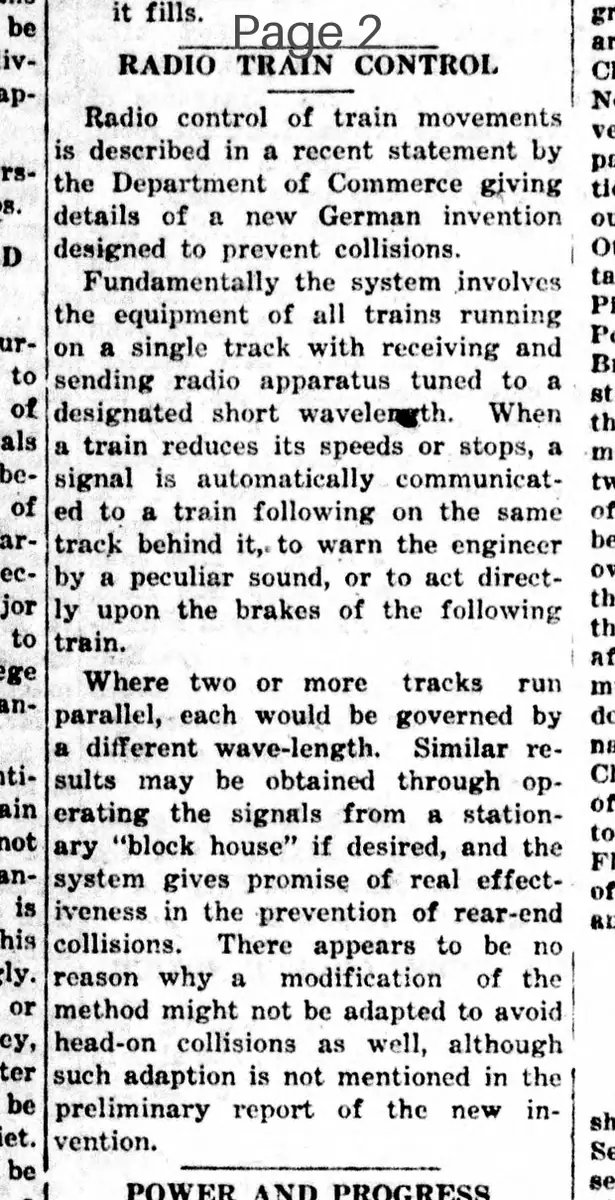
RADIO TRAIN CONTROL
Radio control of train movements is described in a recent statement by the Department of Commerce giving details of a new German invention designed to prevent collisions.
Fundamentally the system involves the equipment of all trains running on a single track with receiving and sending radio apparatus tuned to a designated short wavelength. When a train reduces its speed or stops, a signal is automatically communicated to a train following on the same track behind it, to warn the engineer by a peculiar sound, or to act directly upon the brakes of the following train.
Where two or more tracks run parallel, each would be governed by a different wave-length. Similar results may be obtained through operating the signals from a stationary "block house" if desired, and the system gives promise of real effectiveness in the prevention of rear-end collisions. There appears to be no reason why a modification of the method might not be adapted to avoid head-on collisions as well, although such adaptation is not mentioned in the preliminary report of the new invention.
Radio control of train movements is described in a recent statement by the Department of Commerce giving details of a new German invention designed to prevent collisions.
Fundamentally the system involves the equipment of all trains running on a single track with receiving and sending radio apparatus tuned to a designated short wavelength. When a train reduces its speed or stops, a signal is automatically communicated to a train following on the same track behind it, to warn the engineer by a peculiar sound, or to act directly upon the brakes of the following train.
Where two or more tracks run parallel, each would be governed by a different wave-length. Similar results may be obtained through operating the signals from a stationary "block house" if desired, and the system gives promise of real effectiveness in the prevention of rear-end collisions. There appears to be no reason why a modification of the method might not be adapted to avoid head-on collisions as well, although such adaptation is not mentioned in the preliminary report of the new invention.
What sub-type of article is it?
Curiosity
Extraordinary Event
What themes does it cover?
Triumph
What keywords are associated?
Radio Train Control
German Invention
Collision Prevention
Railway Safety
Automatic Braking
Where did it happen?
Germany
Story Details
Location
Germany
Event Date
Recent
Story Details
Description of a German radio-based system for trains to automatically signal speed reductions or stops to following trains, preventing rear-end collisions, with potential for parallel tracks and head-on avoidance.