Thank you for visiting SNEWPapers!
Sign up free
Literary
April 30, 1791
Gazette Of The United States
New York, New York County, New York
What is this article about?
Translation of Étienne de La Boétie's 'Discourse on Voluntary Servitude,' critiquing monarchy and exploring why people endure tyranny from a single ruler despite having the power to resist. References Homer's Ulysses to argue against multiple or single masters, favoring republics implicitly.
Clipping
OCR Quality
95%
Excellent
Full Text
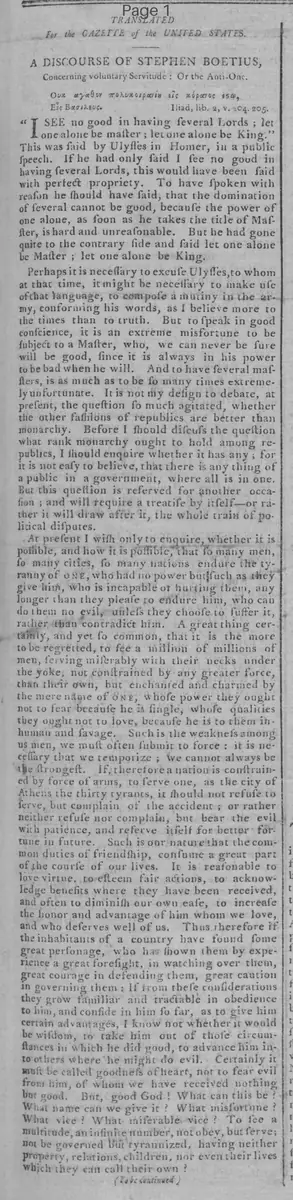
TRANSLATED
For the GAZETTE of the UNITED STATES.
A DISCOURSE OF STEPHEN BOETIUS,
Concerning voluntary Servitude: Or the Anti-One.
Oun ayaθov ποluxospavin eis nópavos ssw,
Eis BaoIλeUs.
Iliad, lib. 2, v. 204. 205.
"I SEE no good in having several Lords: let
one alone be master; let one alone be King."
This was said by Ulysses in Homer, in a public
speech. If he had only said I see no good in
having several Lords, this would have been said
with perfect propriety. To have spoken with
reason he should have said, that the domination
of several cannot be good, because the power of
one alone, as soon as he takes the title of Mas-
ter, is hard and unreasonable. But he had gone
quite to the contrary side and said let one alone
be Master; let one alone be King.
Perhaps it is necessary to excuse Ulysses, to whom
at that time, it might be necessary to make use
of that language, to compose a mutiny in the ar-
my, conforming his words, as I believe more to
the times than to truth. But to speak in good
conscience, it is an extreme misfortune to be
subject to a Master, who, we can never be sure
will be good, since it is always in his power
to be bad when he will. And to have several mas-
ters, is as much as to be so many times extreme-
ly unfortunate. It is not my design to debate, at
present, the question so much agitated, whether
the other fashions of republics are better than
monarchy. Before I should discuss the question
what rank monarchy ought to hold among re-
publics, I should enquire whether it has any; for
it is not easy to believe, that there is any thing of
a public in a government, where all is in one.
But this question is reserved for another occa-
sion; and will require a treatise by itself—or ra-
ther it will draw after it, the whole train of po-
litical disputes.
At present I wish only to enquire whether it is
possible, and how it is possible, that so many men,
so many cities, so many nations endure the ty-
ranny of so one, who had no power but such as they
give him, who is incapable of hurting them, any
longer than they please to endure him, who can
do them no evil, unless they choose to suffer it,
rather than contradict him. A great thing cer-
tainly, and yet so common, that it is the more
to be regretted, to see a million of millions of
men, serving miserably with their necks under
the yoke, not constrained by any greater force,
than their own, but enchanted and charmed by
the mere name of one, whose power they ought
not to fear because he is single, whose qualities
they ought not to love, because he is to them in-
human and savage. Such is the weakness among
us men, we must often submit to force: it is ne-
cessary that we temporize; we cannot always be
the strongest. If, therefore a nation is constrain-
ed by force of arms, to serve one, as the city of
Athens the thirty tyrants, it should not refuse to
serve, but complain of the accident; or rather
neither refuse nor complain, but bear the evil
with patience, and reserve itself for better for-
tune in future. Such is our nature that the com-
mon duties of friendship, consume a great part
of the course of our lives. It is reasonable to
love virtue, to esteem fair actions, to acknow-
ledge benefits where they have been received,
and often to diminish our own ease, to increase
the honor and advantage of him whom we love,
and who deserves well of us. Thus therefore if
the inhabitants of a country have found some
great personage, who has shown them by expe-
rience a great foresight, in watching over them,
great courage in defending them, great caution
in governing them: If from these considerations
they grow familiar and tractable in obedience
to him, and confide in him so far, as to give him
certain advantages, I know not whether it would
be wisdom to take him out of those circum-
stances in which he did good, to advance him in-
to others where he might do evil. Certainly it
must be called goodness of heart, not to fear evil
from him, of whom we have received nothing
but good. But, good God! What can this be?
What name can we give it? What misfortune?
What vice? What miserable vice? To see a
multitude, an infinite number, not obey, but serve;
not be governed but tyrannized, having neither
property, relations, children, nor even their lives
which they can call their own?
(To be continued)
For the GAZETTE of the UNITED STATES.
A DISCOURSE OF STEPHEN BOETIUS,
Concerning voluntary Servitude: Or the Anti-One.
Oun ayaθov ποluxospavin eis nópavos ssw,
Eis BaoIλeUs.
Iliad, lib. 2, v. 204. 205.
"I SEE no good in having several Lords: let
one alone be master; let one alone be King."
This was said by Ulysses in Homer, in a public
speech. If he had only said I see no good in
having several Lords, this would have been said
with perfect propriety. To have spoken with
reason he should have said, that the domination
of several cannot be good, because the power of
one alone, as soon as he takes the title of Mas-
ter, is hard and unreasonable. But he had gone
quite to the contrary side and said let one alone
be Master; let one alone be King.
Perhaps it is necessary to excuse Ulysses, to whom
at that time, it might be necessary to make use
of that language, to compose a mutiny in the ar-
my, conforming his words, as I believe more to
the times than to truth. But to speak in good
conscience, it is an extreme misfortune to be
subject to a Master, who, we can never be sure
will be good, since it is always in his power
to be bad when he will. And to have several mas-
ters, is as much as to be so many times extreme-
ly unfortunate. It is not my design to debate, at
present, the question so much agitated, whether
the other fashions of republics are better than
monarchy. Before I should discuss the question
what rank monarchy ought to hold among re-
publics, I should enquire whether it has any; for
it is not easy to believe, that there is any thing of
a public in a government, where all is in one.
But this question is reserved for another occa-
sion; and will require a treatise by itself—or ra-
ther it will draw after it, the whole train of po-
litical disputes.
At present I wish only to enquire whether it is
possible, and how it is possible, that so many men,
so many cities, so many nations endure the ty-
ranny of so one, who had no power but such as they
give him, who is incapable of hurting them, any
longer than they please to endure him, who can
do them no evil, unless they choose to suffer it,
rather than contradict him. A great thing cer-
tainly, and yet so common, that it is the more
to be regretted, to see a million of millions of
men, serving miserably with their necks under
the yoke, not constrained by any greater force,
than their own, but enchanted and charmed by
the mere name of one, whose power they ought
not to fear because he is single, whose qualities
they ought not to love, because he is to them in-
human and savage. Such is the weakness among
us men, we must often submit to force: it is ne-
cessary that we temporize; we cannot always be
the strongest. If, therefore a nation is constrain-
ed by force of arms, to serve one, as the city of
Athens the thirty tyrants, it should not refuse to
serve, but complain of the accident; or rather
neither refuse nor complain, but bear the evil
with patience, and reserve itself for better for-
tune in future. Such is our nature that the com-
mon duties of friendship, consume a great part
of the course of our lives. It is reasonable to
love virtue, to esteem fair actions, to acknow-
ledge benefits where they have been received,
and often to diminish our own ease, to increase
the honor and advantage of him whom we love,
and who deserves well of us. Thus therefore if
the inhabitants of a country have found some
great personage, who has shown them by expe-
rience a great foresight, in watching over them,
great courage in defending them, great caution
in governing them: If from these considerations
they grow familiar and tractable in obedience
to him, and confide in him so far, as to give him
certain advantages, I know not whether it would
be wisdom to take him out of those circum-
stances in which he did good, to advance him in-
to others where he might do evil. Certainly it
must be called goodness of heart, not to fear evil
from him, of whom we have received nothing
but good. But, good God! What can this be?
What name can we give it? What misfortune?
What vice? What miserable vice? To see a
multitude, an infinite number, not obey, but serve;
not be governed but tyrannized, having neither
property, relations, children, nor even their lives
which they can call their own?
(To be continued)
What sub-type of article is it?
Essay
Satire
What themes does it cover?
Political
Liberty Freedom
Taxation Oppression
What keywords are associated?
Voluntary Servitude
Tyranny
Monarchy
Republic
Ulysses
Homer
Political Liberty
What entities or persons were involved?
Stephen Boetius
Literary Details
Title
A Discourse Of Stephen Boetius, Concerning Voluntary Servitude: Or The Anti One.
Author
Stephen Boetius
Subject
Concerning Voluntary Servitude: Or The Anti One
Key Lines
"I See No Good In Having Several Lords: Let One Alone Be Master; Let One Alone Be King."
But To Speak In Good Conscience, It Is An Extreme Misfortune To Be Subject To A Master, Who, We Can Never Be Sure Will Be Good, Since It Is Always In His Power To Be Bad When He Will.
A Great Thing Certainly, And Yet So Common, That It Is The More To Be Regretted, To See A Million Of Millions Of Men, Serving Miserably With Their Necks Under The Yoke...