Thank you for visiting SNEWPapers!
Sign up free
Poem
November 1, 1923
The Moorefield Examiner
Moorefield, Hardy County, West Virginia
What is this article about?
The poem advises against judging others based on superficial knowledge, emphasizing that true understanding of a person's joys, cares, and struggles reveals their virtues and diminishes prejudices, leading to appreciation and reduced hate.
Clipping
OCR Quality
95%
Excellent
Full Text
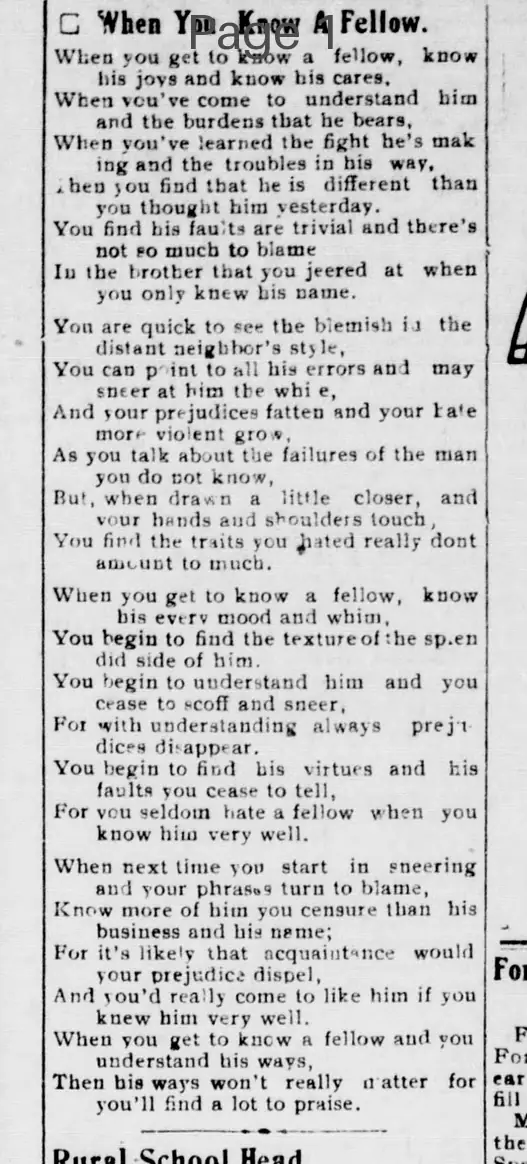
When you get to know a fellow, know
his joys and know his cares.
When you've come to understand him
and the burdens that he bears,
When you've learned the fight he's making
and the troubles in his way,
Then you find that he is different than
you thought him yesterday.
You find his faults are trivial and there's
not so much to blame
In the brother that you jeered at when
you only knew his name.
You are quick to see the blemish in the
distant neighbor's style,
You can point to all his errors and
may sneer at him the while,
And your prejudices fatten and your hate
more violent grow.
As you talk about the failures of the man
you do not know.
But, when drawn a little closer, and
your hands and shoulders touch
You find the traits you hated really don't
amount to much.
When you get to know a fellow, know
his every mood and whim,
You begin to find the texture of the splendid side of him.
You begin to understand him and you
cease to scoff and sneer,
For with understanding always prejudices
disappear.
You begin to find his virtues and his
faults you cease to tell.
For you seldom hate a fellow when you
know him very well.
When next time you start in sneering
and your phrases turn to blame.
Know more of him you censure than his
business and his name;
For it's likely that acquaintance
would your prejudice dispel,
And you'd really come to like him if you
knew him very well.
When you get to know a fellow and you
understand his ways,
Then his ways won't really matter for
you'll find a lot to praise.
his joys and know his cares.
When you've come to understand him
and the burdens that he bears,
When you've learned the fight he's making
and the troubles in his way,
Then you find that he is different than
you thought him yesterday.
You find his faults are trivial and there's
not so much to blame
In the brother that you jeered at when
you only knew his name.
You are quick to see the blemish in the
distant neighbor's style,
You can point to all his errors and
may sneer at him the while,
And your prejudices fatten and your hate
more violent grow.
As you talk about the failures of the man
you do not know.
But, when drawn a little closer, and
your hands and shoulders touch
You find the traits you hated really don't
amount to much.
When you get to know a fellow, know
his every mood and whim,
You begin to find the texture of the splendid side of him.
You begin to understand him and you
cease to scoff and sneer,
For with understanding always prejudices
disappear.
You begin to find his virtues and his
faults you cease to tell.
For you seldom hate a fellow when you
know him very well.
When next time you start in sneering
and your phrases turn to blame.
Know more of him you censure than his
business and his name;
For it's likely that acquaintance
would your prejudice dispel,
And you'd really come to like him if you
knew him very well.
When you get to know a fellow and you
understand his ways,
Then his ways won't really matter for
you'll find a lot to praise.
What sub-type of article is it?
Didactic Verse
What themes does it cover?
Moral Virtue
Friendship
Satire Society
What keywords are associated?
Knowing Fellow
Understanding
Prejudices
Faults
Empathy
Hate
Virtues
Acquaintance
Poem Details
Form / Style
Rhymed Quatrains
Key Lines
When You Get To Know A Fellow, Know
His Joys And Know His Cares.
You Find His Faults Are Trivial And There's
Not So Much To Blame
For With Understanding Always Preju
Dices Disappear.
For You Seldom Hate A Fellow When You
Know Him Very Well.
And You'd Really Come To Like Him If You
Knew Him Very Well.