Thank you for visiting SNEWPapers!
Sign up free
National Opinion
Bradford, Orange County, Vermont
What is this article about?
A traveler detained in Carlisle witnesses a suspicious man in disguise who later provides a false alibi for highway robber Joe Slifer. Recognizing him at trial without his silver-gray wig, the traveler testifies, exposing the fraud and leading to Slifer's conviction and the witness's arrest for perjury.
Clipping
OCR Quality
Full Text
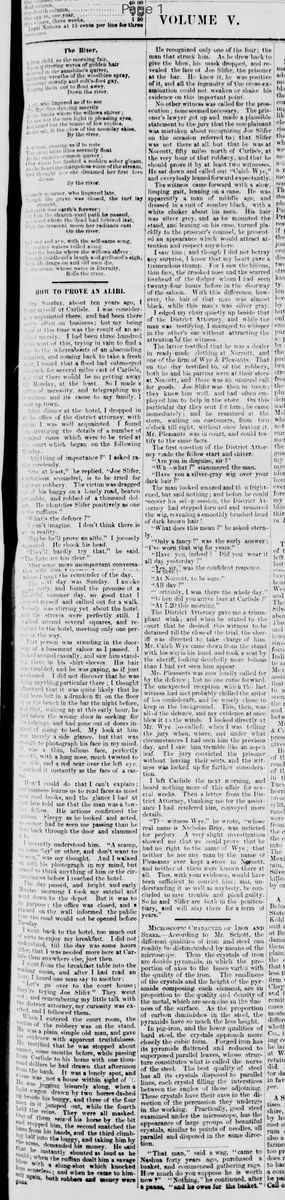
One Sunday, about ten years ago, I found myself at Carlisle. I was considerably acquainted there, and had been there pretty often on business; but my being there at this time was the result of an accident merely. I had been three hundred miles west of this, trying in vain to find a clue to the whereabouts of an absconding defaulter, and coming back to take a fresh start. I found that a flood had submerged the track for several miles east of Carlisle, and that there would be no getting away Monday, at the least. So I made a virtue of necessity, and telegraphing my detention and its cause to my family, I went up town.
After dinner at the hotel, I dropped in at the office of the district attorney, with whom I was well acquainted. I found him arranging the details of a number of criminal cases which were to be tried at court which began on the following Monday.
"Anything of importance?" I asked rather carelessly.
"One at least," he replied, "Joe Slifer, a notorious scoundrel, is to be tried for highway robbery. The victim was dragged out of his buggy on a lonely road, beaten insensible, and robbed of a thousand dollars. He identifies Slifer positively as one of the ruffians."
"What's the defence?"
"I can't imagine. I don't think there is any."
"May be he'll prove an alibi," I jocosely suggested. He shook his head.
"They'll hardly try that," he said. "The facts are too clear."
After some more unimportant conversation with him, I left and spent the remainder of the day wandering about the town.
The next day was Sunday. I awoke quite early, and found the promise of a beautiful summer day, so good that I dressed myself and sallied out for a walk. Nobody was stirring yet about the hotel and the streets were perfectly still. I walked around several squares, and returned to the hotel, meeting only one person on the way.
That person was standing in the doorway of a basement saloon as I passed. I looked around casually, and saw him standing there in his shirt-sleeves. His hair was tumbled, and he was gaping, as if just awakened. I did not discover that he was doing anything particular there; I thought afterward that it was quite likely that he had been left in a drunken fit on the floor or on the bench in the bar the night before, and that, waking up at this early hour, he had taken the wrong door in seeking for his lodgings and had gone out of doors instead of going to bed. My look at him was merely a side glance, but that was enough to photograph his face in my mind. It was a thin, bilious face, perfectly sallow, with a long nose, much twisted to one side, and a red scar over the left eye. I marked it instantly as the face of a rascal. How I could do that I can't explain; our business learns us to read faces as most men read books, and the glance I had at that face told me that the man was a law-fellow. His actions confirmed the intuition. Sleepy as he looked and acted, no sooner had he seen me passing than he dove back through the door and slammed it to.
I instantly understood him. "A scamp, some 'lay' or other, and don't want to be seen," was my thought. And I walked on with his photograph in my mind, but ceased to think anything of him or the circumstances before I reached the hotel.
The day passed, and bright and early Monday morning I took my satchel and went down to the depot. But it was to no purpose: the office was closed, and a placard on the wall informed the public that the road would not be opened before Tuesday.
I went back to the hotel, too much out of sorts to enjoy my breakfast. I did not understand, till the day was some hours older, that I was needed more here at Carlisle than anywhere else, just then.
I went from the breakfast table into the reading room, and after I had read an hour, I heard one man say to another: "Let's go over to the court house; they're trying Joe Slifer." They went out and, remembering my little talk with the district attorney, my curiosity was excited, and I followed them.
When I entered the court room, the victim of the robbery was on the stand. He was a plain, simple old man, and gave his evidence with apparent truthfulness. He testified that he was stopped about sunset some months before, while passing from Carlisle to his home with one thousand dollars he had drawn that afternoon from the bank. It was a lonely spot, and there was not a house within sight of it. He was jogging leisurely along in a light wagon drawn by two horses when a carriage dashed beside his buggy and three of the four men it held seized the horses while the fourth jumped out, seized him by the arms, and instantly demanded the buggy and his money, taking as loud and rough a tone as he said by the roadside. The ruffian dealt him a savage blow with a slung-shot which knocked him senseless; and when he came to himself again, both robbers and money were gone.
He recognized only one of the four: the man that struck him. As he drew back to give the blow, his mask dropped, and revealed the face of Joe Slifer, the prisoner at the bar. He knew it, he was positive of it, and all the ingenuity of the cross-examination could not weaken or shake his evidence on this important point.
No other witness was called for the prosecution; none seemed necessary. The prisoner's lawyer got up and made a plausible statement to the jury that the complainant was mistaken about recognizing Joe Slifer on the occasion referred to: that Slifer was not there at all, but that he was at Norcott, fifty miles north of Carlisle, at the very hour of that robbery, and that he should prove it by at least two witnesses. He sat down and called out "Caleb Wye," and everybody leaned forward expectantly.
The witness came forward with a slow, limping gait, leaning on a cane. He was apparently a man of middle age, and dressed in a suit of sombre black, with a white choker about his neck. His hair was silver grey, and as he mounted the stand, and leaning on his cane, turned placidly to the prisoner's counsel, he presented an appearance which would attract attention and respect anywhere.
I saw him; and though I did not betray any surprise, I know that my heart gave a tremendous thump. For I saw the bilious, thin face, the crooked nose and the scarred forehead of the dodger whom I had seen twenty-four hours before in the doorway of the saloon. With this difference, however, the hair of that man was almost black, while this man's was silver gray.
I edged my chair quietly up beside that of the District Attorney, and while the man was testifying, I managed to whisper in the other's ear without attracting the attention of the witness.
The latter testified that he was a dealer in ready-made clothing at Norcott, and one of the firm of Wye & Pleasants. That on the day testified to, of the robbery, both he and his partner were at their store at Norcott, and there was an unusual call for goods. Joe Slifer was then in town; they knew him well, and had often employed him to help in the store. On this particular day they sent for him; he came immediately; and he remained at the store, waiting on customers, from two o'clock till eight, without once leaving it. Mr. Pleasants was in court, and could testify to the same facts.
The first question of the District Attorney made the fellow start and shiver.
"Are you in disguise, sir?"
"Wh—what?" stammered the man.
"Have you a silver-gray wig over your dark hair?"
The man looked amazed and then frightened, but said nothing; and before he could recover his self-possession, the District Attorney had stepped forward and removed the wig, revealing a smoothly brushed head of dark brown hair!
"What does this mean?" he asked sternly.
"Only a fancy!" was the surly answer: "I've worn that wig for years."
"Have you, indeed? Did you wear it all day yesterday?"
"Yes, sir," was the confident response.
"Where?"
"At Norcott, to be sure."
"All day?"
"Certainly, I was there the whole day."
"When did you arrive here at Carlisle?"
"At 7.20 this morning."
The District Attorney gave me a triumphant wink: and when he stated to the court that he desired this witness to be detained till the close of the trial, the sheriff was directed to take charge of him.
Mr. Caleb Wye came down from the stand with his wig in his hand, and took a seat by the sheriff, looking decidedly more bilious than I had yet seen him appear.
Mr. Pleasants was now loudly called for by the defence; but no one came forward. The unexpected reception which the last witness had met probably chilled the ardor of his confederate, and he wisely chose to keep in the background. This, then, was all of the defence, and my evidence at once blew it to the winds. I looked directly at Mr. Wye (so-called) when I was telling the jury when, where, and under what circumstances I had seen him the previous day, and I saw him tremble like an aspen leaf. The jury convicted the prisoner without leaving their seats, and the witness was locked up for further consideration.
I left Carlisle the next morning, and heard nothing more of this affair for several weeks. Then a letter from the District Attorney, thanking me for the assistance I had rendered him, conveyed more details.
"The witness Wye," he wrote, "whose real name is Nicholas Brav, was indicted for perjury. A very slight investigation showed me that we could prove that he had no right to the name of Wye; that neither he nor any man by the name of Pleasants ever kept a store in Norcott, and neither of them were known there at all. This, with your evidence, would have been sufficient to convict him; and, understanding it as well as anybody, he concluded to save trouble and plead guilty. So he and Slifer are both in the penitentiary, and will stay there for a term of years."
What sub-type of article is it?
What themes does it cover?
What keywords are associated?
What entities or persons were involved?
Where did it happen?
Story Details
Key Persons
Location
Carlisle
Event Date
About Ten Years Ago
Story Details
A narrator detained in Carlisle by a flood sees a suspicious man in a saloon doorway on Sunday morning. At Joe Slifer's trial for highway robbery on Monday, the man appears as Caleb Wye, wearing a silver-gray wig, to provide an alibi claiming Slifer was in Norcott during the crime. The narrator recognizes him without the wig and testifies to seeing him in Carlisle the previous day, exposing the disguise. The alibi fails, Slifer is convicted, and Wye (real name Nicholas Brav) is arrested for perjury.