Thank you for visiting SNEWPapers!
Sign up free
Editorial
May 24, 1798
Gazette Of The United States, & Philadelphia Daily Advertiser
Philadelphia, Philadelphia County, Pennsylvania
What is this article about?
In a 1798 editorial, 'Fabricius' calls for American unanimity in supporting the government against five years of French insults and aggressions, criticizing past apathy and urging resolve to defend national liberty without limits on governmental power.
Merged-components note: Continuation of the same editorial piece, as the text flows directly from one to the next across sequential reading orders.
Clipping
OCR Quality
95%
Excellent
Full Text
PHILADELPHIA,
THURSDAY EVENING, MAY 24
FOR THE GAZETTE OF THE UNITED STATES-
No. I.
UNANIMITY of opinion, among the citizens of any country, on any great national subject, is much to be desired; but in none have the sentiments of the people more influence on their government than in ours, and, consequently, in none is this harmony of judgment more essentially necessary.
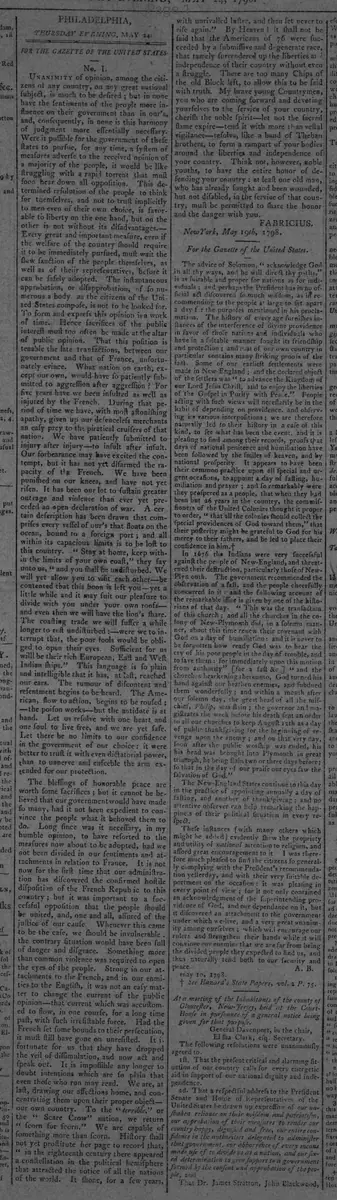
Were it possible for the government of these states to pursue, for any time, a system of measures adverse to the received opinion of a majority of the people, it would be like struggling with a rapid torrent that must soon bear down all opposition. This determined resolution of the people to think for themselves, and not to trust implicitly to men even of their own choice, is favorable to liberty on the one hand, but on the other is not without its disadvantages.— Every great and important measure, even if the welfare of the country should require it to be immediately pursued, must wait the slow sanction of the people themselves, as well as of their representatives, before it can be safely adopted. The instantaneous approbation, or disapprobation, of so numerous a body as the citizens of the United States compose, is not to be looked for. To form and express this opinion is a work of time. Hence sacrifices of the public interest must too often be made at the altar of public opinion. That this position is tenable the late transactions, between our government and that of France, unfortunately evince. What nation on earth, except our own, would have so patiently submitted to aggression after aggression? For five years have we been insulted as well as injured by the French. During that period of time we have, with most astonishing apathy, given up our defenceless merchants an easy prey to the piratical cruisers of that nation. We have patiently submitted to injury after injury-to insult after insult. Our forbearance may have excited the contempt, but it has not yet disarmed the rapacity of the French. We have been punished on our knees, and have not yet risen. It has been our lot to sustain greater outrage and violence than ever yet preceded an open declaration of war. A certain description has been drawn that comprehends every vessel of ours that floats on the ocean, bound to a foreign port; and all within its capacious limits is to be lost to this country. "Stay at home, keep within the limits of your own coast," they say unto us, "and you shall be undisturbed. We will yet allow you to visit each other—be contented that this boon is left you-yet a little while and it may suit our pleasure to divide with you under your own roofs- and even then we will have the lion's share. The coasting trade we will suffer a while longer to rest undisturbed :-were we to interrupt that, the poor fools would be obliged to open their eyes. Sufficient for us will be their rich European, East and West Indian ships." This language is so plain and intelligible that it has, at last, reached our ears. The rumour of discontent and resentment begins to be heard. The American, slow to action, begins to be roused ; -the poison works-but the antidote is at hand. Let us resolve with one heart and one soul to live free, and we are yet safe. Let there be no limits to our confidence in the government of our choice: it were better to trust it with even dictatorial power, than to unnerve and enfeeble the arm extended for our protection.
The blessings of honorable peace are worth some sacrifices ; but it cannot be believed that our government would have made so many, had it not been expedient to convince the people what it behooved them to do. Long since was it necessary, in my humble opinion, to have resorted to the measures now about to be adopted, had we not been divided in our sentiments and attachments in relation to France. It is not now for the first time that our administration has discovered the confirmed hostile disposition of the French Republic to this country; but it was important to a successful opposition that the people should be united, and, one and all, assured of the justice of our cause. Whenever this came to be the case, we should be invulnerable. The contrary situation would have been full of danger and disgrace. Something more than common violence was required to open the eyes of the people. Strong in our attachments to the French, and in our enmities to the English, it was not an easy matter to change the current of the public opinion-that current which was accustomed to flow, in one course, for a long time past, with such irresistible force. Had the French set some bounds to their persecution, it must still have gone on unrestrained. It is fortunate for us that they have dropped the veil of dissimulation, and now act and speak out. It is impossible any longer to doubt intentions which are so plain that even those who run may read. We are, at last, drawing our affections home, and concentrating them upon their proper object— our own country. To the "terrible," or the "Scare Crow" nation, we return "corn for corn." We are capable of something more than corn. History shall not yet prostitute her page to record that, "in the eighteenth century there appeared a constellation in the political hemisphere that attracted the notice of all the nations of the world. It shone, for a few years, with unrivalled lustre, and then set never to rise again." By Heaven! it shall not be said that the Americans of 76 were succeeded by a submissive and degenerate race, that tamely surrendered up the liberties and independence of their country without even a struggle. There are too many Chips of the old Block left, to allow this to be said with truth. My brave young Countrymen, you who are coming forward and devoting yourselves to the service of your country, cherish the noble spirit-let not the sacred flame expire--tend it with more than vestal vigilance-resolve, like a band of Theban brothers, to form a rampart of your bodies around the liberties and independence of your country. Think not, however, noble youths, to have the entire honor of defending your country : at least one old man, who has already fought and been wounded, but not disabled, in the service of that country, must be permitted to share the honor and the danger with you,
FABRICIUS.
New-York, May 19th, 1798.
THURSDAY EVENING, MAY 24
FOR THE GAZETTE OF THE UNITED STATES-
No. I.
UNANIMITY of opinion, among the citizens of any country, on any great national subject, is much to be desired; but in none have the sentiments of the people more influence on their government than in ours, and, consequently, in none is this harmony of judgment more essentially necessary.
Were it possible for the government of these states to pursue, for any time, a system of measures adverse to the received opinion of a majority of the people, it would be like struggling with a rapid torrent that must soon bear down all opposition. This determined resolution of the people to think for themselves, and not to trust implicitly to men even of their own choice, is favorable to liberty on the one hand, but on the other is not without its disadvantages.— Every great and important measure, even if the welfare of the country should require it to be immediately pursued, must wait the slow sanction of the people themselves, as well as of their representatives, before it can be safely adopted. The instantaneous approbation, or disapprobation, of so numerous a body as the citizens of the United States compose, is not to be looked for. To form and express this opinion is a work of time. Hence sacrifices of the public interest must too often be made at the altar of public opinion. That this position is tenable the late transactions, between our government and that of France, unfortunately evince. What nation on earth, except our own, would have so patiently submitted to aggression after aggression? For five years have we been insulted as well as injured by the French. During that period of time we have, with most astonishing apathy, given up our defenceless merchants an easy prey to the piratical cruisers of that nation. We have patiently submitted to injury after injury-to insult after insult. Our forbearance may have excited the contempt, but it has not yet disarmed the rapacity of the French. We have been punished on our knees, and have not yet risen. It has been our lot to sustain greater outrage and violence than ever yet preceded an open declaration of war. A certain description has been drawn that comprehends every vessel of ours that floats on the ocean, bound to a foreign port; and all within its capacious limits is to be lost to this country. "Stay at home, keep within the limits of your own coast," they say unto us, "and you shall be undisturbed. We will yet allow you to visit each other—be contented that this boon is left you-yet a little while and it may suit our pleasure to divide with you under your own roofs- and even then we will have the lion's share. The coasting trade we will suffer a while longer to rest undisturbed :-were we to interrupt that, the poor fools would be obliged to open their eyes. Sufficient for us will be their rich European, East and West Indian ships." This language is so plain and intelligible that it has, at last, reached our ears. The rumour of discontent and resentment begins to be heard. The American, slow to action, begins to be roused ; -the poison works-but the antidote is at hand. Let us resolve with one heart and one soul to live free, and we are yet safe. Let there be no limits to our confidence in the government of our choice: it were better to trust it with even dictatorial power, than to unnerve and enfeeble the arm extended for our protection.
The blessings of honorable peace are worth some sacrifices ; but it cannot be believed that our government would have made so many, had it not been expedient to convince the people what it behooved them to do. Long since was it necessary, in my humble opinion, to have resorted to the measures now about to be adopted, had we not been divided in our sentiments and attachments in relation to France. It is not now for the first time that our administration has discovered the confirmed hostile disposition of the French Republic to this country; but it was important to a successful opposition that the people should be united, and, one and all, assured of the justice of our cause. Whenever this came to be the case, we should be invulnerable. The contrary situation would have been full of danger and disgrace. Something more than common violence was required to open the eyes of the people. Strong in our attachments to the French, and in our enmities to the English, it was not an easy matter to change the current of the public opinion-that current which was accustomed to flow, in one course, for a long time past, with such irresistible force. Had the French set some bounds to their persecution, it must still have gone on unrestrained. It is fortunate for us that they have dropped the veil of dissimulation, and now act and speak out. It is impossible any longer to doubt intentions which are so plain that even those who run may read. We are, at last, drawing our affections home, and concentrating them upon their proper object— our own country. To the "terrible," or the "Scare Crow" nation, we return "corn for corn." We are capable of something more than corn. History shall not yet prostitute her page to record that, "in the eighteenth century there appeared a constellation in the political hemisphere that attracted the notice of all the nations of the world. It shone, for a few years, with unrivalled lustre, and then set never to rise again." By Heaven! it shall not be said that the Americans of 76 were succeeded by a submissive and degenerate race, that tamely surrendered up the liberties and independence of their country without even a struggle. There are too many Chips of the old Block left, to allow this to be said with truth. My brave young Countrymen, you who are coming forward and devoting yourselves to the service of your country, cherish the noble spirit-let not the sacred flame expire--tend it with more than vestal vigilance-resolve, like a band of Theban brothers, to form a rampart of your bodies around the liberties and independence of your country. Think not, however, noble youths, to have the entire honor of defending your country : at least one old man, who has already fought and been wounded, but not disabled, in the service of that country, must be permitted to share the honor and the danger with you,
FABRICIUS.
New-York, May 19th, 1798.
What sub-type of article is it?
Foreign Affairs
War Or Peace
Partisan Politics
What keywords are associated?
French Aggression
American Unity
Public Opinion
Foreign Policy
National Defense
Quasi War
What entities or persons were involved?
French Republic
United States Government
American People
Editorial Details
Primary Topic
Call For Unity Against French Aggression
Stance / Tone
Patriotic Exhortation Supporting Government
Key Figures
French Republic
United States Government
American People
Key Arguments
Unanimity Of Public Opinion Is Essential For Effective Government
Americans Have Patiently Endured Five Years Of French Insults And Injuries
Past Forbearance Has Sacrificed Public Interest To Public Opinion
Government Delayed Strong Measures To Unite The People Against France
French Hostility Is Now Undeniable, Requiring Full Support For Defensive Actions
Americans Must Resolve To Defend Liberty Without Limiting Government Power