Thank you for visiting SNEWPapers!
Sign up free
Kentucky Gazette And General Advertiser
Lexington, Fayette County, Kentucky
What is this article about?
In Paris on February 17, 1804, the Legislative Body hears a report from the Grand Judge detailing a British-orchestrated plot to assassinate First Consul Bonaparte and overthrow the French government. Conspirators including Pichegru, Moreau, and Georges are implicated and arrested.
Clipping
OCR Quality
Full Text
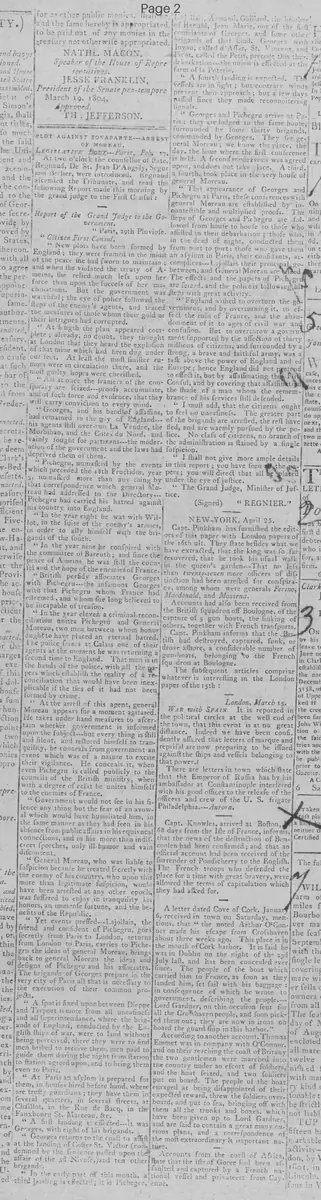
LEGISLATIVE BODY—Paris, Feb. 17.
At two o'clock the counsellor of state, Regnault, De St. Jean D'Angely, Segur and Berlier, were introduced. Regnault ascended the Tribunate, and read the following Report made this morning by the grand judge to the First Consul:
Report of the Grand Judge to the Government.
Paris, 29th Pluvio se.
Citizen First Consul,
New plots have been formed by England; they were framed in the midst of the peace she had sworn to maintain; and when she violated the treaty of Amiens, she relied much less upon her force than upon the success of her machinations. But the government was watchful; the eye of police followed the steps of the enemy's agents, and traced the measures of those whom their gold or their intrigues had corrupted.
At length the plan appeared complete; already, no doubt, they thought at London that they heard the explosion of that mine which had been dug under our feet. At least the most sinister rumors were in circulation there, and the most guilty hopes were cherished.
All at once the framers of the conspiracy are seized—proofs accumulate, and of such force and evidence, that they will carry conviction to every mind.
Georges, and his band of assassins, had remained in the pay of England—his agents still over-run La Vendee, the Morbihan, and the Cotes du Nord, and vainly sought for partizans—the moderation of the government and the laws had deprived them of them.
Pichegru, unmasked by the events which preceded the 18th Fructidor, year 5, unmasked more than any thing by that correspondence which general Moreau had addressed to the Directory—Pichegru had carried his hatred against his country into England.
In the year eight he was with Willot, in the suite of the enemy's armies, in order to ally himself with the brigands of the south.
In the year nine he conspired with the committee of Bareuth; and since the peace of Amiens he was still the counsel and the hope of the enemies of France.
British perfidy associates Georges with Pichegru—the infamous Georges with that Pichegru whom France had esteemed, and whom she long believed to be incapable of treason.
In the year eleven a criminal reconciliation unites Pichegru and General Moreau, two men between whom honor ought to have placed an eternal hatred. The police seizes at Calais one of their agents at the moment he was returning a second time to England. That man is in the hands of the police, with all the papers which establish the reality of a reconciliation that would have been inexplicable if the ties of it had not been formed by crime.
At the arrest of this agent, general Moreau appears for a moment agitated. He takes under hand measures to ascertain whether government is informed upon the subject—but every thing is still and silent, and restored himself to tranquility, he conceals from government an event which was of a nature to excite their vigilance. He conceals it, when even Pichegru is called publicly to the councils of the British ministry, when with a degree of eclat he unites himself to the enemies of France.
Government would not see in his silence any thing but the fear of an avowal which would have humiliated him, in the same manner as they had seen in his absence from public affairs in his equivocal connections, and in his more than indiscreet speeches, only ill-humor and vain discontent.
General Moreau, who was liable to suspicion because he treated secretly with the enemy of his country, who upon this more than legitimate suspicion, would have been arrested at any other epoch, was suffered to enjoy in tranquility his honors, an immense fortune, and the benefits of the Republic.
Yet events press.—Lajolais, the friend and confident of Pichegru, goes secretly from Paris to London, returns from London to Paris, carries to Pichegru the ideas of general Moreau, brings back to general Moreau the ideas and designs of Pichegru and his associates. The brigands of Georges prepare in the very city of Paris all that is necessary to the execution of their common projects.
A spot is fixed upon between Dieppe and Treport remote from all uneasiness and all superintendence, where the brigands of England, conducted by the English ships of war, were to land without being perceived, there they were to find men bribed to receive them, men paid to guide them during the night from station to station agreed upon, and to bring them even to Paris.
At Paris an asylum is prepared for them, in houses hired before hand, where are trusty guardians; they have them in several quarters, in several streets, at Chaillot, in the Rue de Bac, in the Faubourg St. Marceau, &c.
A first landing is effected—it was Georges, with eight of his brigands.
Georges returns to the coast to assist at the landing of Coster St. Victor (condemned by the sentence passed upon the affair of the 2d Nivose,) and ten other brigands.
In the early part of this month, a third landing is effected; it is Pichegru, Lajolais, Hyacinth, Guillard, the brother of Roulh, Jean Marie, one of the first confidants of Georges, and some other brigands of that kind. Georges with Joyau, called d'Aunay, St. Vincent, and Picot, called the Petit, precede this third debarkation—the union is effected at the farm of la Peterie.
A fourth landing is expected. The vessels are in sight; but contrary winds prevent their approach; but a few days passed since they made reconnoitering signals.
Georges and Pichegru arrive at Paris: they are lodged in the same house, surrounded by some thirty brigands, commanded by Georges. They see general Moreau; we know the place, the day, the hour where the first conference is held. A second rendezvous was agreed upon, and does not take place. A third, a fourth, took place in the very house of general Moreau.
This appearance of Georges and Pichegru at Paris, these conferences with general Moreau are established by incontestable and multiplied proofs. The steps of Georges and Pichegru are followed from house to house to those who assisted in their debarkation; those who, in the dead of night, conducted them from port to port: those who gave them an asylum in Paris, their confidants, accomplices—Lajolais their principal go-between, and General Moreau are seized. The effects and the papers of Pichegru are seized, and the police is following his steps with great activity.
England wished to overturn the government, and by overturning it, to effect the ruin of France, and the abandonment of it to ages of civil war and confusion. But to overthrow a government supported by the affection of thirty millions of citizens, and surrounded by a strong, a brave and faithful army, was a task above the power of England and of Europe; hence England did not pretend to effect it, but by assassinating the First Consul, and by covering that assassination the shade of a man whom the remembrance of his services still defended.
I must add, that the citizens ought to feel no uneasiness. The greater part of the brigands are arrested, the rest have fled, and are warmly pursued by the police. No class of citizens, no branch of the administration is stained by a single suspicion.
I shall not give more ample details in this report; you have seen all the papers; you will direct that all be placed under the eye of justice.
The Grand Judge, Minister of Justice,
(Signed)
REGNIER.
What sub-type of article is it?
What keywords are associated?
What entities or persons were involved?
Where did it happen?
Foreign News Details
Primary Location
Paris
Event Date
Feb. 17
Key Persons
Outcome
plot foiled; key conspirators including georges, pichegru, lajolais, and moreau arrested; most brigands seized or fled; no broader involvement in administration.
Event Details
British-backed conspiracy to assassinate the First Consul and overthrow the government involved landings of brigands led by Georges and Pichegru near Dieppe, secret meetings with General Moreau in Paris, and preparations for insurrection. Police surveillance led to arrests and seizure of evidence.