Thank you for visiting SNEWPapers!
Sign up free
Editorial
April 8, 1796
Gazette Of The United States
Philadelphia, Philadelphia County, Pennsylvania
What is this article about?
Grand Jury of New-Jersey addresses the US Circuit Court, praising Judge Iredell's charge on subordinating individual interests to the general will to avoid insurrections. They express gratitude for America's peace and prosperity, defend the Constitution and recent treaty with Britain against complaints, and hope for lasting stability.
Clipping
OCR Quality
95%
Excellent
Full Text
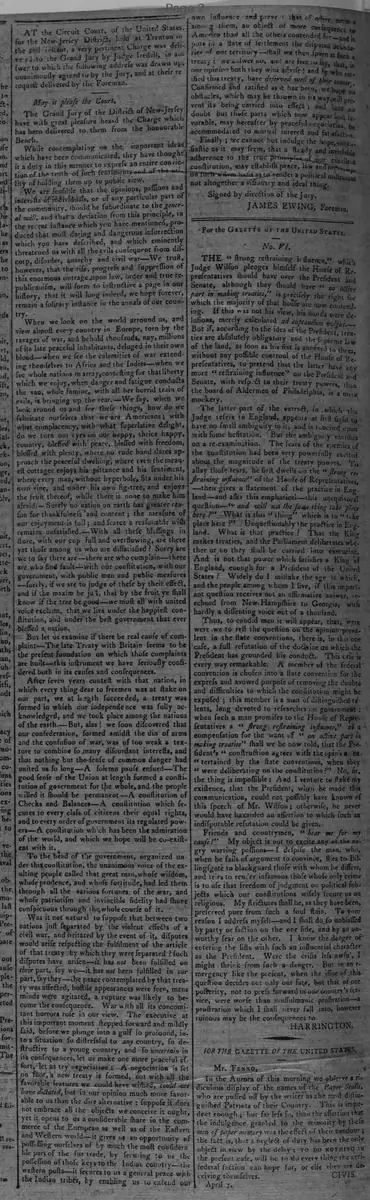
AT the Circuit Court, of the United States, for the New-Jersey District, held at Trenton on the 2nd instant, a very pertinent Charge was delivered to the Grand Jury by Judge Iredell, in answer to which the following address was drawn up, unanimously agreed to by the jury, and at their request delivered by the Foreman.
May it please the Court,
The Grand Jury of the District of New-Jersey have with great pleasure heard the Charge which has been delivered to them from the honourable Bench.
While contemplating on the important ideas which have been communicated, they have thought it a duty in this manner to express an entire conviction of the truth of such sentiments and of the utility of holding them up to public view.
We are sensible that the opinions, passions and interests of individuals, or of any particular part of the community, should be subordinate to the general will, and that a deviation from this principle, in the recent instance which you have mentioned, produced that most daring and dangerous insurrection which you have described, and which eminently threatened us with all the evils consequent from discord, disorder, anarchy and civil war—We trust, however, that the rise, progress and suppression of this enormous outrage upon law, order and true republicanism, will form so instructive a page in our history, that it will long indeed, we hope forever, remain a solitary instance in the annals of our country.
When we look on the world around us, and view almost every country in Europe, torn by the ravages of war, and behold thousands, nay, millions of its late peaceful inhabitants, deluged in their own blood—when we see the calamities of war extending themselves to Africa and the Indies—when we see whole nations in array, contesting for that liberty which we enjoy, when danger and fatigue conducts the van, while famine, with all her horrid train of evils, is bringing up the rear.—We say, when we look around us and see these things, how do we felicitate ourselves that we are Americans; with what complacency, with what superlative delight, do we turn our eyes on our happy, thrice happy, country, blessed with peace, blessed with freedom, blessed with plenty, where no rude hand dares approach the peaceful dwelling, where even the meanest cottager enjoys his pittance and his sentiment, where every man, without hyperbole, sits under his own vine, and under his own fig-tree, and enjoys the fruit thereof, while there is none to make him afraid.—Surely no nation on earth has greater reason for thankfulness and content; the measure of our enjoyment is full; and scarce a reasonable wish remains unsatisfied. With all these blessings in store, with our cup full and overflowing, are there yet those among us who are dissatisfied? Sorry are we to say there are—there are who complain——there are who find fault with our constitution, with our government, with public men and public measures—surely, if we are to judge of these by their effect, and if the maxim be just, that by their fruit we shall know if the tree be good we must all with united voice exclaim, that we live under the happiest constitution, and under the best government that ever blessed a nation.
But let us examine if there be real cause of complaint—The late Treaty with Britain seems to be the present foundation on which those complaints are built—this instrument we have seriously considered both in its causes and consequences.
After seven years contest with that nation, in which every thing dear to freemen was at stake on our part, we at length succeeded, a treaty was formed in which our independence was fully acknowledged, and we took place among the nations of the earth.—But, alas! we soon discovered that our confederation, formed amidst the din of arms and the confusion of war, was of too weak a texture to combine so many discordant interests, and that nothing but the sense of common danger had united us so long—A solemn pause ensued—The good sense of the Union at length formed a constitution of government for the whole, and the people willed it should be permanent—A constitution of Checks and Balances—A constitution which secures to every class of citizens their equal rights, and to every order of government its regulated powers—A constitution which has been the admiration of the world, and which we hope will be co-extent with it.
To the head of the government, organized under this constitution, the unanimous voice of the exulting people called that great man, whose wisdom, whose prudence, and whose fortitude, had led them through all the various fortunes of the war, and whose patriotism and invincible fidelity had shone conspicuous through the whole course of it.
Was it not natural to suppose that between two nations just separated by the violent effects of a civil war, and irritated by the event of it, disputes would arise respecting the fulfilment of the articles of that treaty by which they were separated? Such disputes have arisen—it has not been fulfilled on their part, say we—it has not been fulfilled on our part, say they—the peace contemplated by that treaty was affected, hostile appearances were seen, mens minds were agitated, a rupture was likely to become the consequence. War with all its concomitant horrors rose in our view. The executive at this important moment stepped forward and mildly said, before we plunge into a gulf so profound, into a situation so distressing to any country, so destructive to a young country, and so uncertain in its consequences, let us make one more peaceful effort, let us try negociation: A negociation is set on foot, a new treaty is formed, not with all the favorable features we could have wished, could we have dictated, but in our opinion much more favorable to us than the dire alternative: suppose it does not embrace all the objects we conceive it ought, yet it opens to us a considerable share in the commerce of the European as well as of the Eastern and Western world—it gives us an opportunity of possessing ourselves of by much the most considerable part of the fur trade, by securing to us the possession of those keys to the Indian country, the western posts—it secures to us a general peace with the Indian tribes, by enabling us to extend our own influence and prevent that of other nations among them, an object of more consequence to America than all the others contended for—and it puts in a state of settlement the disputed boundaries of our territory—shall we then spurn at such a treaty? we answer no. and are free to say, that, in our opinion both they who advised and he who ratified this treaty, have deserved well of their country.
Confirmed and ratified as it has been, we hope no obstacles, which may be thrown in its way, will prevent its being carried into effect; and have no doubt but those parts which now appear least favorable, may hereafter by peaceful negociation, be accommodated to mutual interest and satisfaction.
Finally; we cannot but indulge the hope, enthusiastic as it may seem, that a steady and inviolable adherence to the true principles of our excellent constitution, may establish peace, law and good government on such a firm basis as to render a political millennium not altogether a visionary and ideal thing.
Signed by direction of the Jury.
JAMES EWING, Foreman.
May it please the Court,
The Grand Jury of the District of New-Jersey have with great pleasure heard the Charge which has been delivered to them from the honourable Bench.
While contemplating on the important ideas which have been communicated, they have thought it a duty in this manner to express an entire conviction of the truth of such sentiments and of the utility of holding them up to public view.
We are sensible that the opinions, passions and interests of individuals, or of any particular part of the community, should be subordinate to the general will, and that a deviation from this principle, in the recent instance which you have mentioned, produced that most daring and dangerous insurrection which you have described, and which eminently threatened us with all the evils consequent from discord, disorder, anarchy and civil war—We trust, however, that the rise, progress and suppression of this enormous outrage upon law, order and true republicanism, will form so instructive a page in our history, that it will long indeed, we hope forever, remain a solitary instance in the annals of our country.
When we look on the world around us, and view almost every country in Europe, torn by the ravages of war, and behold thousands, nay, millions of its late peaceful inhabitants, deluged in their own blood—when we see the calamities of war extending themselves to Africa and the Indies—when we see whole nations in array, contesting for that liberty which we enjoy, when danger and fatigue conducts the van, while famine, with all her horrid train of evils, is bringing up the rear.—We say, when we look around us and see these things, how do we felicitate ourselves that we are Americans; with what complacency, with what superlative delight, do we turn our eyes on our happy, thrice happy, country, blessed with peace, blessed with freedom, blessed with plenty, where no rude hand dares approach the peaceful dwelling, where even the meanest cottager enjoys his pittance and his sentiment, where every man, without hyperbole, sits under his own vine, and under his own fig-tree, and enjoys the fruit thereof, while there is none to make him afraid.—Surely no nation on earth has greater reason for thankfulness and content; the measure of our enjoyment is full; and scarce a reasonable wish remains unsatisfied. With all these blessings in store, with our cup full and overflowing, are there yet those among us who are dissatisfied? Sorry are we to say there are—there are who complain——there are who find fault with our constitution, with our government, with public men and public measures—surely, if we are to judge of these by their effect, and if the maxim be just, that by their fruit we shall know if the tree be good we must all with united voice exclaim, that we live under the happiest constitution, and under the best government that ever blessed a nation.
But let us examine if there be real cause of complaint—The late Treaty with Britain seems to be the present foundation on which those complaints are built—this instrument we have seriously considered both in its causes and consequences.
After seven years contest with that nation, in which every thing dear to freemen was at stake on our part, we at length succeeded, a treaty was formed in which our independence was fully acknowledged, and we took place among the nations of the earth.—But, alas! we soon discovered that our confederation, formed amidst the din of arms and the confusion of war, was of too weak a texture to combine so many discordant interests, and that nothing but the sense of common danger had united us so long—A solemn pause ensued—The good sense of the Union at length formed a constitution of government for the whole, and the people willed it should be permanent—A constitution of Checks and Balances—A constitution which secures to every class of citizens their equal rights, and to every order of government its regulated powers—A constitution which has been the admiration of the world, and which we hope will be co-extent with it.
To the head of the government, organized under this constitution, the unanimous voice of the exulting people called that great man, whose wisdom, whose prudence, and whose fortitude, had led them through all the various fortunes of the war, and whose patriotism and invincible fidelity had shone conspicuous through the whole course of it.
Was it not natural to suppose that between two nations just separated by the violent effects of a civil war, and irritated by the event of it, disputes would arise respecting the fulfilment of the articles of that treaty by which they were separated? Such disputes have arisen—it has not been fulfilled on their part, say we—it has not been fulfilled on our part, say they—the peace contemplated by that treaty was affected, hostile appearances were seen, mens minds were agitated, a rupture was likely to become the consequence. War with all its concomitant horrors rose in our view. The executive at this important moment stepped forward and mildly said, before we plunge into a gulf so profound, into a situation so distressing to any country, so destructive to a young country, and so uncertain in its consequences, let us make one more peaceful effort, let us try negociation: A negociation is set on foot, a new treaty is formed, not with all the favorable features we could have wished, could we have dictated, but in our opinion much more favorable to us than the dire alternative: suppose it does not embrace all the objects we conceive it ought, yet it opens to us a considerable share in the commerce of the European as well as of the Eastern and Western world—it gives us an opportunity of possessing ourselves of by much the most considerable part of the fur trade, by securing to us the possession of those keys to the Indian country, the western posts—it secures to us a general peace with the Indian tribes, by enabling us to extend our own influence and prevent that of other nations among them, an object of more consequence to America than all the others contended for—and it puts in a state of settlement the disputed boundaries of our territory—shall we then spurn at such a treaty? we answer no. and are free to say, that, in our opinion both they who advised and he who ratified this treaty, have deserved well of their country.
Confirmed and ratified as it has been, we hope no obstacles, which may be thrown in its way, will prevent its being carried into effect; and have no doubt but those parts which now appear least favorable, may hereafter by peaceful negociation, be accommodated to mutual interest and satisfaction.
Finally; we cannot but indulge the hope, enthusiastic as it may seem, that a steady and inviolable adherence to the true principles of our excellent constitution, may establish peace, law and good government on such a firm basis as to render a political millennium not altogether a visionary and ideal thing.
Signed by direction of the Jury.
JAMES EWING, Foreman.
What sub-type of article is it?
Constitutional
Foreign Affairs
War Or Peace
What keywords are associated?
Constitution
Jay Treaty
Whiskey Rebellion
American Peace
Foreign Treaty
Government Support
What entities or persons were involved?
Judge Iredell
Grand Jury Of New Jersey
George Washington
Britain
Editorial Details
Primary Topic
Support For The Us Constitution And Recent Treaty With Britain
Stance / Tone
Strongly Supportive Of Government, Constitution, And Treaty
Key Figures
Judge Iredell
Grand Jury Of New Jersey
George Washington
Britain
Key Arguments
Individual Opinions And Interests Must Be Subordinate To The General Will To Prevent Insurrections Like The Recent One
America Is Blessed With Peace, Freedom, And Plenty Compared To War Torn Europe
The Constitution Is The Best Government, Securing Equal Rights And Balanced Powers
The Recent Treaty With Britain, Though Not Perfect, Averts War And Secures Commerce, Western Posts, Indian Peace, And Boundaries
Those Who Advised And Ratified The Treaty Have Served The Country Well