Thank you for visiting SNEWPapers!
Sign up free
The National Intelligencer And Washington Advertiser
Washington, District Of Columbia
What is this article about?
On June 12, in the House of Commons, Viscount Melville was permitted to address the house in his defense against impeachment charges related to financial misconduct in the naval treasury, denying knowledge of improper use of funds by paymaster Alexander Trotter and protesting the resolutions against him.
Merged-components note: These components form a continuous narrative of Lord Viscount Melville's speech in the House of Commons regarding his impeachment, which is foreign news from Britain. The original label of the first was 'story', changed to 'foreign_news'.
Clippings
1 of 3
OCR Quality
Full Text
JUNE 12.
IMPEACHMENT OF LORD MELVILLE
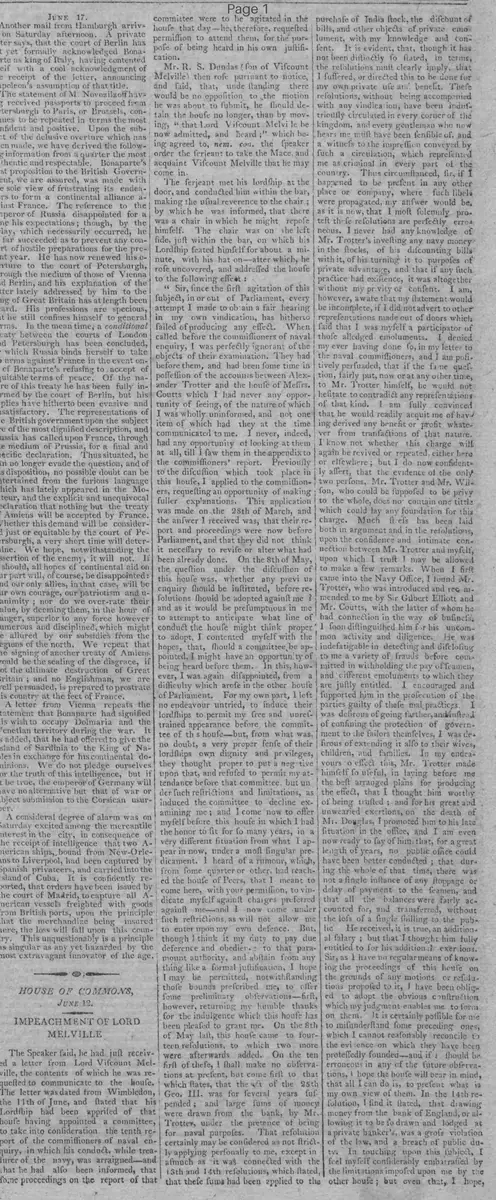
The committee were to be agitated in the house that day --he, therefore, requested permission to attend them, for the purpose of being heard in his own justification.
Mr. R. S. Dundas (son of Viscount Melville) then rose pursuant to notice, and said, that, understanding there would be no opposition to the motion he was about to submit, he should detain the house no longer, than by moving, "that Lord Viscount Melville be now admitted, and heard;" which being agreed to, nem. con. the speaker order the serjeant to take the Mace, and acquaint Viscount Melville that he may come in.
The serjeant met his lordship at the door, and conducted him within the bar, making the usual reverence to the chair; by which he was informed, that there was a chair in which he might repose himself. The chair was on the left side, just within the bar, on which his Lordship seated himself for about a minute, with his hat on--after which, he rose uncovered, and addressed the house to the following effect:
"Sir, since the first agitation of this subject, in or out of Parliament, every attempt I made to obtain a fair hearing in my own vindication, has hitherto failed of producing any effect. When called before the commissioners of naval enquiry, I was perfectly ignorant of the objects of their examination. They had before them, and had been some time in possession of the accounts between Alexander Trotter and the house of Messrs. Coutts which I had never any opportunity of seeing, of the nature of which I was wholly uninformed, and not one item of which had they at the time communicated to me. I never, indeed, had any opportunity of looking at them at all, till I saw them in the appendix to the commissioners' report. Previously to the discussion which took place in this house, I applied to the commissioners, requesting an opportunity of making fuller explanations. This application was made on the 28th of March, and the answer I received was, that their report and proceedings were now before Parliament, and that they did not think it necessary to review or alter what had been already done. On the 8th of May, the question under the discussion of this house was, whether any previous enquiry should be instituted, before resolutions should be adopted against me? and as it would be presumptuous in me to attempt to anticipate what line of conduct the house might think proper to adopt, I contented myself with the hopes, that, should a committee be appointed, I might have an opportunity of being heard before them. In this, however, I was again disappointed, from a difficulty which arose in the other house of Parliament. For my own part, I left no endeavour untried, to induce their lordships to permit my free and unrestrained appearance before the committee of this house--but, from what was, no doubt, a very proper sense of their lordships own dignity and privileges, they thought proper to put a negative upon that, and refused to permit my attendance before that committee. but under such restrictions and limitations, as induced the committee to decline examining me; and I come now to offer myself before this house in which I had the honor to sit for so many years, in a very different situation from what I appear in now, under a most singular predicament. I heard of a rumour, which, from some quarter or other, had reached the house of Peers, that I meant to come here, with your permission, to vindicate myself against charges preferred against me--and I now come under such restrictions, as will not allow me to enter upon my own defence. But, though I think it my duty to pay due deference and obedience to that paramount authority, and abstain from any thing like a formal justification, I hope I may be permitted, notwithstanding those bounds prescribed me, to offer some preliminary observations--first, however, returning my humble thanks for the indulgence which this house has been pleased to grant me. On the 8th of May last, this house came to fourteen resolutions, to which two more were afterwards added. On the ten first of these, I shall make no observations at present, but come first to that which states, that the act of the 25th Geo. III. was for several years suspended; and large sums of money were drawn from the bank, by Mr. Trotter, under the pretence of being for naval purposes. That resolution certainly may be considered as not strictly applying personally to me, except in as much as it was connected with the 13th and 14th resolutions, which stated that these sums had been applied to the purchase of India stock, the discount of bills, and other objects of private emolument, with my knowledge and consent. It is evident, that, though it has not been distinctly stated, in terms, the resolutions must clearly imply, that I suffered, or directed this to be done for my own private use and benefit. These resolutions, without being accompanied with any vindication, have been industriously circulated in every corner of the kingdom, and every gentleman who now hears me must have been sensible of, and a witness to the impression conveyed by such a circulation, which represented me as criminal in every part of the country. Thus circumstanced, sir, if I happened to be present in any other place or company, where such libels were propagated, my answer would be, as it is now, that I most solemnly protest these resolutions are perfectly erroneous. I never had any knowledge of Mr. Trotter's investing any navy money in the stocks, of his discounting bills with it, of his turning it to purposes of private advantage, and that if any such practice had existence, it was altogether without my privity or consent. I am, however, aware that my statement would be incomplete, if I did not advert to other representations made out of doors which said that I was myself a participator of those alleged emoluments. I denied my ever having done so, in my letter to the naval commissioners, and I am positively persuaded, that if the same question, fairly put, now or at any other time, to Mr. Trotter himself, he would not hesitate to contradict any representations of that kind. I am fully convinced that he would readily acquit me of having derived any benefit or profit whatever from transactions of that nature. I know not whether this charge will again be revived or repeated, either here or elsewhere: but I do now confidently assert, that the evidence of the only two persons, Mr. Trotter and Mr. Wilson, who could be supposed to be privy to the whole, does not contain one tittle which could lay any foundation for this charge. Much stress has been laid both in argument and in the resolutions, upon the confidence and intimate connection between Mr. Trotter and myself, upon which I trust I may be allowed to make a few remarks. When I first came into the Navy Office, I found Mr. Trotter, who was introduced and recommended to me by Sir Gilbert Elliott and Mr. Coutts, with the latter of whom he had connection in the way of business. I soon distinguished him for his uncommon activity and diligence. He was indefatigable in detecting and disclosing to me a variety of frauds before committed in withholding the pay of seamen, and different emoluments to which they are justly entitled. I encouraged and supported him in the prosecution of the parties guilty of these mal practices, I was desirous of going farther, and instead of confining the protection of government to the sailors themselves. I was desirous of extending it also to their wives, children, and families. In my endeavours to effect this, Mr. Trotter made himself so useful, in laying before me the best arranged plans for producing the effect, that I thought him worthy of being trusted: and for his great and unwearied exertions, on the death of Mr. Douglas, I promoted him to his late situation in the office, and I am even now ready to say of him, that, for a great length of years, no public office could have been better conducted; that during the whole of that time, there was not a single instance of any stoppage or delay of payment to the seamen, and that all the balances were fairly accounted for, and transferred, without the loss of a single shilling to the public He received, it is true, an additional salary; but that I thought him fully entitled to for his additional exertions. Sir, as I have no regular means of knowing the proceedings of this house on the grounds of any motions or resolutions proposed to it, I have been obliged to adopt the obvious construction which my judgment enables me to form on them. It is certainly possible for me to misunderstand some preceding ones, which I cannot reasonably reconcile to the evidence on which they have been professedly founded--and if I should be erroneous in any of the future observations, I hope the house will bear in mind, that all I can do is, to present what is my own view of them. In the 14th resolution, I find it stated, that drawing money from the bank of England, or allowing it to be so drawn and lodged at a private banker's, was a gross violation of the law, and a breach of public duty. In touching upon this subject, I feel myself considerably embarrassed by the limitations imposed upon me by the other house; but even that, I hope
Should not prevent me from stating one positive fact which is, that on no occasion whatever did I ever authorize Mr. Trotter to draw money from the Bank of England, and lodge it any where for his own private emolument.
Thus I assert in the most distinct manner, and must further contend, that neither before the Naval Commissioners, nor the Committee of this House, is there a particle of evidence in support of a charge of that nature. It does not any where appear that all the instruments for drawing money from the Bank for Naval purposes were not made out legally, and according to the true intent and meaning of the Act of Parliament.
When under examination myself, I told the Commissioners no more than that I allowed Mr. Trotter to lodge money in the hands of a private banker, for the convenience of making payments during the interval that may elapse till those payments were demanded. I further stated, that I took it for granted these sums were always drawn under competent authority. I thought at the time, and had a right to believe that they perfectly understood me: and what appears the strangest of all is, that they reported the evidence, reported the examination correctly enough to draw conclusions, in order to found a charge, which appears to me contrary to the evidence.
However constrained I must find myself by the limitations of the Lords, I must make bold to say, that the assertions contained in the Report are made in contradiction to truth, and the evidence which was taken before them. There is, Sir, one universal mistake, which seems to have pervaded the whole of these proceedings. The Act of the 25th of the King, of which I must be allowed to have some share of knowledge, never intended, nor had it in contemplation to make a regular digest of regulations for the office of Treasurer of the Navy.
Its true intent and object, as very clearly expressed, were to restrain Treasurers or Paymasters from retiring from office, as had frequently been done before, with large balances unaccounted for, to remain in their hands for a great length of time. The whole of the act is comprised in twelve short clauses, enjoining that the Treasurers accounts should in future be official, and not personal, as was the former practice. During the whole of my administration, that law was rigidly complied with, and in retiring from office, I have not been accused of retaining any balance whatever.
The House should consider, that beyond the necessary controul of the Treasurer, his office is quite distinct from that of the Paymaster, and that of the Paymaster General not very much connected with those of other persons employed in that department. A great deal of money must pass through the hands of inferior officers in different parts of the country, where the demands are made.
In the month of January last, the Pay Office was kept open for a long time, to make good small demands; and there were six thousand eight hundred and two payments made in different proportions of sums, from three or four pounds so low as four shillings and six pence, and many of them even to a smaller amount, to supply such sums as different sailors were entitled to. It must, therefore be obvious, that to answer such numerous classes of demands without delay, it is necessary to have always a very large sum, either in the iron chest of the office, or at some convenient banker's, as it would be endless to pay them all by draft on the Bank of England, specifying the names of the persons in whose favor they were drawn.
The Act of Parliament therefore did not, nor was it ever intended to apply to inserting the names of the persons in whose favour the drafts were made; but on the contrary, enjoined that from the moment assignments of demands were made from the respective offices, the Paymaster should have the money ready, which he could not effect without previously drawing it from the Bank.
So far therefore was the Act from making this practice criminal, that it was in fact prohibitory of any other method. The Act of the 25th of George III. so frequently alluded to, was founded on the Report of the Finance Committee of 1792, in which it was stated that the Treasurer of the Navy, or the Paymaster, were not then accountable for the sums drawn from the Bank in consequence of assignments of demands to the public, but only to the persons in whose favor the assignments were made.
It complained of that want of responsibility to the public which enabled them to retain large balances in their hands until the claims were absolutely made, and then only personally responsible to the parties. To remedy this was the foundation of the Act, which rendered their accounts public, and I consider myself perfectly right in stating this to be the true intent and construction of the Law.
But, supposing me to be wrong on this construction, and that the intention of the Act was to compel the treasurer to give separate drafts on the Bank of England to every claimant, specifying his name, and the nature of his demand; will any one honestly say that my misunderstanding or misconstruction of the act was a gross violation of the law, and a gross breach of duty; or even that every positive violation of the words of an act of Parliament is, in all possible cases, a gross breach of public duty?
I come next, sir, to another part of my examination before the commissioners. If I then said, as I admit to have done, that I thought some emolument might fairly arise to the paymaster from his placing money in the hands of a private banker, provided it should be always forthcoming when large demands were made, I spoke in the general knowledge which every man must have of business.
I did not think it unfair that, during the interval between the lodgement of such money and the demands, an understanding of a mutually accommodating nature should subsist between the banker and the paymaster. In all transactions of that kind, is there any gentleman now present or who does not know, that the bankers have always some interest, and derive some emolument from whatever money may be deposited in their hands; and who is not aware, that they are in the habit of giving some reciprocal accommodation to the persons so depositing large sums of money?
This practice was not peculiar to my administration of the office of Treasurer of the navy, as it was continued for two years afterwards, until my successor, Mr. Bathurst, reversed it, from an opinion that it was not consistent with the strict letter of the law.
I shall, for many reasons sir, now abstain from going into any detail of the minutiae of that office, which, perhaps, like others, may be the subject of future regulation—but I must maintain, that the method here condemned is much preferable to the former practice, of leaving the money in the bank of England, in the name of, and subject to, the responsibility of the sub-accountants; nor can I conceive how, in that manner, regularly to pay, and faithfully to administer the discharge of every demand made me from the out-ports.
I knew that it may, and has, I believe, been said, that since the practice was changed, no inconvenience has resulted to the public. To this argument all I shall answer is, that there has been hitherto but a very short experience of the effects of a different system, and that, in the practice of so many former years, the plan of lodging money at private bankers was found productive of very beneficial effects.
In justice to myself, I beg leave to state, sir, that my intercourse with the naval commissioners commenced on the 26th of April, in their letter to me, calling for an explanation of a variety of transactions. They had, as I already observed, before them at the time, all the accounts between Mr. Trotter and the house of Messrs. Coutts, of which I was altogether ignorant.
I was obliged to answer off-handed, in the several questions which they had ready, in an arranged and digested form, and had not within my reach any materials which could assist my recollection. I own that I felt myself disagreeably circumstanced on account of a previous communication from Mr. Trotter, that his accounts with Messrs. Coutts were so blended and confused that it was impossible distinctly to separate them; but this difficulty I distinctly stated to them at the time, with the impossibility I felt of giving from memory the explanation they required.
I however answered every thing as far as I was informed, and only objected to explain those matters of private and confidential communication, which I thought my duty would not suffer me to disclose. I am thoroughly and clearly convinced that I never allowed Mr. Trotter to apply any part of the public money to my private use or benefit, and might safely have said so in the first instance, though so much sarcastic eloquence has been displayed, and so much acrimonious wit employed on the subject of my having said the words, "to the best of my recollection."
It has also been brought as an auxiliary argument against me, that I preferred holding the office of treasurer of the navy, together with the presidency of the board of controul for India affairs, to that of Secretary of state with the same emoluments, which, it was said, I should not have done, if I had no private interest in doing so, and that interest, of course, of an indirect or clandestine nature.
I can, however, conscientiously declare, in the presence of many, but more particularly of one right hon. gentleman, who very well knows it, that I never in my life went into the secretary of state's office by my own consent, even for a single moment. At the time I accepted of it by his majesty's command, which my duty or inclination would not suffer me to disobey, I was told I was to hold it only for a few months, until the return of a certain noble lord, who was then upon a foreign mission.
I very cheerfully and gladly resigned it afterwards, when another noble lord received his appointment. I then held the office of President over the political administration of the affairs of India, and retained with it the office of treasurer of the navy; and, after all, I fancy this preference will not appear very extraordinary, when gentlemen consider how much these two offices were always known to be intimately connected with each other.
I have a right to apologise to the House for intruding so long upon the attention they have been pleased to shew; but I trust, I shall be excused trespassing on them with a few more observations. Gentlemen will, no doubt, feel the necessity a man in my situation has for doing so, when they reflect, that, after retiring from the spot I now stand in, I shall have no opportunity whatever of interfering in any debate that may arise, and must, therefore, be extremely desirous and anxious, that, what their indulgence has now allowed me to offer, should be distinctly understood.
Every one, sir, must be conscious, that there are a vast number of persons, who will be fully satisfied with the partial report of the commissioners of naval enquiry, who declined hearing any further explanations from me, and that these persons have not looked to any thing like a justification.
I am, therefore, I think, very justly entitled to state, and even to press upon your consideration, that I never had, either directly or indirectly, any means or opportunity of seeing the private accounts between Mr. Trotter and Mr. Coutts, till I found them in the appendix to the report of the commissioners. I am, therefore, completely at the mercy of Mr. Trotter's accounts which I never had the means of reading or correcting.
Many things also in the evidence of Mr. Trotter, both before the commissioners and the committee, rested much more upon the recollection of events long past, than on any present accounts which he could at the time resort to. Mr. Trotter's evidence confounded both facts and persons.
When he said that he had been at one time from 20 to 23,000l. in advance for me, and had drawn for it in the course of one day, he was as much in mistake or error, as he was in stating that he had known and considered Mr. Tweedy as only in the subordinate office of a messenger to the pay office, but had trusted him from his being in intimate confidence with me.
So far however, from that having been the case, Mr. Tweedy was only known to me officially as a messenger, and it never happened that I had ever occasion to see or speak to him above once or twice in my life. The man, therefore, could never have been with me in habits of intercourse or confidence; and upon these points, I have to lament that the recollection of Mr. Trotter is not now by any means the same which his friends knew it to be fifteen or twenty years ago.
The commissioners, however, thought it right to proceed upon an extensive enquiry into this subject, and, on the examination of his family, it appeared from the testimony of his son, that in the father's accounts he could find no trace of any intercourse whatever between him and me.
What now, sir, chiefly remains for me to observe upon, is the application of two sums of money which I objected to account for. Upon this subject I must remark, that in the whole course of the long administration in which I bore a part, I was the confidential adviser of his majesty's government in every measure which had any relation to Scotland.
I was so officially, from the first, with a very short interval: but in general was in the same manner consulted to the last. In all the transactions which occurred in so great a length of time, gentlemen will see that many things must have unavoidably occurred for requiring the application of public money in a private and confidential manner, to the amount of about 60,000l. which I now declare that I never will, and never can disclose, without a breach both of public duty and private honor.
With respect to the application of 40,000l. for a time from the naval money for the accommodation of the treasury under very delicate circumstances, I refused to give any explanation to the naval commissioners, I thought it my duty to have done so at the time, and I am sure that there were times when those who afforded an explanation of it would have usually thought it their duty to have declined so doing.
Mr. Trotter could never have meant to say, that he ever advanced for me such a sum as 20,000l. on the same day; and I am certain, that if he was asked the question now, he would say, that I never had the slightest knowledge of its having come out of the public money.
He must have intended to state, that this sum arose during the whole course of his agency, for which I think I paid about 1,000l. interest. He stated that there was an account current between us, and this included the sum of 20,000l. upon the whole.
I very well recollect subscribing 10,000l. to the loyal loan, and I did so from a knowledge that it was expected that all the chief servants of Government should be subscribers to a considerable amount. Two instalments of it were paid, as I well recollect, out of my remittances from Scotland, and so far was I from thinking that share in the loyalty loan any part of my property, that I immediately executed a power to get rid of my stock in it as soon as an opportunity should offer.
When it is considered that in his connections with me for forty years, upwards of 70,000l. of mine passed through his hands from receiving the salaries of my different offices here and my remittances from Scotland, it will not seem wonderful that the accumulated balance, taking the different periods at which the money was advanced, should be even 20,000l. against me; I never had any occasion to require any thing like 20,000l. at one time, and it frequently happened that Mr. Trotter was in arrears with me, as was the case at the time of our final settlement.
In regard to the 40,000l. advanced to the treasury, as already alluded to, I am ready to admit, that I gave my concurrence to it in common with the other superior servants of government, and am willing to take my share of the responsibility.
Upon the subject of the conversation between Mr. Raikes and Mr. Pitt, of a suspicion that more money was drawn for naval purposes, from the bank, than was deemed necessary for the public service, I have only to declare, that it did not occur to my memory, at the time of my examination: and that the recollection of Mr. Pitt's having mentioned it to me afterwards, is rather excited or revived from recent circumstances, than from any distinct impression which I retained of it.
I now remember that I then treated it as an idle rumour, such as I had reason to believe; and my answer to Mr. Pitt must have then been the same, which I have now to submit to the consideration of the house.
The next topic that suggests itself, sir, is the loss sustained by the public by the balances which remained in the hands of Mr. Jellicoe: and I must say, that circumstance has given me less uneasiness than any of the others connected with this subject.
That debt, such as it was, had been incurred before ever I became treasurer of the navy. I used my best exertions in endeavoring to recover it, and the failure of having done so can not be attributed to any fault of mine.
There is another subject, sir, to which I beg to call the attention of the house, because a great many very severe comments have been passed on it: and the matter has been so grossly misrepresented in every way that it was possible to conceive and so industriously circulated through every corner of the country, I mean, sir, the release that was given between Mr. Trotter and myself, that it was impossible for me to pass it by without particular observation.
In whatever way we proceed to consider that transaction, I think the nature of it is such, that it is scarcely possible for the mind of any man to be so perverse or so malignant, as to attribute it to an unfair or foul proceeding, or to any kind of transaction, which either or both of us were unwilling should come to light.
As to the thing itself, I assure the house that I knew nothing of it till I received it at the distance of 40 miles from the metropolis, and of so little consequence did I regard it; and so very trifling was the impression it made on my mind, in point of weight or importance, that I really do not know how, or in what manner it came to my hands, whether it came to me in a cover, or whether it was discovered through the medium of any man of business.
I am inclined to think, however, this last was not the way, or I should have been apt to recollect it more particularly. All I remember is, that I was at my son's house in the country, and it is most likely to have been delivered to me by one of my two servants, and I signed it as a matter, that was in a manner necessary between two persons, between whom there had passed accounts of so extensive and complicated a nature.
Mr. Trotter had been asked the question by the Committee, whether any particular conversation had taken place on it? and he had answered, No. He was also asked, whether there was any other person that could give any further account of it? To this he had also answered, No.
Mr. Spottswoode, who drew it up, had been dead these six months, and of course they were deprived of his evidence; but they have that of his son, and his partner; and if there had been any thing remaining as to this deed, they must have known of it. They neither of them did; and this I think is the strongest negative evidence, that can be given in such a matter of business.
It had been said to be astonishing that there should not be some draft of it. But the very supposition was absurd on the face of it, that because there was no draft, he and some other person had been concerned in foul transactions, which they wished to conceal.
Could not the parties, if there had been any such, have easily and readily destroyed the vouchers and other documents that might lead to detection, without having any actual release, by which they put a deed into the hands of a variety of persons, who might afterwards discover what had been done.
Besides, such a deed, to be effectual, must be recorded in some of the Supreme Courts, and thus the deed itself would prove the strongest evidence against the parties.
There is, Sir, another supposition, that this took place immediately on the appointment of the Naval Commissioners, which is equally absurd; for at the time that took place, I was at so great a distance, as I before mentioned, that I knew nothing of it; and if any such intentions had been in contemplation, or any apprehensions entertained on account of any discoveries that might ensue, such a deed as this would certainly have been resorted to in some antecedent period, and not deferred so long.
Some persons have expressed considerable surprise, that such a clause should be contained in such a deed of release, as that for the destroying of vouchers or memoranda, but I believe, they are not uncommon as to loose papers, and there is nothing in it that relates to books of accounts.
I have dwelt longer on this point, Sir, than I otherwise should have done, on account of the number of reports & acrimonious observations which have gone abroad concerning it. It is not, however, my intention to intrude on the time and patience of the house much further, as I am conscious I have no reason to be afraid that I shall not be able to convince the whole world of the rectitude of my conduct and intentions.
I certainly do not mean to say that I have not experienced, or do not feel at present, the utmost anxiety on these various accounts, and at what has been for some time passing in this house relative to myself. I should think and freely confess, that I must be possessed of extraordinary apathy indeed, could I be insensible to proceedings so highly interesting on a subject of such magnitude and importance.
I have felt, Sir, most keenly the many severe comments and observations which have been made on transactions that have been said to attach to me, but which I deny to be the fact. I have, Sir, however, felt them like a man; and if there are persons who think thereby to break down the spirit with which I ought to defend myself, they will find themselves mistaken.
I own, Sir, that every mode has been resorted to, which could have a tendency to that point, and I have been lacerated, not only in my own feelings, but from the reflection that, in the wounds I have received, the smart was doubled on the recollection of some of the hands that were obliged to inflict the probe.
I am, Sir, notwithstanding, ready to meet the attack with that fortitude and patience which ever attend on a mind conscious of the rectitude and purity of its actions and intentions.
A time, however, may come, and I hope it is not far distant, when those who now pursue my conduct with such unexampled rigour will perceive their error, and become conscious of the injustice that has been done me, through misconception and misrepresentation.
This is, however, not the time to enter upon that theme; but I feel the consciousness of my own innocence deeply implanted in my own mind, and I shall descend to my grave with the pleasing and heartfelt satisfaction, that, however the shafts of severity and cruelty may be levelled against me, at the present moment, the future impartial historian will be able to hand down my name in the list of those who have strenuously, and I hope not ineffectually, exerted, during a long life of public service, their unremitted endeavours to promote the welfare, and the dearest and most essential interests of their country.
I am sorry, Sir, to detain the house so long, but I cannot leave it without requesting to be heard a few words on the subject, at present immediately fixed to occupy their attention and consideration.
If the Motion intended to be brought forward this day, or any like it should take place, I shall be placed in such a situation as no subject of this realm was ever placed before. It is very well known to the House that the person who now addresses them has been employed in high official situations, that he is a person of high rank, & has been a Minister of state, and as such, I should suppose, he would be thought to deserve, at least, equal consideration with those who move in the inferior orders.
I should have thought he might have expected to have been treated with at least an equal degree of candor and lenity, and that some considerable degree of criminality would have been actually proved against him; before this House, or any other tribunal, would have consented and decreed, that he should be actually punished in the severest manner.
It may, perhaps, be thought by some, and I have, no doubt, but it is confidently asserted by many, that I have received no actual punishment; but I would ask the House, and the world at large, is it no punishment to be stigmatised, as being unworthy the confidence of my Sovereign?
Is it no punishment to be dismissed from a high official situation, and to be branded with the odious charge of being no longer fit to continue in his Majesty's councils? If this be not punishment, and of the severest kind, I know not what the word implies.
I will, sir, put the case, that an impeachment had actually been voted, when this subject was first brought before the House I will even go further, and suppose, by way of argument, that the impeachment had succeeded, and that the charges alledged against me had been fully proved.
The punishment, I have a right to suppose, might not have been more than what has already been inflicted, without my having had any opportunity of being heard in my own defence, and upon evidence which, I have before said, and which I now repeat, has been misconceived and mistaken.
I will not say, sir, that your proceedings are deserving the character of harshness and oppression; but certainly the operation and effects they have produced must be allowed to be tantamount as to myself.
It is not perhaps of equal importance in the eye and estimation of the world at large, that such a punishment as this should have fallen to the lot of a man at my time of life, who cannot be supposed, according to the common course of things, to have held these honors many years longer; but, supposing this to be so, let me ask what would it have been, had such a proceeding taken place with a man in a younger period of life, whose ambition was all alive, who wished not only to arrive at the highest offices of the state, but to continue in the enjoyment of them?
It cannot surely be denied that it would have been the highest and most severe punishment that could well be conceived, to stigmatise him thus in his own person, and with such opprobrious terms and marks of disgrace as would not fail to convey the most melancholy and cruel effects to his unfortunate, though innocent posterity?
I would further ask—is it no punishment that the Attorney General should be ordered to commence a prosecution against a man for the recovery of a sum of money equal perhaps to the amount of his whole fortune, because it is alledged only to have been unfairly attained?
Is it no punishment that in the close of life, that interesting period in which repose, retirement and tranquility are most peculiarly requisite for its sustenance and comfort, he should be harrassed by the institution of a process which is to make him liable for what he has not received, and which may, perhaps, eventually reduce him to absolute poverty?
If placing any person in such circumstances as these, be not severe punishment, I know not what can deserve the name.
Besides, sir, if I am to be impeached, I should be glad to know by whom I am to be tried? The house will do well to consider that what has already passed in their proceedings has produced the effect of stimulating a great number of Peers to stand forward in various parts of the country, and to promulgate opinions on the subject of his conduct in terms which shew forcibly and clearly they have already prejudged my cause, and cannot therefore think of sitting as my judges.
These noble lords could certainly never have dreamed of the word impeachment as applicable to my case, or they would never have taken the parts that many of them had done.
I beg leave to remind the House of the proceedings that took place some few years ago at Maidstone. At that time a man of the name of Raikes, who was one of the jury, had uttered intemperate words against some or all of the parties to be tried.
On this being represented to the judge, he was not allowed to act in the capacity of a juryman, but his name was struck out of the pannel: so careful and jealous is the law of this country of suffering any man to sit in judgment on another whose cause he has in his own mind determined before hand.
The same disadvantage will attend me in the case of an impeachment in reference to my accusers. A certain number would be appointed by this House to manage
the proceedings, and to conduct the trial with fairness and impartiality. Among these, in all likelihood, will be found gentlemen who have been haranguing the multitude, and inflaming their minds against me in Palace-yard, and various other places in London, and through every part of the country, so that if those be not idle reports, there is no fair chance of my meeting an impartial jury, before whatever tribunal I may be tried.
I have another observation, sir, which applies to what has been said, as to accounting under another charge. The Attorney General has, I understand, been ordered to institute a civil action against me for the money which it is alleged and supposed I have obtained from the public. Is it just that I shall have two different prosecutions against me at the same time, and that the Attorney General should have it in his power to bring the evidence adduced in the civil action before the criminal tribunal, and vice versa? I think this a kind of procedure that it is impossible justice can allow: it is such a mixture of one thing with another as no words can describe. It will be such a proceeding as, if allowed, there can be no security for any person of rank who acts in official situations; they will always be liable to this double mode of proceeding, and to be harassed continually, whilst the lower orders will be free from any such disadvantages. This is a rigorous jealousy of the aristocracy, which I do not think it deserves; but which, after having troubled the house so long, I will not dwell upon any further. Viscount Melville then made the usual salutations to the House, and withdrew.
What sub-type of article is it?
What keywords are associated?
What entities or persons were involved?
Where did it happen?
Foreign News Details
Primary Location
House Of Commons
Event Date
June 12.
Key Persons
Outcome
viscount melville delivered a lengthy defense speech denying charges of financial impropriety; no immediate resolution or vote reported.
Event Details
Mr. R. S. Dundas moved for Viscount Melville to be heard in the House of Commons. Melville addressed the house, protesting the resolutions from May 8 accusing him of allowing naval funds to be misused for private gain by paymaster Alexander Trotter. He denied knowledge of investments in stocks or bill discounting, asserted compliance with the Act of 25th Geo. III., explained practices for handling payments, defended his relationship with Trotter, addressed specific sums like 40,000l. to the treasury and 20,000l. advances, discussed the release deed with Trotter, and complained of unfair treatment and prejudgment by peers.