Thank you for visiting SNEWPapers!
Sign up free
Richmond Enquirer
Richmond, Richmond County, Virginia
What is this article about?
Correspondence between King George III and Prime Minister William Pitt in 1801 regarding Catholic and Dissenter emancipation after the Irish Union. Pitt advocates for reforms to secure Ireland's tranquility, but the King refuses on religious and constitutional grounds, prompting Pitt's resignation. Includes letters from the Duke of York opposing the measures.
Merged-components note: Merged sequential components as they form a continuous historical document on correspondence between George III, Mr. Pitt, and others.
Clipping
OCR Quality
Full Text
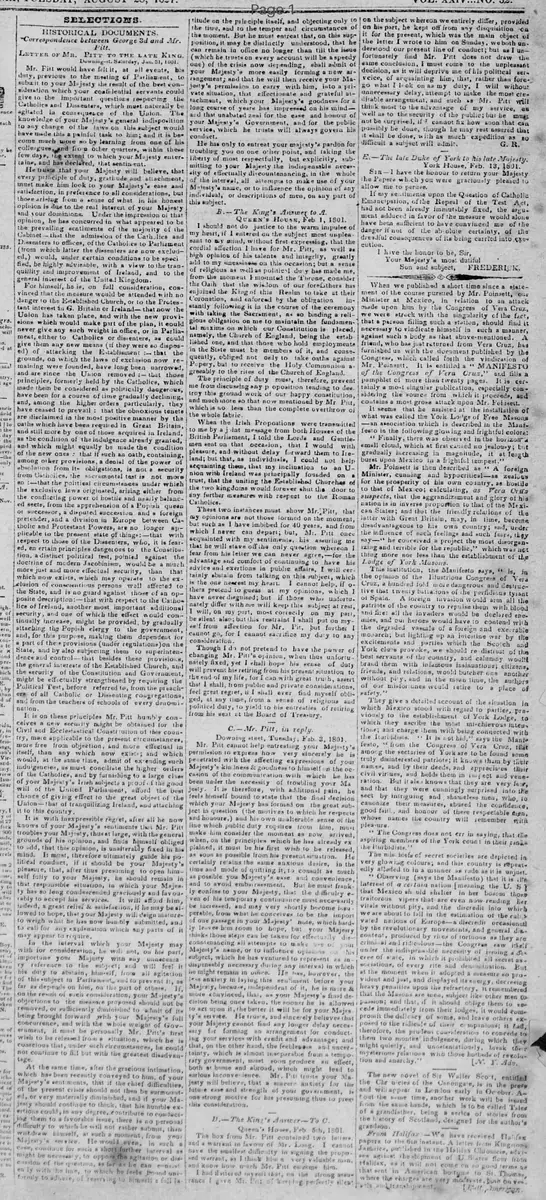
HISTORICAL DOCUMENTS.
-Correspondence between George 3d and Mr. Pitt.
LETTER of Mr. Pitt To the Late King.
Downing-st, Saturday, Jan 31, 1801,
Mr. Pitt would have felt it, at all events, his duty, previous to the meeting of Parliament, to submit to your Majesty the result of the best consideration which your confidential servants could give to the important questions respecting the Catholics and Dissenters, which must naturally be agitated in consequence of the Union. The knowledge of your Majesty's general indisposition to any change of the laws on this subject would have made this a painful task to him; and it is become much more so by learning from one of his colleagues, and from other quarters, within these few days, the extent to which your Majesty entertains, and has declared, that sentiment.
He trusts that your Majesty will believe, that every principle of duty, gratitude and attachment, must make him look to your Majesty's ease and satisfaction, in preference to all considerations, but those arising from a sense of what in his honest opinion is due to the real interest of your Majesty and your dominions. Under the impression of that opinion, he has concurred in what appeared to be the prevailing sentiments of the majority of the Cabinet -that the admission of the Catholics and Dissenters to offices, of the Catholics to Parliament (from which latter the dissenters are now excluded,) would, under certain conditions to be specified, be highly advisable, with a view to the tranquillity and improvement of Ireland, and to the general interest of the United Kingdom.
For himself, he is, on full consideration, convinced that the measure would be attended with no danger to the Established Church, or to the Protestant interest in G. Britain or Ireland- that now the Union has taken place, and with the new provisions which would make part of the plan, it could never give any such weight in office, or in Parliament, either to Catholics or dissenters, as could give them any new means (if they were so disposed) of attacking the Establishment :-- that the grounds, on which the laws of exclusion now remaining were founded, have long been narrowed, and are since the Union removed:-that those principles, formerly held by the Catholics, which made them be considered as politically dangerous, have been for a course of time gradually declining and, among the higher orders particularly, they have ceased to prevail : that the obnoxious tenets are disclaimed in the most positive manner by the oaths which have been required in Great Britain, and still more by one of those acquired in Ireland, as the condition of the indulgence already granted, and which might equally be made the condition of the new ones : that if such an oath, containing, among other provisions, a denial of the power of absolution from its obligations, is not a security from Catholics. the sacramental test is not more so :--that the political circumstances under which the exclusive laws originated, arising either from the conflicting power of hostile and nearly balanced sects, from the apprehension of a Popish queen or successor, a disputed succession and a foreign pretender, and a division in Europe between Catholic and Protestant Powers, are no longer applicable to the present state of things:-that with respect to those of the Dissenters, who, it is feared, entertain principles dangerous to the Constitution, a distinct political test, pointed against the doctrine of modern Jacobinism, would be a much more just and more effectual security, than that which now exists, which may operate to the exclusion of conscientious persons well affected to the State, and is no guard against those of an opposite description:-that with respect to the Catholics of Ireland, another most important additional security, and one of which the effect would continually increase, might be provided, by gradually attaching the Popish clergy to the government, and, for this purpose, making them dependent for a part of their provisions (under regulations) on the State, and by also subjecting them to superintendence and control--that besides these provisions, the general interests of the Established Church, and the security of the Constitution and Government, might be effectually strengthened by requiring the Political Test, before referred to, from the preachers of all Catholic or Dissenting congregations, and from the teachers of schools of every denomination.
It is on these principles Mr. Pitt humbly conceives a new security might be obtained for the Civil and Ecclesiastical Constitution of this country, more applicable to the present circumstances, more free from objection, and more effectual in itself, than any which now exists; and which would, at the same time, admit of extending such indulgences, as must conciliate the higher orders of the Catholics, and by furnishing to a large class of your Majesty's Irish subjects a proof of the good will of the United Parliament, afford the best chance of giving effect to the great object of the Union-that of tranquilizing Ireland, and attaching it to this country.
It is with inexpressible regret, after all he now knows of your Majesty's sentiments that Mr. Pitt troubles your Majesty, thus at large, with the general grounds of his opinion, and finds himself obliged to add, that this opinion, is unalterably fixed in his mind. It must, therefore ultimately guide his political conduct, if it should be your Majesty's pleasure, that, after thus presuming to open himself fully to your Majesty, he should remain in that responsible situation, in which your Majesty has so long condescended graciously and favourably to accept his services. It will afford him, indeed, a great relief & satisfaction, if he may be allowed to hope, that your Majesty will deign maturely to weigh what he has now humbly submitted, and to call for any explanation which any parts of it may appear to require.
In the Interval which your Majesty may wish for consideration, he will not, on his part, importune your Majesty with any unnecessary reference to the subject; and will feel it his duty to abstain, himself, from all agitation of this subject in Parliament and to prevent it, as far as depends on him, on the part of others. If, on the result of such consideration, your Majesty's objections to the measure proposed should not be removed, or sufficiently diminished to admit of its being brought forward with your Majesty's full concurrence, and with the whole weight of Government, it must be personally Mr. Pitt's first wish to be released from a situation, which he is conscious that, under such circumstances, he could not continue to fill but with the greatest disadvantage.
At the same time, after the gracious intimation, which has been recently conveyed to him, of your Majesty's sentiments, that if the chief difficulties, of the present crisis should not then be surmounted, or very materially diminished, and if your Majesty should continue to think, that his humble exertions could, in any degree, contribute to conducting them to a favorable issue, there is no personal difficulty to which he will not rather submit, than withdraw himself, at such a moment, from your Majesty's service. He would even, in such a case, continue for such a short further Interval as might be necessary, to oppose the agitation or discussion of the question, as far as he can consistently with the line, to which he feels bound uniformly to adhere, of reserving to himself a full latitude on the principle itself, and objecting only to the time, and to the temper and circumstances of the moment. But he must entreat that, on this supposition, it may be distinctly understood, that he can remain in office no longer than till the issue (which he trusts on every account will be a speedy one) of the crisis now depending, shall admit of your Majesty's more easily forming a new arrangement; and that he will then receive your Majesty's permission to carry with him, into a private situation, that affectionate and grateful attachment, which your Majesty's goodness for a long course of years has impressed on his mind—and that unabated zeal for the ease and honour of your Majesty's Government, and for the public service, which he trusts will always govern his conduct.
He has only to entreat your majesty's pardon for troubling you on one other point, and taking the liberty of most respectfully, but explicitly, submitting to your Majesty the indispensable necessity of effectually discountenancing, in the whole of the interval, all attempts to make use of your Majesty's name, or to influence the opinion of any individual, or descriptions of men, on any part of this subject.
B.-The King's Answer to A.
Queen's House, Feb 1, 1801.
I should not do justice to the warm impulse of my heart, if I entered on the subject most unpleasant to my mind, without first expressing, that the cordial affection I have for Mr. Pitt, as well as high opinion of his talents and integrity, greatly add to my uneasiness on this occasion; but a sense of religious as well as political duty has made me, from the moment I mounted the Throne, consider the Oath that the wisdom of our forefathers has enjoined the King of this Realm to take at their Coronation, and enforced by the obligation instantly following it in the course of the ceremony with taking the Sacrament, as so binding a religious obligation on me to maintain the fundamental maxims on which our Constitution is placed. namely, the Church of England, being the established one, and that those who hold employments in the State must be members of it, and consequently, obliged not only to take oaths against Popery, but to receive the Holy Communion agreeably to the rites of the Church of England.
The principle of duty must, therefore, prevent me from discussing any proposition tending to destroy this ground work of our happy constitution, and much more so that now mentioned by Mr Pitt, which is no less than the complete overthrow of the whole fabric.
When the Irish Propositions were transmitted to me by a joint message from both Houses of the British Parliament, I told the Lords and Gentlemen sent on that occasion, that I would with pleasure, and without delay forward them to Ireland; but that, as individuals, I could not help acquainting them, that my inclination to an Union with Ireland was principally founded on a trust, that the uniting the Established Churches of the two kingdoms would forever shut the door to any further measures with respect to the Roman Catholics.
These two instances must show Mr. Pitt, that my opinions are not those formed on the moment, but such as I have imbibed for 40 years, and from which I never can depart; but, Mr. Pitt once acquainted with my sentiments, his assuring me that he will stave off the only question whereon I fear from his letter we can never agree,-for the advantage and comfort of continuing to have his advice and exertions in public affairs, I will certainly abstain from talking on this subject, which is the one nearest my heart. I cannot help. if others pretend to guess at my opinions, which I have never disguised; but if those who unfortunately differ with me will keep this subject at rest, I will, on my part, most cordially on my part, be silent also; but this restraint I shall put on myself from affection for Mr. Pitt, but further I cannot go, for I cannot sacrifice my duty to any consideration.
Though I do not pretend to have the power of changing Mr. Pitt's opinion, when thus unfortunately fixed, yet I shall hope his sense of duty will prevent his retiring from his present situation to the end of my life, for I can with great truth, assert that I shall, from public and private considerations, feel great regret, if I shall ever find myself obliged, at any time, from a sense of religious and political duty, to yield to his entreaties of retiring from his seat at the Board of Treasury.
C.-Mr. Pitt, in reply.
Downing street, Tuesday, Feb. 3, 1801.
Mr. Pitt cannot help entreating your Majesty's permission to express how very sincerely he is penetrated with the affecting expressions of your Majesty's kindness & goodness to himself on the occasion of the communication with which he has been under the necessity of troubling your Majesty. It is therefore, with additional pain, he feels himself bound to state that the final decision which your Majesty has formed on the great subject in question (the motives to which he respects and honours,) and his own unalterable sense of the line which public duty requires from him, must make him consider the moment as now arrived, when, on the principles which he has already explained, it must be his first wish to be released, as soon as possible from his present situation. He certainly retains the same anxious desire, in the time and mode of quitting it, to consult as much as possible your Majesty's ease and convenience, and to avoid embarrassment. But he must frankly confess to your Majesty, that the difficulty even of his temporary continuance must necessarily be increased, and may very shortly become insuperable, from what he conceives to be the import of one passage in your Majesty's note, which hardly leaves him room to hope, but your Majesty thinks those steps can be taken for effectually discountenancing all attempts to make use of your Majesty's name, or to influence opinions on this subject, which he has ventured to represent as indispensably necessary during any interval in which he might remain in office. He has, however, less anxiety in laying this sentiment before your Majesty, because, independent of it, he is more & more convinced, that, as your Majesty's final decision being once taken, the sooner he is allowed to act upon it, the better it will be for your Majesty's service. He trusts, and sincerely believes that your Majesty cannot find any longer delay necessary for forming an arrangement for conducting your services with credit and advantage; and that, on the other hand, the feebleness and uncertainty, which is almost inseparable from a temporary government, must soon produce an effect, both at home and abroad, which might lead to serious inconvenience. Mr. Pitt trusts your Majesty will believe, that a sincere anxiety for the future ease and strength of your government, is one strong motive for his presuming thus to press this consideration.
D.-The King's Answer-To C.
Queen's House, Feb 5th, 1801.
The box from Mr. Pitt contained two letters. and a warrant in favour of Mr. Long. I cannot have the smallest difficulty in signing the proposed warrant, as I think him a very valuable man, and know how much Mr. Pitt esteems him.
I had flattered myself that, on the strong assurance I gave Mr. Pitt of keeping perfect silence on the subject whereon we entirely differ, provided on his part, he kept off from any disquisition on it for the present, which was the main object of the letter I wrote to him on Sunday, we both understood our present line of conduct; but as I unfortunately find Mr. Pitt does not draw the same conclusion, I must come to the unpleasant decision, as it will deprive me of his political services, of acquainting him, that, rather than forego what I look on as my duty, I will without unnecessary delay, attempt to make the most creditable arrangement, and such as Mr. Pitt will think most to the advantage of my service, as well as to the security of the public; but he must not be surprised, if I cannot fix how soon that can possibly be done, though he may rest assured that it shall be done, with as much expedition as so difficult a subject will admit.
G. R.
E.-The late Duke of York to his late Majesty.
York House, Feb. 13, 1801.
Sir—I have the honour to return your Majesty the Papers which you were graciously pleased to allow me to peruse.
If my sentiments upon the Question of Catholic Emancipation, of the Repeal of the Test Act, had not been already immutably fixed, the arguments adduced in favor of the measure would alone have been sufficient to have convinced me of the danger if not of the absolute certainty, of the dreadful consequences of its being carried into execution.
I have the honor to be, Sir,
Your Majesty's most dutiful
Son and subject, FREDERICK.
What sub-type of article is it?
What themes does it cover?
What keywords are associated?
What entities or persons were involved?
Where did it happen?
Story Details
Key Persons
Location
Downing St, Queen's House, York House, United Kingdom
Event Date
1801 01 31 To 1801 02 13
Story Details
Series of letters where Pitt urges Catholic and Dissenter emancipation post-Irish Union for Ireland's stability, proposing safeguards; King George III refuses based on coronation oath and Church of England establishment, leading to Pitt's resignation; Duke of York opposes the measures.