Thank you for visiting SNEWPapers!
Sign up free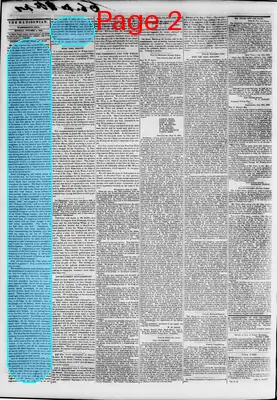
Editorial
October 3, 1842
The Daily Madisonian
Washington, District Of Columbia
What is this article about?
An editorial defends Henry Clay's peaceful retirement at Ashland against friends urging his return to politics and forged letters attributed to him. It criticizes the formation of political clubs like the Trenton Clay Club for promoting disorder and debauchery, advocating open discussion instead. Contrasts Clay favorably with historical figures like Themistocles.
Clipping
OCR Quality
95%
Excellent
Full Text
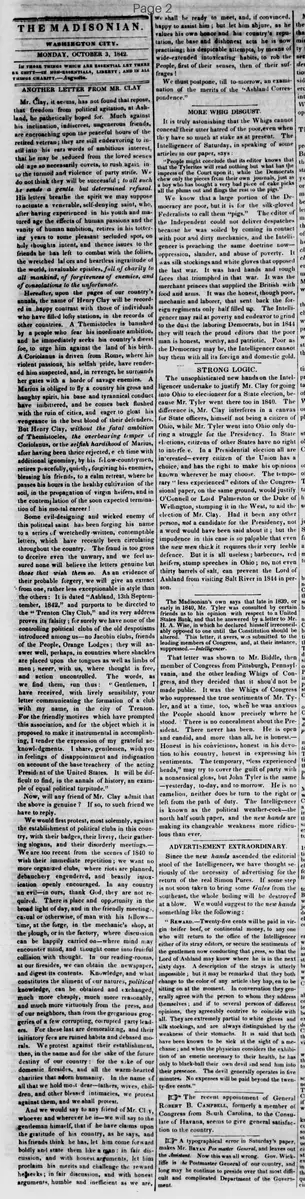
ANOTHER LETTER FROM MR. CLAY
Mr. Clay, it seems, has not found that repose, that freedom from political agitation, at Ashland, he pathetically hoped for. Much against his inclination, indiscreet, ungenerous friends, are encroaching upon the peaceful hours of the retired veteran; they are still endeavoring to instil into his ears words of ambitious interest, that he may be seduced from the loved scenes old age so necessarily covets, to rush again into the turmoil and violence of party strife. We do not think they will be successful; to all such he sends a gentle but determined refusal.
His letters breathe the spirit we may suppose to actuate a venerable, self-denying saint, who, after having experienced in his youth and matured age the effects of human passions and the vanity of human ambition, retires in his tottering years to some pleasant secluded spot, on holy thoughts intent, and thence issues to the friends he has left to combat with the follies, the wretched labors and heartless ingratitude of the world, invaluable epistles, full of charity to all mankind, of forgiveness of enemies, and of consolations to the unfortunate.
Hereafter, upon the pages of our country's annals, the name of Henry Clay will be recorded in happy contrast with those of individuals who have filled lofty stations, in the records of other countries. A Themistocles is banished by a people who fear his inordinate ambition, and he immediately seeks his country's dearest foe, to urge him against the land of his birth. A Coriolanus is driven from Rome, where his violent passions, his selfish pride, have rendered him suspected, and, in revenge, he surrounds her gates with a horde of savage enemies. A Marius is obliged to fly a country his gross and haughty spirit, his base and tyrannical conduct have imbittered, and he comes back flushed with the ruin of cities, and eager to gloat his vengeance in the best blood of their defenders.
But Henry Clay, without the fatal ambition of Themistocles, the overbearing temper of Coriolanus, or the selfish hardihood of Marius, after having been thrice rejected, each time with additional ignominy, by his fellow-countrymen, retires peacefully, quietly, forgiving his enemies, blessing his friends, to a calm retreat, where he passes his hours in the healthy cultivation of the soil, in the propagation of virgin heifers, and in the contemplation of the soon expected termination of his mortal career!
Some evil-designing and wicked enemy of this political saint has been forging his name to a series of wretchedly-written, contemptible letters, which have recently been circulating throughout the country. The fraud is too gross to deceive even the unwary, and we feel assured none will believe the letters genuine but those that wish them so. As an evidence of their probable forgery, we will give an extract from one, rather less exceptionable in style than the others: It is dated "Ashland, 13th September, 1842," and purports to be directed to the "Trenton Clay Club," and its very address proves its falsity; for surely we have none of the controlling political clubs of the old despotisms introduced among us—no Jacobin clubs, Friends of the People, Orange Lodges; they will answer well, perhaps, in countries where shackles are placed upon the tongues as well as limbs of men; never, with us, where thought is free, and action uncontrolled. The words, as we find them, run thus: "Gentlemen, I have received, with lively sensibility, your letter communicating the formation of a club with my name, in the city of Trenton.
For the friendly motives which have prompted this association, and for the object which it is proposed to make it instrumental in accomplishing, I tender the expression of my grateful acknowledgments. I share, gentlemen, with you in feelings of disappointment and indignation on account of the base treachery of the acting President of the United States. It will be difficult to find, in the annals of history, an example of equal political turpitude."
Now, will any friend of Mr. Clay admit that the above is genuine? If so, to such friend we have to reply.
We would first protest, most solemnly, against the establishment of political clubs in this country, with their badges, their livery, their gathering slogans, and their disorderly meetings.—We are too recent from the scenes of 1840 to wish their immediate repetition; we want no more organized clubs, where riots are planned, debauchery engendered, and beastly intoxication openly encouraged. In any country an evil—in ours, thank God, they are not required. There is place and opportunity in the broad light of day, and in the friendly meetings, casual or otherwise, of man with his fellows—time, at the forge, in the mechanic's shop, at the plough, or in the factory, where discussion can be happily carried on—where mind may encounter mind, and thought come into fruitful collision with thought. In our reading-rooms, at our firesides, we can obtain the newspaper, and digest its contents. Knowledge, and what constitutes the aliment of our natures, political knowledge, can be obtained and exchanged, much more cheaply, much more reasonably, and much more virtuously from the press, and of our neighbors, than from the gregarious groggeries of a few corrupting, corrupted party leaders. For these last are demoralizing, and their initiatory rites are ruined habits and debased morals. We protest against their establishment, then, in the name and for the sake of the future destiny of our country: for the sake of our domestic firesides, and all the warm-hearted charities that adorn humanity. In the name of all that we hold most dear—fathers, wives, children, and other blessed intimacies, we protest against them, and we shall protest.
And we would say to any friend of Mr. Clay, whoever and wherever he is—we will say to the gentleman himself, that if he have claims upon the gratitude of his country, as he says, and his friends think he has, let him come forward boldly and state them like a man: in fair discussion, and with honest arguments, let him proclaim his merits and challenge the reward he seeks; in fair discussion, and with honest arguments, humble and inefficient as we are, we shall be ready to meet, and, if convinced, happy to assist him; but let him abjure, as he values his own honor and his country's reputation, the base and dishonest acts he is now practising; his despicable attempts, by means of wide-extended intoxicating habits, to rob the People, first of their senses, then of their suffrages!
We must postpone, till to-morrow, an examination of the merits of the "Ashland Correspondence."
Mr. Clay, it seems, has not found that repose, that freedom from political agitation, at Ashland, he pathetically hoped for. Much against his inclination, indiscreet, ungenerous friends, are encroaching upon the peaceful hours of the retired veteran; they are still endeavoring to instil into his ears words of ambitious interest, that he may be seduced from the loved scenes old age so necessarily covets, to rush again into the turmoil and violence of party strife. We do not think they will be successful; to all such he sends a gentle but determined refusal.
His letters breathe the spirit we may suppose to actuate a venerable, self-denying saint, who, after having experienced in his youth and matured age the effects of human passions and the vanity of human ambition, retires in his tottering years to some pleasant secluded spot, on holy thoughts intent, and thence issues to the friends he has left to combat with the follies, the wretched labors and heartless ingratitude of the world, invaluable epistles, full of charity to all mankind, of forgiveness of enemies, and of consolations to the unfortunate.
Hereafter, upon the pages of our country's annals, the name of Henry Clay will be recorded in happy contrast with those of individuals who have filled lofty stations, in the records of other countries. A Themistocles is banished by a people who fear his inordinate ambition, and he immediately seeks his country's dearest foe, to urge him against the land of his birth. A Coriolanus is driven from Rome, where his violent passions, his selfish pride, have rendered him suspected, and, in revenge, he surrounds her gates with a horde of savage enemies. A Marius is obliged to fly a country his gross and haughty spirit, his base and tyrannical conduct have imbittered, and he comes back flushed with the ruin of cities, and eager to gloat his vengeance in the best blood of their defenders.
But Henry Clay, without the fatal ambition of Themistocles, the overbearing temper of Coriolanus, or the selfish hardihood of Marius, after having been thrice rejected, each time with additional ignominy, by his fellow-countrymen, retires peacefully, quietly, forgiving his enemies, blessing his friends, to a calm retreat, where he passes his hours in the healthy cultivation of the soil, in the propagation of virgin heifers, and in the contemplation of the soon expected termination of his mortal career!
Some evil-designing and wicked enemy of this political saint has been forging his name to a series of wretchedly-written, contemptible letters, which have recently been circulating throughout the country. The fraud is too gross to deceive even the unwary, and we feel assured none will believe the letters genuine but those that wish them so. As an evidence of their probable forgery, we will give an extract from one, rather less exceptionable in style than the others: It is dated "Ashland, 13th September, 1842," and purports to be directed to the "Trenton Clay Club," and its very address proves its falsity; for surely we have none of the controlling political clubs of the old despotisms introduced among us—no Jacobin clubs, Friends of the People, Orange Lodges; they will answer well, perhaps, in countries where shackles are placed upon the tongues as well as limbs of men; never, with us, where thought is free, and action uncontrolled. The words, as we find them, run thus: "Gentlemen, I have received, with lively sensibility, your letter communicating the formation of a club with my name, in the city of Trenton.
For the friendly motives which have prompted this association, and for the object which it is proposed to make it instrumental in accomplishing, I tender the expression of my grateful acknowledgments. I share, gentlemen, with you in feelings of disappointment and indignation on account of the base treachery of the acting President of the United States. It will be difficult to find, in the annals of history, an example of equal political turpitude."
Now, will any friend of Mr. Clay admit that the above is genuine? If so, to such friend we have to reply.
We would first protest, most solemnly, against the establishment of political clubs in this country, with their badges, their livery, their gathering slogans, and their disorderly meetings.—We are too recent from the scenes of 1840 to wish their immediate repetition; we want no more organized clubs, where riots are planned, debauchery engendered, and beastly intoxication openly encouraged. In any country an evil—in ours, thank God, they are not required. There is place and opportunity in the broad light of day, and in the friendly meetings, casual or otherwise, of man with his fellows—time, at the forge, in the mechanic's shop, at the plough, or in the factory, where discussion can be happily carried on—where mind may encounter mind, and thought come into fruitful collision with thought. In our reading-rooms, at our firesides, we can obtain the newspaper, and digest its contents. Knowledge, and what constitutes the aliment of our natures, political knowledge, can be obtained and exchanged, much more cheaply, much more reasonably, and much more virtuously from the press, and of our neighbors, than from the gregarious groggeries of a few corrupting, corrupted party leaders. For these last are demoralizing, and their initiatory rites are ruined habits and debased morals. We protest against their establishment, then, in the name and for the sake of the future destiny of our country: for the sake of our domestic firesides, and all the warm-hearted charities that adorn humanity. In the name of all that we hold most dear—fathers, wives, children, and other blessed intimacies, we protest against them, and we shall protest.
And we would say to any friend of Mr. Clay, whoever and wherever he is—we will say to the gentleman himself, that if he have claims upon the gratitude of his country, as he says, and his friends think he has, let him come forward boldly and state them like a man: in fair discussion, and with honest arguments, let him proclaim his merits and challenge the reward he seeks; in fair discussion, and with honest arguments, humble and inefficient as we are, we shall be ready to meet, and, if convinced, happy to assist him; but let him abjure, as he values his own honor and his country's reputation, the base and dishonest acts he is now practising; his despicable attempts, by means of wide-extended intoxicating habits, to rob the People, first of their senses, then of their suffrages!
We must postpone, till to-morrow, an examination of the merits of the "Ashland Correspondence."
What sub-type of article is it?
Partisan Politics
Moral Or Religious
What keywords are associated?
Henry Clay
Ashland Retirement
Forged Letters
Political Clubs
Partisan Intrigue
Voter Intoxication
What entities or persons were involved?
Henry Clay
Themistocles
Coriolanus
Marius
Trenton Clay Club
Acting President Of The United States
Editorial Details
Primary Topic
Defense Of Henry Clay's Retirement And Opposition To Political Clubs
Stance / Tone
Supportive Of Henry Clay's Peaceful Retirement, Critical Of Political Intrigue And Forged Letters
Key Figures
Henry Clay
Themistocles
Coriolanus
Marius
Trenton Clay Club
Acting President Of The United States
Key Arguments
Henry Clay Has Retired Peacefully To Ashland, Forgiving Enemies And Blessing Friends, Unlike Ambitious Historical Figures Like Themistocles, Coriolanus, And Marius
Recent Letters Purporting To Be From Clay Are Forgeries, Too Poorly Written And Politically Charged To Be Genuine
Political Clubs Like The Trenton Clay Club Are Inappropriate In America, Promoting Riots, Debauchery, And Intoxication Rather Than Open Discussion
Clay Should State His Claims Openly Through Honest Arguments, Not Through Dishonest Means Like Intoxicating Voters
Political Knowledge Should Be Exchanged Through Newspapers, Neighbors, And Daily Interactions, Not Corrupting Clubs