Thank you for visiting SNEWPapers!
Sign up free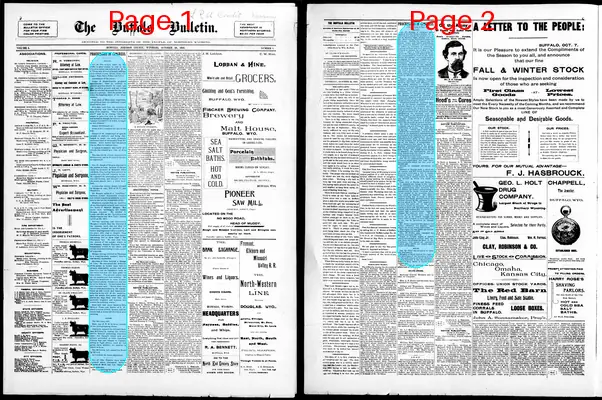
The Buffalo Bulletin
Buffalo, Johnson County County, Wyoming
What is this article about?
U.S. Congress proceedings from October 16-21: Senate debates rules amendments to curb filibustering on repeal bill, defeats women's suffrage motion in Cherokee outlet; heated exchanges among senators like Morgan, Hill, Sherman. House passes McCreary bill on Chinese registration and Cox banking bill amid financial discussions.
Merged-components note: Continuation of congressional proceedings from page 1 to page 2.
Clippings

1 of 2
OCR Quality
Full Text
SENATE.
Oct. 16 - The motion made by Mr. Peffer to allow women to vote in the Cherokee outlet was defeated by 40 to 9. Those who defended female suffrage were Allison, Carey, Dolph, Frye, Gallinger, Hoar, Kyle, Peffer and Teller.
Amendment of the rules:
Lodge of Massachusetts proposed amendments: That no written or printed speeches should be read, and that members present and not voting shall be counted as present for the purpose of a quorum. Said the Senate was today the laughing stock of the whole country.
Vest, dem. of Miss., made objections, and declared that unconditional repeal would never pass.
Hill, dem., said that the tyranny of the minority was worse than the tyranny of the majority. "Has it come to this?" said he in closing, "that the Senate is powerless first to legislate, and second to change its rules so it can legislate hereafter? If it has, it might as well disband."
Repeal bill brought up:
Jones of Nev. resumed his speech till 3:45.
Palmer of Ill. complained of speeches made to obstruct, and being challenged to name one such, promptly mentioned that of the Senator from Nebraska. Allen denied that his speech was an effort to consume time.
A motion to adjourn was made at 6 o'clock, but refused by a vote of 39 to 18.
The time till 10 o'clock was spent in filibustering, and at 10 o'clock the Senate adjourned.
Oct. 17 - Dolph of Oregon objected to the journal as read, because it did not recite the presence of Senators Allen and Kyle, they having been present on Sunday roll calls and refusing to vote. He regarded the proceedings as ridiculous and farcical, and thought it time the Senate should have a little backbone.
A somewhat stormy debate followed by Morgan of Ala., Hill of N. Y., and Washburn.
Mr. Morgan spoke of a "coalition" between certain democratic senators and certain republican senators, as certain to disrupt the democratic party.
Washburn replied that no coalition of any description existed, and excited the wrath of Senator Morgan. Hot words were exchanged, but finally Morgan resumed. He alluded to Lodge and Hill as the "juveniles from Massachusetts and New York," which called up Mr. Hill.
Hill was amusing, and referring to Morgan's remark that the decision of the supreme court did not bind his conscience, related an anecdote of a lawyer arguing a case before a justice of the peace, who read a chapter from Blackstone, not to show that the justice was wrong, but to show what a fool Blackstone was. He also read from the journal of the Senate, where on one occasion, Senator Thurman being temporarily called to the chair, and certain senators refusing to vote, counted a quorum.
Morgan having referred to Thurman in a complimentary manner, this hit was warmly applauded.
Sherman of Ohio favored a change of rules. He contrasted the behavior of the Senate in former days with its present destructive action, and said that there was no legislative body in the world that had not some power to close debate. The present Senate had sat two months and done nothing. He urged the democrats to come to some agreement among themselves, and not to do the baby act. In conclusion Senator Sherman said: "Break down this barrier now maintained by the Senate; break up this violent and insolent obstruction to the will of the majority; give the Senate free power and play, and in ten days from this time the skies will brighten and business will resume its ordinary course."
Some talk took place between Hill, Mills of Texas, and Butler of S. C., about a caucus of both houses, and the Senate took a recess till 10 o'clock next morning.
HOUSE.
The McCreary bill:
Blair, rep. of N. H., in favor, defended the photographing clause.
Caminetti opposed the bill and Chairman McCreary in closing the debate, said he favored protecting American labor, but thought honor and conscience prevented us from deporting Chinese who had refused to register, acting on legal advice, until we had given them another six months in which to do so.
The McCreary bill passed the House by 167 to 9.
At 5 o'clock the House adjourned.
Oct. 17 - The Pension laws debate produced warm discussion between Burrows of Mich. and Col. Oates, an ex-Confederate.
The Cox banking bill was passed.
(Continued on page 8.)
(Continued from 1st Page.)
SENATE.
Oct. 18—Morgan of Alabama spoke against Senator Dolph's motion to record on the journal the presence of Allen on Monday night, during roll call.
Mr. Allen having declined to answer to his name. During his speech the Supreme Court and "astute politicians were severely handled, and the ruling of Allen G. Thurman in counting a quorum of those who were present but refused to answer, he termed a "half truth." After a brief altercation between Mr. Morgan and Miller of Texas, the amendment was laid on the table.
Teller of Colorado, on a similar motion, to amend the journal, complained of interference of the Secretary of the Treasury. Such interference, he said, was more damaging to the dignity of the senate than the misconduct of a few of its own members. He denied that the silver senators were obstructionists, and said that the right to refrain from voting had frequently been exercised by Blaine, Conkling and Carpenter.
Daniel, dem. of Virginia, thought Dolph's amendment and Hill's amendment to the rules both dilatory, and was ready instantly to submit the question of repeal to a majority of democrats; would Mr. Mills do the same.
There was no reply, and Mr. Daniel continued. In answer to a question by Mr. Aldrich he thought the rules of the Senate provided no method by which the majority could arrive at the determination of any question in spite of the tactics of the minority.
Voorhees denied the reported meeting of the finance committee. Mills accused Daniel of revolution and bitterly arraigned the majority for "sitting still like children and permitting the government to be paralyzed, while indignation was sweeping over the whole land" at the inaction of the senate, "and the great branch of the government instituted with a power to legislate for the people is a dead body until the minority permits it to act."
Mr. Mills refused the proposition of a caucus, but was willing to join in a conference of houses. He concluded by saying: "There was a time when I talked for compromise, but since the chief of the democratic administration is charged with infidelity to his party, and there is the beginning of an anti-administration party in the senate, I cut my bridges and burn them behind me on the subject of compromise. I am a democrat who stands by the organized administration of my party, and the democratic people will do the same thing. The people do not intend to abandon the organization, nor do they intend to see the chief of that administration pulled down."
At 5:15 the senate took a recess.
Oct. 19—A communication from the Treasury department was read showing a probable deficit for the year of $50,000,000.
Debate on proposed alteration of rules:
Stewart of Nevada made a short silver speech, and Hill asked Dubois how the senate could pass a bill if twenty senators insist it shall not be done.
The reply of Dubois failed to show any method by which this could be done.
Cole, dem. of Florida and Butler of S. C. opposed any change in the rules.
At this point a cross fire of questions and answers took place between Hill and Butler, the former endeavoring to obtain from the South Carolina senator an answer to his question, how a vote could be reached. Mr. Butler tried in every way to avoid a direct answer, and finally getting heated and further excited by the applause in the gallery given to Mr. Hill, apparently invited the latter out on the street corner to settle the question. He was called to order and the discussion continued, and Senator Hill declared the senate had a constitutional right to change the rules; he said: "If we have, as the senator says, tied ourselves up so we cannot change the rules, then I propose to untie the rules so we can be permitted to change them."
Mr. Butler concluded his speech and Teller withdrew his motion, upon which the whole debate had arisen.
The repeal bill was taken up, and the senate adjourned at 5:05.
Oct. 21—Peffer, pop. resumed his speech and spoke till 1:15.
Jones of Nevada began a speech which threatened to extend over several days, but yielded the floor to Mr. Voorhees, who moved an executive session, after which the senate took a recess till Monday.
HOUSE.
Oct. 21—Time was occupied in financial discussions.
Dingley of Maine denied the right of the Secretary of the Treasury to draw on the gold reserve to meet current expenses, and said if the Secretary had power to issue bonds it would restore confidence.
There being no quorum, the house adjourned at 3:05.
What sub-type of article is it?
What keywords are associated?
What entities or persons were involved?
Where did it happen?
Domestic News Details
Primary Location
Washington, D.C.
Event Date
Oct. 16 21
Key Persons
Outcome
motion for women's suffrage in cherokee outlet defeated 40-9; mccreary bill passed house 167-9; cox banking bill passed; various motions and debates on rules and repeal bill without final resolution; senate recesses and adjourns multiple times.
Event Details
Senate debates on rules amendments to limit filibustering and count non-voting members for quorum; discussions on repeal bill with obstructions and speeches; objections to journal entries; heated exchanges on coalitions, supreme court rulings, and minority tactics; House debates and passes McCreary bill on Chinese registration and Cox banking bill; financial discussions on treasury reserve.