Thank you for visiting SNEWPapers!
Sign up free
Editorial
November 19, 1795
Gazette Of The United States
Philadelphia, Philadelphia County, Pennsylvania
What is this article about?
Analysis of the commercial articles (12th-15th) in the US-British treaty, focusing on trade with British West-Indies. Critiques limitations on US vessels and exports, defends Senate's rejection, and values the precedent set despite imperfections.
Merged-components note: Sequential reading order and content continuation of the same editorial on treaty articles.
Clipping
OCR Quality
95%
Excellent
Full Text
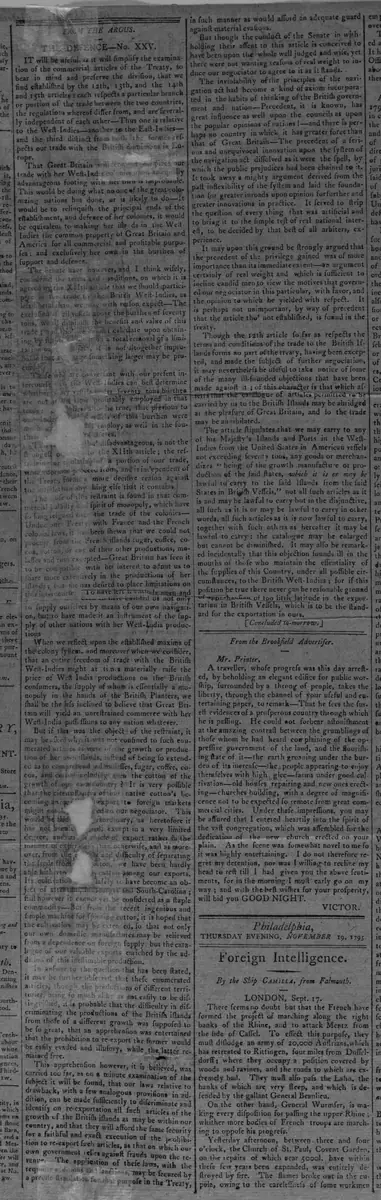
It will be useful, as it will simplify the examination of the commercial articles of the Treaty, to bear in mind and preserve the division, that we find established by the 12th, 13th, and the 14th and 15th articles: each respects a particular branch or portion of the trade between the two countries, the regulations whereof differ from, and are severally independent of each other—Thus one is relative to the West-Indies—another to the East-Indies—and the third distinct from both these—respects our trade with the British dominions in Europe.
That Great Britain will consent to place our trade with her West-India colonies upon an equally advantageous footing with her own is improbable. This would be doing what no one of the great colonizing nations has done, or is likely to do—It would be to relinquish the principal ends of the establishment, and defence of her colonies, it would be equivalent to making her islands in the West-Indies the common property of Great Britain and America for all commercial and profitable purposes; and exclusively her own in the burthen of support and defence.
The Senate have however, and I think wisely, considered the terms and conditions, on which it is agreed by the 12th article that we should participate in the trade to the British West-Indies, as less liberal than, we may with reason expect—The exclusion of all vessels above the burthen of seventy tons by itself, though not a total removal of a limitation to our trade; and though we cannot calculate upon obtaining concessions, would diminish the benefits and value of this article.
Those who are conversant with our present intercourse in the West-Indies can best determine whether, any vessels over seventy tons burthen are not as highly as profitably employed in that trade: It is certain to be true, that previous to the war, few of this burthen were so employed, as well in the out as in the homeward bound trade; though disadvantageous, is not the strongest objection to the 12th article: the restriction upon the exporting of a portion of our trade, which comes from, and is independent of the Treaty, forms a more decisive reason against the article than any thing else that it contains.
The use of this restraint is found in that commercial and monopoly spirit, which has so long reigned over the trade of the colonies—Under our Treaty with France and the French colonial laws, it has been shewn that we could not procure from the French islands sugar, coffee, cocoa, cotton, or any of their other productions, molasses and rum excepted—Great Britain has seen it to be compatible with her interest to admit us to a share more extensively in the productions of her islands; but she has desired to place limitations on this intercourse.
To have lessened these limitations and have enabled us not only to supply ourselves by means of our own navigation, but to have made it an instrument of the supply of other nations with her West-India productions.
When we reflect upon the established maxims of the colony system, and moreover when we consider, that an entire freedom of trade with the British West-Indies might at times materially raise the price of West India productions on the British consumers, the supply of whom is essentially a monopoly in the hands of the British Planters, we shall be the less inclined to believe that Great Britain will yield an unrestrained commerce with her West-India possessions to any nation whatever.
In answer to the question that has been stated, it may be further observed that these enumerated articles, though the productions of different territories, being so much alike as not easily to be distinguished, it is probable that the difficulty in discriminating the productions of the British islands from those of a different growth was supposed to be so great, that an apprehension was entertained that the prohibition to re-export the former would be easily evaded and illusory, while the latter remained free.
This apprehension however, it is believed, was carried too far, as on a minute examination of the subject it will be found, that our laws relative to drawback, with a few analogous provisions in addition, can be made sufficiently to discriminate and identify on re-exportation all such articles of the growth of the British islands as may be within our country, and that they will afford the same security for a faithful and exact execution of the prohibition to re-export such articles, as that on which our own government relies against frauds upon the revenue. The application of these laws, with the requisite additions and sanctions, may be secured by a precise stipulation for that purpose in the Treaty.
In such manner as would afford an adequate guard against material evasions.
But though the conduct of the Senate in withholding their assent to this article is conceived to have been upon the whole well judged and wise, yet there were not wanting reasons of real weight to induce our negotiator to agree to it as it stands.
The inviolability of the principles of the navigation act had become a kind of axiom incorporated in the habits of thinking of the British government and nation—Precedent, it is known, has great influence as well upon the councils as upon the popular opinions of nations!—and there is perhaps no country in which it has greater force than that of Great Britain—The precedent of a serious and unequivocal innovation upon the system of the navigation act dissolved as it were the spell, by which the public prejudices had been chained to it.
It took away a mighty argument derived from the past inflexibility of the system and laid the foundation for greater inroads upon opinion for further and greater innovations in practice. It served to strip the question of every thing that was artificial and to bring it to the simple test of real national interest, to be decided by that best of all arbiters, experience.
It may upon this ground be strongly argued that the precedent of the privilege gained was of more importance than its immediate extent—an argument certainly of real weight and which is sufficient to incline candid men to view the motives that governed our negotiator in this particular, with favor, and the opinion to which he yielded with respect. It is perhaps not unimportant, by way of precedent that the article though not established, is found in the treaty.
Though the 12th article so far as respects the terms and conditions of the trade to the British Islands forms no part of the treaty, having been excepted, and made the subject of further negotiation, it may nevertheless be useful to take notice of some of the many ill-founded objections that have been made against it; of this character is that which asserts that the catalogue of articles permitted to be carried by us to the British Islands may be abridged at the pleasure of Great Britain, and so the trade may be annihilated.
The article stipulates that we may carry to any of his Majesty's Islands and Ports in the West-Indies from the United States in American vessels not exceeding seventy tons, any goods or merchandizes "being of the growth manufacture or production of the said States, which it is or may be lawful to carry to the said Islands from the said States in British Vessels," not all such articles as it is and may be lawful to carry but in the disjunctive, all such as it is or may be lawful to carry in other words, all such articles as it is now lawful to carry, together with such others as hereafter it may be lawful to carry: the catalogue may be enlarged but cannot be diminished. It may also be remarked incidentally that this objection sounds ill in the mouths of those who maintain the essentiality of the supplies of this Country, under all possible circumstances, to the British West-Indies; for if this position be true there never can be reasonable ground of apprehension of too little latitude in the exportation in British Vessels, which is to be the standard for the exportation in ours.
[Concluded to-morrow.
That Great Britain will consent to place our trade with her West-India colonies upon an equally advantageous footing with her own is improbable. This would be doing what no one of the great colonizing nations has done, or is likely to do—It would be to relinquish the principal ends of the establishment, and defence of her colonies, it would be equivalent to making her islands in the West-Indies the common property of Great Britain and America for all commercial and profitable purposes; and exclusively her own in the burthen of support and defence.
The Senate have however, and I think wisely, considered the terms and conditions, on which it is agreed by the 12th article that we should participate in the trade to the British West-Indies, as less liberal than, we may with reason expect—The exclusion of all vessels above the burthen of seventy tons by itself, though not a total removal of a limitation to our trade; and though we cannot calculate upon obtaining concessions, would diminish the benefits and value of this article.
Those who are conversant with our present intercourse in the West-Indies can best determine whether, any vessels over seventy tons burthen are not as highly as profitably employed in that trade: It is certain to be true, that previous to the war, few of this burthen were so employed, as well in the out as in the homeward bound trade; though disadvantageous, is not the strongest objection to the 12th article: the restriction upon the exporting of a portion of our trade, which comes from, and is independent of the Treaty, forms a more decisive reason against the article than any thing else that it contains.
The use of this restraint is found in that commercial and monopoly spirit, which has so long reigned over the trade of the colonies—Under our Treaty with France and the French colonial laws, it has been shewn that we could not procure from the French islands sugar, coffee, cocoa, cotton, or any of their other productions, molasses and rum excepted—Great Britain has seen it to be compatible with her interest to admit us to a share more extensively in the productions of her islands; but she has desired to place limitations on this intercourse.
To have lessened these limitations and have enabled us not only to supply ourselves by means of our own navigation, but to have made it an instrument of the supply of other nations with her West-India productions.
When we reflect upon the established maxims of the colony system, and moreover when we consider, that an entire freedom of trade with the British West-Indies might at times materially raise the price of West India productions on the British consumers, the supply of whom is essentially a monopoly in the hands of the British Planters, we shall be the less inclined to believe that Great Britain will yield an unrestrained commerce with her West-India possessions to any nation whatever.
In answer to the question that has been stated, it may be further observed that these enumerated articles, though the productions of different territories, being so much alike as not easily to be distinguished, it is probable that the difficulty in discriminating the productions of the British islands from those of a different growth was supposed to be so great, that an apprehension was entertained that the prohibition to re-export the former would be easily evaded and illusory, while the latter remained free.
This apprehension however, it is believed, was carried too far, as on a minute examination of the subject it will be found, that our laws relative to drawback, with a few analogous provisions in addition, can be made sufficiently to discriminate and identify on re-exportation all such articles of the growth of the British islands as may be within our country, and that they will afford the same security for a faithful and exact execution of the prohibition to re-export such articles, as that on which our own government relies against frauds upon the revenue. The application of these laws, with the requisite additions and sanctions, may be secured by a precise stipulation for that purpose in the Treaty.
In such manner as would afford an adequate guard against material evasions.
But though the conduct of the Senate in withholding their assent to this article is conceived to have been upon the whole well judged and wise, yet there were not wanting reasons of real weight to induce our negotiator to agree to it as it stands.
The inviolability of the principles of the navigation act had become a kind of axiom incorporated in the habits of thinking of the British government and nation—Precedent, it is known, has great influence as well upon the councils as upon the popular opinions of nations!—and there is perhaps no country in which it has greater force than that of Great Britain—The precedent of a serious and unequivocal innovation upon the system of the navigation act dissolved as it were the spell, by which the public prejudices had been chained to it.
It took away a mighty argument derived from the past inflexibility of the system and laid the foundation for greater inroads upon opinion for further and greater innovations in practice. It served to strip the question of every thing that was artificial and to bring it to the simple test of real national interest, to be decided by that best of all arbiters, experience.
It may upon this ground be strongly argued that the precedent of the privilege gained was of more importance than its immediate extent—an argument certainly of real weight and which is sufficient to incline candid men to view the motives that governed our negotiator in this particular, with favor, and the opinion to which he yielded with respect. It is perhaps not unimportant, by way of precedent that the article though not established, is found in the treaty.
Though the 12th article so far as respects the terms and conditions of the trade to the British Islands forms no part of the treaty, having been excepted, and made the subject of further negotiation, it may nevertheless be useful to take notice of some of the many ill-founded objections that have been made against it; of this character is that which asserts that the catalogue of articles permitted to be carried by us to the British Islands may be abridged at the pleasure of Great Britain, and so the trade may be annihilated.
The article stipulates that we may carry to any of his Majesty's Islands and Ports in the West-Indies from the United States in American vessels not exceeding seventy tons, any goods or merchandizes "being of the growth manufacture or production of the said States, which it is or may be lawful to carry to the said Islands from the said States in British Vessels," not all such articles as it is and may be lawful to carry but in the disjunctive, all such as it is or may be lawful to carry in other words, all such articles as it is now lawful to carry, together with such others as hereafter it may be lawful to carry: the catalogue may be enlarged but cannot be diminished. It may also be remarked incidentally that this objection sounds ill in the mouths of those who maintain the essentiality of the supplies of this Country, under all possible circumstances, to the British West-Indies; for if this position be true there never can be reasonable ground of apprehension of too little latitude in the exportation in British Vessels, which is to be the standard for the exportation in ours.
[Concluded to-morrow.
What sub-type of article is it?
Trade Or Commerce
Foreign Affairs
Economic Policy
What keywords are associated?
West Indies Trade
Jay Treaty
Navigation Acts
Commercial Articles
Senate Rejection
Vessel Limits
Export Restrictions
Colonial Monopoly
What entities or persons were involved?
Great Britain
Us Senate
Us Negotiator
British West Indies
United States
Editorial Details
Primary Topic
Critique Of 12th Article On Us Trade With British West Indies In The Treaty
Stance / Tone
Critical Of Limitations But Appreciative Of Precedent And Negotiator's Efforts
Key Figures
Great Britain
Us Senate
Us Negotiator
British West Indies
United States
Key Arguments
Division Of Treaty Articles By Trade Regions: West Indies, East Indies, Europe.
Unlikely For Britain To Equalize Us Trade With Its Own In West Indies Due To Colonial Monopoly.
Senate Wisely Rejected 12th Article's Terms As Less Liberal Than Expected.
Vessel Size Limit (70 Tons) Diminishes Benefits; Pre War Trade Used Smaller Vessels.
Export Restrictions On West India Products More Decisive Objection Than Vessel Limits.
Britain Admits Us To Share But With Limitations To Protect Monopoly.
Full Trade Freedom Unlikely As It Could Raise Prices For British Consumers.
Re Export Prohibitions Can Be Enforced With Us Laws And Treaty Stipulations.
Precedent Of Innovation On Navigation Acts More Valuable Than Immediate Gains.
Objection That Britain Can Abridge Export List Is Ill Founded; List Can Only Expand.