Thank you for visiting SNEWPapers!
Sign up free
Story
November 7, 1789
The Kentucky Gazette
Lexington, Fayette County, Kentucky
What is this article about?
Arthur Lee shares a handbill from Dr. Haygarth recommending immediate and thorough washing of mad dog bite wounds with cold then warm water to prevent rabies infection, based on 1788 cases in North Wales.
Clipping
OCR Quality
95%
Excellent
Full Text
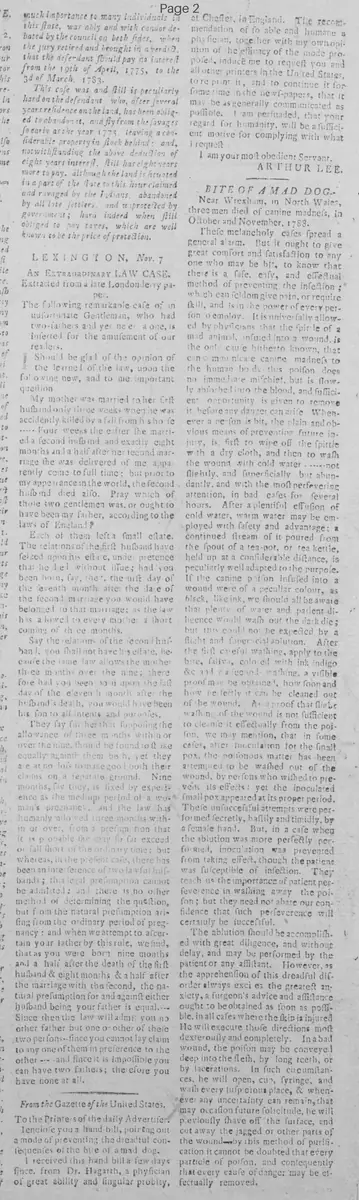
From the Gazette of the United States.
To the Printers of the daily Advertiser.
I enclose you a hand bill, pointing out a mode of preventing the dreadful consequences of the bite of a mad dog.
I received this hand bill a few days since, from Dr. Haygarth, a physician of great ability and singular probity, at Chester, in England. The recommendation of so able and humane physician, together with my own opinion of the efficacy of the mode proposed, induces me to request you and all other printers in the United States, to print it, and to continue it for some time in the newspapers, that it may be as generally communicated as possible. I am persuaded, that your regard for humanity, will be a sufficient motive for complying with what I request.
I am your most obedient Servant.
ARTHUR LEE.
BITE OF A MAD DOG.-
Near Wrexham, in North Wales, three men died of canine madness, in October and November, 1788.
These melancholy cases spread a general alarm. But it ought to give great comfort and satisfaction to any one who may be bit, to know that there is a safe, easy, and effectual method of preventing the infection ; which can seldom give pain, or require skill, and is in the power of every person employed. It is universally allowed by physicians that the spittle of a mad animal, infused into a wound, is the only cause hitherto known, that can communicate canine madness to the human body this poison does no immediate mischief, but is slow. It is absorbed into the blood, and sufficient opportunity is given to remove it before any danger can arise When- ever a person is bit, the plain and obvious means of preventing future injury, is first to wipe off the spittle with a dry cloth, and then to wash the wound with cold water ...--not slightly, and superficially but abundantly, and with the most persevering attention, in bad cases for several hours. After a plentiful effusion of cold water, warm water may be employed with safety and advantage; a continued stream of it poured from the spout of a tea-pot, or tea kettle, held up at a considerable distance, is peculiarly well adapted to the purpose.
If the canine poison infused into a wound were of a peculiar colour, as black, like ink, we should all be aware that plenty of water and patient diligence would wash out the dark dye; but this could not be expected by a slight and superficial ablution. After the first careful washing, apply to the bite, saliva, colored with ink indigo &c and repeated washing, a visible proof may be obtained, how soon and how really it can, be cleaned out of the wound. As a proof that simple washing of the wound is not sufficient to cleanse it effectually from the poison, we may mention, that in some cases, after inoculation for the small pox, the poisonous matter has been attempted to be washed out of the wound, by persons who wished to prevent its effects: yet the inoculated small pox appeared at its proper period.
These unsuccessful attempts were performed secretly, hastily and timidly, by a female hand. But, in a case when the ablution was more perfectly performed, inoculation was prevented from taking effect, though the patient was susceptible of infection. They teach us the importance of patient perseverance in washing away the poison; but they need not abate our confidence that such perseverance will certainly be successful.
The ablution should be accomplished with great diligence, and without delay, and may be performed by the patient or any assistant. However, as the apprehension of this dreadful disorder always excites the greatest anxiety, a surgeon's advice and assistance ought to be obtained as soon as possible, in all cases where the skin is injured He will execute those directions most dexterously and completely. In a bad wound, the poison may be conveyed deep into the flesh, by long teeth, or by lacerations. In such circumstances, he will open, cup, syringe, and wash every suspicious place, & whenever any uncertainty can remain, that may occasion future solicitude, he will previously shave off the surface, and cut away the jagged or other parts of the wound-by this method of purification it cannot be doubted that every particle of poison, and consequently that every cause of danger may be effectually removed.
To the Printers of the daily Advertiser.
I enclose you a hand bill, pointing out a mode of preventing the dreadful consequences of the bite of a mad dog.
I received this hand bill a few days since, from Dr. Haygarth, a physician of great ability and singular probity, at Chester, in England. The recommendation of so able and humane physician, together with my own opinion of the efficacy of the mode proposed, induces me to request you and all other printers in the United States, to print it, and to continue it for some time in the newspapers, that it may be as generally communicated as possible. I am persuaded, that your regard for humanity, will be a sufficient motive for complying with what I request.
I am your most obedient Servant.
ARTHUR LEE.
BITE OF A MAD DOG.-
Near Wrexham, in North Wales, three men died of canine madness, in October and November, 1788.
These melancholy cases spread a general alarm. But it ought to give great comfort and satisfaction to any one who may be bit, to know that there is a safe, easy, and effectual method of preventing the infection ; which can seldom give pain, or require skill, and is in the power of every person employed. It is universally allowed by physicians that the spittle of a mad animal, infused into a wound, is the only cause hitherto known, that can communicate canine madness to the human body this poison does no immediate mischief, but is slow. It is absorbed into the blood, and sufficient opportunity is given to remove it before any danger can arise When- ever a person is bit, the plain and obvious means of preventing future injury, is first to wipe off the spittle with a dry cloth, and then to wash the wound with cold water ...--not slightly, and superficially but abundantly, and with the most persevering attention, in bad cases for several hours. After a plentiful effusion of cold water, warm water may be employed with safety and advantage; a continued stream of it poured from the spout of a tea-pot, or tea kettle, held up at a considerable distance, is peculiarly well adapted to the purpose.
If the canine poison infused into a wound were of a peculiar colour, as black, like ink, we should all be aware that plenty of water and patient diligence would wash out the dark dye; but this could not be expected by a slight and superficial ablution. After the first careful washing, apply to the bite, saliva, colored with ink indigo &c and repeated washing, a visible proof may be obtained, how soon and how really it can, be cleaned out of the wound. As a proof that simple washing of the wound is not sufficient to cleanse it effectually from the poison, we may mention, that in some cases, after inoculation for the small pox, the poisonous matter has been attempted to be washed out of the wound, by persons who wished to prevent its effects: yet the inoculated small pox appeared at its proper period.
These unsuccessful attempts were performed secretly, hastily and timidly, by a female hand. But, in a case when the ablution was more perfectly performed, inoculation was prevented from taking effect, though the patient was susceptible of infection. They teach us the importance of patient perseverance in washing away the poison; but they need not abate our confidence that such perseverance will certainly be successful.
The ablution should be accomplished with great diligence, and without delay, and may be performed by the patient or any assistant. However, as the apprehension of this dreadful disorder always excites the greatest anxiety, a surgeon's advice and assistance ought to be obtained as soon as possible, in all cases where the skin is injured He will execute those directions most dexterously and completely. In a bad wound, the poison may be conveyed deep into the flesh, by long teeth, or by lacerations. In such circumstances, he will open, cup, syringe, and wash every suspicious place, & whenever any uncertainty can remain, that may occasion future solicitude, he will previously shave off the surface, and cut away the jagged or other parts of the wound-by this method of purification it cannot be doubted that every particle of poison, and consequently that every cause of danger may be effectually removed.
What sub-type of article is it?
Medical Curiosity
Curiosity
What themes does it cover?
Recovery
Moral Virtue
What keywords are associated?
Mad Dog Bite
Rabies Prevention
Wound Washing
Canine Madness
Medical Advice
What entities or persons were involved?
Arthur Lee
Dr. Haygarth
Where did it happen?
Near Wrexham, In North Wales; Chester, In England
Story Details
Key Persons
Arthur Lee
Dr. Haygarth
Location
Near Wrexham, In North Wales; Chester, In England
Event Date
October And November, 1788
Story Details
Three men died of canine madness near Wrexham in 1788, prompting alarm. Dr. Haygarth recommends immediate thorough washing of bite wounds with cold then warm water to remove the slow-acting poison from mad dog saliva, preventing infection. Surgical intervention advised for deep wounds.