Thank you for visiting SNEWPapers!
Sign up free
Story
July 18, 1904
Waterbury Evening Democrat
Waterbury, New Haven County, Connecticut
What is this article about?
Boys in Seville Cathedral perform a dignified dance with castanets before the altar, accompanied by music, in the presence of clergy, creating a profound and sacred impression on witnesses.
Clipping
OCR Quality
95%
Excellent
Full Text
DANCE BEFORE THE ALTAR.
Impressive Ceremony Witnessed in
the Cathedral at Seville Critics
Are Moved by It.
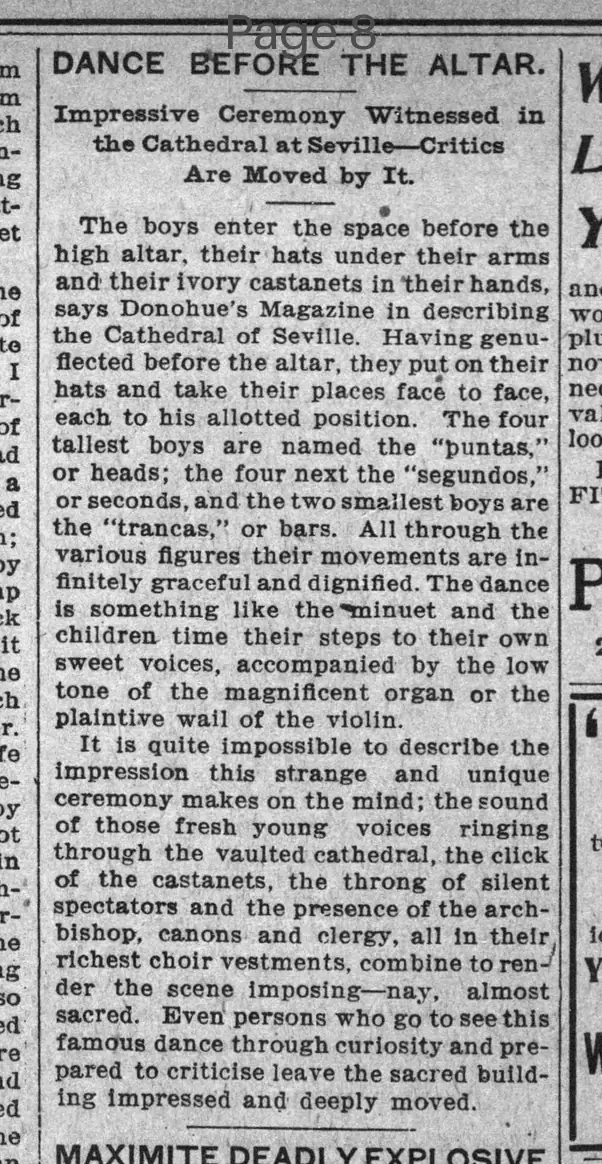
The boys enter the space before the high altar, their hats under their arms and their ivory castanets in their hands, says Donohue's Magazine in describing the Cathedral of Seville. Having genuflected before the altar, they put on their hats and take their places face to face, each to his allotted position. The four tallest boys are named the "puntas," or heads; the four next the "segundos," or seconds, and the two smallest boys are the "trancas," or bars. All through the various figures their movements are infinitely graceful and dignified. The dance is something like the minuet and the children time their steps to their own sweet voices, accompanied by the low tone of the magnificent organ or the plaintive wail of the violin.
It is quite impossible to describe the impression this strange and unique ceremony makes on the mind; the sound of those fresh young voices ringing through the vaulted cathedral, the click of the castanets, the throng of silent spectators and the presence of the archbishop, canons and clergy, all in their richest choir vestments, combine to render the scene imposing—nay, almost sacred. Even persons who go to see this famous dance through curiosity and prepared to criticise leave the sacred building impressed and deeply moved.
Impressive Ceremony Witnessed in
the Cathedral at Seville Critics
Are Moved by It.
The boys enter the space before the high altar, their hats under their arms and their ivory castanets in their hands, says Donohue's Magazine in describing the Cathedral of Seville. Having genuflected before the altar, they put on their hats and take their places face to face, each to his allotted position. The four tallest boys are named the "puntas," or heads; the four next the "segundos," or seconds, and the two smallest boys are the "trancas," or bars. All through the various figures their movements are infinitely graceful and dignified. The dance is something like the minuet and the children time their steps to their own sweet voices, accompanied by the low tone of the magnificent organ or the plaintive wail of the violin.
It is quite impossible to describe the impression this strange and unique ceremony makes on the mind; the sound of those fresh young voices ringing through the vaulted cathedral, the click of the castanets, the throng of silent spectators and the presence of the archbishop, canons and clergy, all in their richest choir vestments, combine to render the scene imposing—nay, almost sacred. Even persons who go to see this famous dance through curiosity and prepared to criticise leave the sacred building impressed and deeply moved.
What sub-type of article is it?
Curiosity
Historical Event
What themes does it cover?
Social Manners
Moral Virtue
What keywords are associated?
Seville Cathedral
Altar Dance
Castanets
Boys Ceremony
Sacred Dance
What entities or persons were involved?
Boys
Archbishop
Canons And Clergy
Where did it happen?
Cathedral At Seville
Story Details
Key Persons
Boys
Archbishop
Canons And Clergy
Location
Cathedral At Seville
Story Details
Boys perform a graceful dance with castanets before the high altar in Seville Cathedral, genuflecting first and timing steps to their voices and music from organ or violin, in presence of archbishop and clergy in vestments, impressing spectators deeply.