Thank you for visiting SNEWPapers!
Sign up free
Story
April 7, 1862
The Evansville Daily Journal
Evansville, Vanderburgh County, Indiana
What is this article about?
A Cincinnati Gazette correspondent accuses Dr. Hewitt, Medical Director under Gen. Grant on the Tennessee River, of gross incompetence, drunkenness, and inhumanity toward wounded soldiers at Paducah, Fort Henry, and Fort Donelson, calling for his court-martial and execution.
Clipping
OCR Quality
95%
Excellent
Full Text
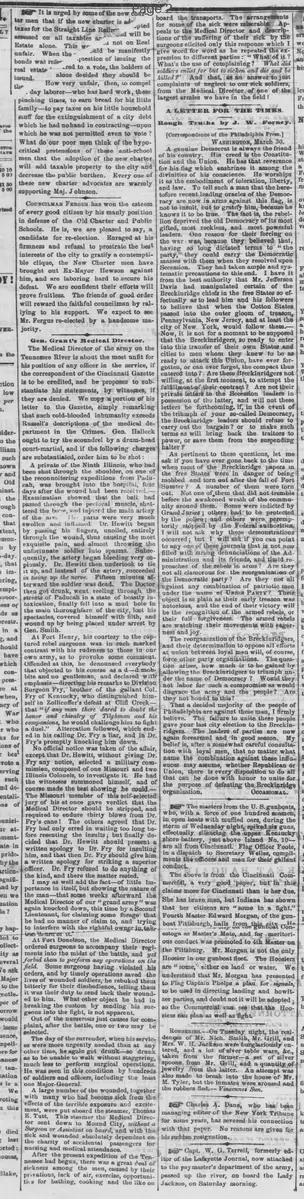
Gen. Grant's Medical Director.
The Medical Director of the army on the Tennessee River is about the most unfit for his position of any officer in the service, if the correspondent of the Cincinnati Gazette is to be credited, and he proposes to substantiate his statements, by witnesses, if they are denied. We copy a portion of his letter to the Gazette, simply remarking that such cold-blooded inhumanity exceeds Russell's descriptions of the medical department in the Crimea. Gen. Halleck ought to try the scoundrel by a drum-head court-martial, and if the following charges are substantiated, order him to be shot:
A private of the Ninth Illinois, who had been shot through the shoulder, on one of the reconnoitering expeditions from Paducah, was brought into the hospital, four days after the wound had been received. Examination showed that the ball had passed through the pectoral muscle, shattered the bone, and injured the main artery of the arm. The parts were very much swollen and inflamed. Dr. Hewitt began by passing his fingers, unoiled, entirely through the wound, thus causing the most exquisite pain, and almost throwing the unfortunate soldier into spasms. Subsequently, the artery began bleeding very copiously. Dr. Hewitt then undertook to tie it up, and instead of the artery, succeeded in tying up the nerve. Fifteen minutes afterward the soldier was dead. The Doctor then got drunk, went reeling through the streets of Paducah in a state of beastly intoxication, finally fell into a mud hole in the main thoroughfare of the city, lost his spectacles, covered himself with filth, and wound up by being placed under arrest by Gen. Smith.
At Fort Henry, his courtesy to the captured rebel surgeons was in such marked contrast with his rudeness to those in our own army, as to provoke some comment. Offended at this, he denounced everybody that objected to his course as a d-d mobbite and no gentleman, and declared with emphasis--directing his remarks to Division Surgeon Fry, brother of the gallant Col. Fry of Kentucky, who distinguished himself in Zollicoffer's defeat at Cliff Creek--that "if any man there dared to doubt the honor and chivalry of Tilghman and his companions, he would challenge him to fight a duel." Altercation followed, which ended in his calling Dr. Fry a liar, and in Dr. Fry's promptly knocking him down. No official notice was taken of the affair, except that Dr. Hewitt, without giving Dr. Fry any notice, selected a military commission, composed of one Missouri and two Illinois Colonels, to investigate it. He had the witnesses summoned himself, and of course made the best showing he could. The Missouri member of this self-selected jury of his at once gave verdict that the Medical Director should be stripped, and required to endure thirty blows from Dr. Fry's cane! The others agreed that Dr. Fry had only erred in waiting too long before resenting the insults; but finally decided that Dr. Hewitt should present a written apology to Dr. Fry for insulting him, and that then Dr. Fry should give him a written apology for striking a superior officer. Dr. Fry refused to do anything of the kind, and there the matter rested. I may as well add the fact-of little importance in itself, but showing the nature of the man-that some weeks afterward the Medical Director of our "grand army" was again knocked down, this time by a Second Lieutenant, for claiming some forage that he had no manner of claim to, and trying to interfere with the rightful owner in taking it.
At Fort Donelson, the Medical Director ordered surgeons to accompany their regiments into the midst of the battle, and yet forbid them to perform any operations on the field. Some surgeons having violated his orders, and by timely operations saved the lives of wounded soldiers, he rebuked them bitterly for their disobedience, telling them it was their duty to send back their wounded to him. What other object he had in breaking the custom by sending his surgeons into the fight, is not apparent. Out of the numerous just causes for complaint, after the battle, one or two may be selected.
The day of the surrender, when his services were more urgently needed than at any other time, he again got drunk-so drunk as to be unable to walk without staggering, much less to perform surgical operations. He was seen in this condition by hundreds of soldiers and officers, including the least one Major-General.
A large number of the wounded, together with many who had become sick from the effects of the terrible exposure and excitement, were put aboard the steamer, Thomas E. Tutt. This steamer the Medical Director sent down to Mound City, without a Surgeon or Assistant on board, and with the sick and wounded absolutely dependent on the charity of accidental passengers for nursing and medical attendance.
After the present expedition of the Tennessee had begun, there was a great deal of sickness among the men, caused by their privations, lack of air, exercise, opportunities for bathing, cooking and the like on board the transports. The arrangements for some of the sick were miserable. Appeals to the Medical Director and descriptions of the suffering of their sick by the surgeons elicited only this response which I give word for word as he repeated the expression to different parties: "What of it? What's the use of complaining? What did soldier's enlist for but to sicken and die and be killed?" And that, as an answer to just complaints of neglect to our sick soldiers, from the Medical Director of one of the largest armies we have in the field!
The Medical Director of the army on the Tennessee River is about the most unfit for his position of any officer in the service, if the correspondent of the Cincinnati Gazette is to be credited, and he proposes to substantiate his statements, by witnesses, if they are denied. We copy a portion of his letter to the Gazette, simply remarking that such cold-blooded inhumanity exceeds Russell's descriptions of the medical department in the Crimea. Gen. Halleck ought to try the scoundrel by a drum-head court-martial, and if the following charges are substantiated, order him to be shot:
A private of the Ninth Illinois, who had been shot through the shoulder, on one of the reconnoitering expeditions from Paducah, was brought into the hospital, four days after the wound had been received. Examination showed that the ball had passed through the pectoral muscle, shattered the bone, and injured the main artery of the arm. The parts were very much swollen and inflamed. Dr. Hewitt began by passing his fingers, unoiled, entirely through the wound, thus causing the most exquisite pain, and almost throwing the unfortunate soldier into spasms. Subsequently, the artery began bleeding very copiously. Dr. Hewitt then undertook to tie it up, and instead of the artery, succeeded in tying up the nerve. Fifteen minutes afterward the soldier was dead. The Doctor then got drunk, went reeling through the streets of Paducah in a state of beastly intoxication, finally fell into a mud hole in the main thoroughfare of the city, lost his spectacles, covered himself with filth, and wound up by being placed under arrest by Gen. Smith.
At Fort Henry, his courtesy to the captured rebel surgeons was in such marked contrast with his rudeness to those in our own army, as to provoke some comment. Offended at this, he denounced everybody that objected to his course as a d-d mobbite and no gentleman, and declared with emphasis--directing his remarks to Division Surgeon Fry, brother of the gallant Col. Fry of Kentucky, who distinguished himself in Zollicoffer's defeat at Cliff Creek--that "if any man there dared to doubt the honor and chivalry of Tilghman and his companions, he would challenge him to fight a duel." Altercation followed, which ended in his calling Dr. Fry a liar, and in Dr. Fry's promptly knocking him down. No official notice was taken of the affair, except that Dr. Hewitt, without giving Dr. Fry any notice, selected a military commission, composed of one Missouri and two Illinois Colonels, to investigate it. He had the witnesses summoned himself, and of course made the best showing he could. The Missouri member of this self-selected jury of his at once gave verdict that the Medical Director should be stripped, and required to endure thirty blows from Dr. Fry's cane! The others agreed that Dr. Fry had only erred in waiting too long before resenting the insults; but finally decided that Dr. Hewitt should present a written apology to Dr. Fry for insulting him, and that then Dr. Fry should give him a written apology for striking a superior officer. Dr. Fry refused to do anything of the kind, and there the matter rested. I may as well add the fact-of little importance in itself, but showing the nature of the man-that some weeks afterward the Medical Director of our "grand army" was again knocked down, this time by a Second Lieutenant, for claiming some forage that he had no manner of claim to, and trying to interfere with the rightful owner in taking it.
At Fort Donelson, the Medical Director ordered surgeons to accompany their regiments into the midst of the battle, and yet forbid them to perform any operations on the field. Some surgeons having violated his orders, and by timely operations saved the lives of wounded soldiers, he rebuked them bitterly for their disobedience, telling them it was their duty to send back their wounded to him. What other object he had in breaking the custom by sending his surgeons into the fight, is not apparent. Out of the numerous just causes for complaint, after the battle, one or two may be selected.
The day of the surrender, when his services were more urgently needed than at any other time, he again got drunk-so drunk as to be unable to walk without staggering, much less to perform surgical operations. He was seen in this condition by hundreds of soldiers and officers, including the least one Major-General.
A large number of the wounded, together with many who had become sick from the effects of the terrible exposure and excitement, were put aboard the steamer, Thomas E. Tutt. This steamer the Medical Director sent down to Mound City, without a Surgeon or Assistant on board, and with the sick and wounded absolutely dependent on the charity of accidental passengers for nursing and medical attendance.
After the present expedition of the Tennessee had begun, there was a great deal of sickness among the men, caused by their privations, lack of air, exercise, opportunities for bathing, cooking and the like on board the transports. The arrangements for some of the sick were miserable. Appeals to the Medical Director and descriptions of the suffering of their sick by the surgeons elicited only this response which I give word for word as he repeated the expression to different parties: "What of it? What's the use of complaining? What did soldier's enlist for but to sicken and die and be killed?" And that, as an answer to just complaints of neglect to our sick soldiers, from the Medical Director of one of the largest armies we have in the field!
What sub-type of article is it?
Historical Event
Crime Story
Tragedy
What themes does it cover?
Misfortune
Justice
Crime Punishment
What keywords are associated?
Medical Misconduct
Civil War Surgery
Drunken Officer
Soldier Neglect
Military Incompetence
Fort Henry
Fort Donelson
What entities or persons were involved?
Dr. Hewitt
Gen. Grant
Gen. Halleck
Gen. Smith
Dr. Fry
Col. Fry
Tilghman
Where did it happen?
Tennessee River, Paducah, Fort Henry, Fort Donelson, Mound City
Story Details
Key Persons
Dr. Hewitt
Gen. Grant
Gen. Halleck
Gen. Smith
Dr. Fry
Col. Fry
Tilghman
Location
Tennessee River, Paducah, Fort Henry, Fort Donelson, Mound City
Story Details
Correspondent details Dr. Hewitt's fatal mishandling of a wounded soldier in Paducah, drunken brawls and biased treatment at Fort Henry, obstructive orders and neglect of wounded at Fort Donelson, and callous response to sick soldiers on transports, urging his trial and execution.