Thank you for visiting SNEWPapers!
Sign up free
Editorial
October 1, 1811
The Enquirer
Richmond, Henrico County, Virginia
What is this article about?
Editorial in The Enquirer discusses the citizenship case of James McClure, born in the US in 1785, whose father was naturalized in 1786. Detained in France as British, the author argues under the 1802 US naturalization act, McClure qualifies as a citizen, critiquing Gen. Armstrong's contrary decision.
Clipping
OCR Quality
88%
Good
Full Text
The Enquirer.
RICHMOND, OCTOBER 1, 1811.
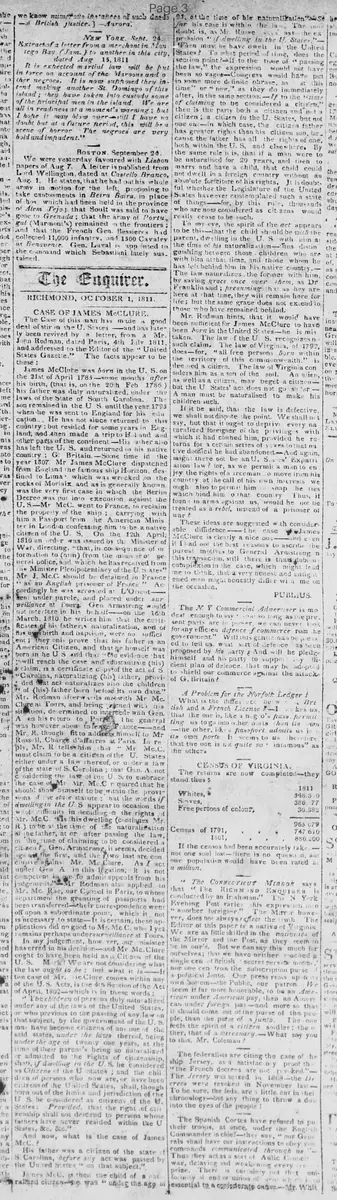
CASE OF JAMES McCLURE.
The Case of this man has made a good deal of stir in the U. States—and has lately been revived by a letter from a Mr. John Rodman, dated Paris, 4th July 1811. and addressed to the Editor of the "United States Gazette."
The facts appear to be these:
James McClure was born in the U. S. on the 21st of April 1785—some months after his birth, (that is, on the 20th Feb 1786) his father was duly naturalized, under the laws of the State of South Carolina. The son remained in the U S. until the year 1795 when—he was sent to England for his education.. He has not since returned to this country; but resided for some years in England; and then made a trip to Holland and other parts of the continent. —His father also has left the U. S. and returned to his native country; G. Britain.—Some time in the year 1807. Mr James McClure dispatched from England the famous ship Horizon. destined to Lima· which was wrecked on the rocks of Morlaix. and as is generally known. was the very first case in which the Berlin Decree was put into execution, against the U.S—Mr McC. went to France, to reclaim the property of the ship;, carrying with him a Passport from the American Minister in London confessing him to be a native citizen of the U. S. On the 12th April: 1810 an order was issued by the Minister of War, directing, "that, in consequence of information to him from the minister of general police, and which he has received from the Minister Plenipotentiary of the U S Ates" Mr J. Mc.C should be detained in France " as an English prisoner of France " Accordingly he was arrested at L'Orient— sent under parole, and placed under surveillance at Tours. Gen Armstrong would not interfere in his behalf---on the 16th March. 1810 he writes him that the certificates of his father's naturalization, and of his own birth and baptism, were no sufficient; they only prove that his father is an American Citizen, and that he himself was born in the U s and that "the evidence that will reach the case and substantiate (his) claim, is a certificate Copy of the act of S Carolina, naturalizing (his) father, provided that act naturalizes also the children of (his) father born before its own date."
Mr. Rodman afterwards met with Mr Mc. Clure at Tours, and being stricken with his situation, determined to intercede with Gen. A on his return to Paris the general was however about to leave France—and Mr, R. though fit to address himself to Mr Russell, Charge d'affaires at Paris. In reply, Mr. R tells us that " Mr Mc.C. must claim to be a citizen of the U. States either under a law thereof, or under a law of the state of S. Carolina; that Gen. A. not considering the law of the US. to embrace the case of Mr Mr. Mc.C required that he should show himself to be within the provisions if the state statute :' that the words of dwelling in the U S appear to occasion the whole difficulty in deciding on the rights of Mr. Mc.C. sIs (his dwelling (continues Mr. R ) to be at the time of the naturalization of the father, at or after passing the law, of the, time of claiming to be considered a citizen?. Gen. Armstrong, it seems, decided against the first, and the two last are conclusive against. Mr. Mc Clure. As I act under Gen A in this legation, it is not Competent in me to admit appeals from his judgement." Mr Rodman also applied to Mr. Mc. Rae, our Consul in Paris, to whose department the granting of passports had been transferred—their correspondence went off upon a subordinate point, which it not is necessary to state—It is certain, these applications did no good to Mr. Mc C. who yet remains perhaps under surveillance at Tours.
In my judgement, however, our minister has erred in his decision—and Mr Mc.Clure ought to have been held as a Citizen of the U.S. Mark! We are not considering what the law ought to be; but what it is—If the case of Mr. Mc.Ciure comes within any of the U.S. Acts, it is the 4th Section of the Act of April, 1802—which is in these words:
"The children of persons duly naturalized under any of the laws of the United States, or who previous to the passing of any law on that subject, by the government of the U. S. may have become citizens of any one of the said states, under the laws thereof, being under the age of twenty one years, at the time of their parent's being so naturalized or admitted to the rights of citizenship, shall, if dwelling in the U.S. be considered as Citizens of the United States ; and the children of persons who now are, or have been citizens of the United States, shall, though born out of the limits and jurisdiction of the U. S. be considered as citizens of the U. States: Provided, that the right of citizenship shall not descend to persons whose fathers have never resided within the U States, &c. &c."
And now, what is the case of James McC.?
His father was a citizen of the state of SCarolina, before any act was passed by the United States" on that subject."
James McC. is then the child of a naturalized citizen—he was " under the age of 21. at the time of his naturalization" and his case is within the law. The doubt is, as Mr. Russe says as the expression " if dwelling in the U. States."
When must he have dwelt in the United States? To what period of time, does the section point all to the time of " passing the law." the expression would not have been so vague—Congress would have put in some more definite phrase. as at this time" or " now." as they do immediately after, in the same section.—If to the "time of claiming to be considered a citizen," then is the party both a citizen and not a citizen; a citizen in the U. States. but not one out—in which case, the citizen father has greater rights than his citizen son, because the father has all the rights of one. both within the U. S. and elsewhere. By the same rule it is, that if a man were to be naturalised for 20 years, and then to marry and have a child, that child could not dwell in a foreign country without an absolute forfeiture of his rights. It is doubtful whether the Legislature of the United States have ever contemplated such a state of things—for, by this rule. thousands who are now considered as citizens would really cease to be such.
To my view, the spirit of the act appears to be this—that the child should be with the parent, dwelling in the U. S with him at the time of his naturalization—thus distinguishing between those. children who are with him at that time, and those whom he has left behind him in his native country.— The law naturalizes the former with him, by saying grace once over them, as Dr Franklin said; presuming by as they are here at that time, they will remain here for life; but the same grace does not extend to those who have remained behind.
Mr. Rodman hints. that it would have been sufficient for James McClure to have been born in the United States—he is mistaken. The law of the U S. recognizes no such claim. The law of Virginia, of 1792, does—for, "all free persons born within the territory of this commonwealth." is deemed a citizen. The law of Virginia considers him as a son of the soil. An alien, as well as a citizen, may beget a citizen—but the U States' act does not go so far—A man must be naturalized to make his children such.
If it be said, that the law is defective. we shall not dispute the point. We shall not say, but that it ought to deprive every naturalized foreigner of the privileges with which it had clothed him, provided he returns for a certain series of years to that native domicile he had abandoned—And again, might there not be a U. S. t es' Explanation law ? for, as we permit a man to enjoy the rights of a freeman to move from his country at the call of his own interests we ought also to permit him to snap the ties which bind him to that country Thus, if found in arms against us, would he not be treated as a rebel, instead of a prisoner of war?
These ideas are suggested with considerable diffidence—the case James McClure is clearly a nice one---and even if I had not the best reasons to ascribe the purest motives to General Armstrong in this transaction, still there is that dubious complexion in the case, which might lead me to think, that a very honest and enlightened man might honestly differ with me on the occasion.
PUBLIUS.
RICHMOND, OCTOBER 1, 1811.
CASE OF JAMES McCLURE.
The Case of this man has made a good deal of stir in the U. States—and has lately been revived by a letter from a Mr. John Rodman, dated Paris, 4th July 1811. and addressed to the Editor of the "United States Gazette."
The facts appear to be these:
James McClure was born in the U. S. on the 21st of April 1785—some months after his birth, (that is, on the 20th Feb 1786) his father was duly naturalized, under the laws of the State of South Carolina. The son remained in the U S. until the year 1795 when—he was sent to England for his education.. He has not since returned to this country; but resided for some years in England; and then made a trip to Holland and other parts of the continent. —His father also has left the U. S. and returned to his native country; G. Britain.—Some time in the year 1807. Mr James McClure dispatched from England the famous ship Horizon. destined to Lima· which was wrecked on the rocks of Morlaix. and as is generally known. was the very first case in which the Berlin Decree was put into execution, against the U.S—Mr McC. went to France, to reclaim the property of the ship;, carrying with him a Passport from the American Minister in London confessing him to be a native citizen of the U. S. On the 12th April: 1810 an order was issued by the Minister of War, directing, "that, in consequence of information to him from the minister of general police, and which he has received from the Minister Plenipotentiary of the U S Ates" Mr J. Mc.C should be detained in France " as an English prisoner of France " Accordingly he was arrested at L'Orient— sent under parole, and placed under surveillance at Tours. Gen Armstrong would not interfere in his behalf---on the 16th March. 1810 he writes him that the certificates of his father's naturalization, and of his own birth and baptism, were no sufficient; they only prove that his father is an American Citizen, and that he himself was born in the U s and that "the evidence that will reach the case and substantiate (his) claim, is a certificate Copy of the act of S Carolina, naturalizing (his) father, provided that act naturalizes also the children of (his) father born before its own date."
Mr. Rodman afterwards met with Mr Mc. Clure at Tours, and being stricken with his situation, determined to intercede with Gen. A on his return to Paris the general was however about to leave France—and Mr, R. though fit to address himself to Mr Russell, Charge d'affaires at Paris. In reply, Mr. R tells us that " Mr Mc.C. must claim to be a citizen of the U. States either under a law thereof, or under a law of the state of S. Carolina; that Gen. A. not considering the law of the US. to embrace the case of Mr Mr. Mc.C required that he should show himself to be within the provisions if the state statute :' that the words of dwelling in the U S appear to occasion the whole difficulty in deciding on the rights of Mr. Mc.C. sIs (his dwelling (continues Mr. R ) to be at the time of the naturalization of the father, at or after passing the law, of the, time of claiming to be considered a citizen?. Gen. Armstrong, it seems, decided against the first, and the two last are conclusive against. Mr. Mc Clure. As I act under Gen A in this legation, it is not Competent in me to admit appeals from his judgement." Mr Rodman also applied to Mr. Mc. Rae, our Consul in Paris, to whose department the granting of passports had been transferred—their correspondence went off upon a subordinate point, which it not is necessary to state—It is certain, these applications did no good to Mr. Mc C. who yet remains perhaps under surveillance at Tours.
In my judgement, however, our minister has erred in his decision—and Mr Mc.Clure ought to have been held as a Citizen of the U.S. Mark! We are not considering what the law ought to be; but what it is—If the case of Mr. Mc.Ciure comes within any of the U.S. Acts, it is the 4th Section of the Act of April, 1802—which is in these words:
"The children of persons duly naturalized under any of the laws of the United States, or who previous to the passing of any law on that subject, by the government of the U. S. may have become citizens of any one of the said states, under the laws thereof, being under the age of twenty one years, at the time of their parent's being so naturalized or admitted to the rights of citizenship, shall, if dwelling in the U.S. be considered as Citizens of the United States ; and the children of persons who now are, or have been citizens of the United States, shall, though born out of the limits and jurisdiction of the U. S. be considered as citizens of the U. States: Provided, that the right of citizenship shall not descend to persons whose fathers have never resided within the U States, &c. &c."
And now, what is the case of James McC.?
His father was a citizen of the state of SCarolina, before any act was passed by the United States" on that subject."
James McC. is then the child of a naturalized citizen—he was " under the age of 21. at the time of his naturalization" and his case is within the law. The doubt is, as Mr. Russe says as the expression " if dwelling in the U. States."
When must he have dwelt in the United States? To what period of time, does the section point all to the time of " passing the law." the expression would not have been so vague—Congress would have put in some more definite phrase. as at this time" or " now." as they do immediately after, in the same section.—If to the "time of claiming to be considered a citizen," then is the party both a citizen and not a citizen; a citizen in the U. States. but not one out—in which case, the citizen father has greater rights than his citizen son, because the father has all the rights of one. both within the U. S. and elsewhere. By the same rule it is, that if a man were to be naturalised for 20 years, and then to marry and have a child, that child could not dwell in a foreign country without an absolute forfeiture of his rights. It is doubtful whether the Legislature of the United States have ever contemplated such a state of things—for, by this rule. thousands who are now considered as citizens would really cease to be such.
To my view, the spirit of the act appears to be this—that the child should be with the parent, dwelling in the U. S with him at the time of his naturalization—thus distinguishing between those. children who are with him at that time, and those whom he has left behind him in his native country.— The law naturalizes the former with him, by saying grace once over them, as Dr Franklin said; presuming by as they are here at that time, they will remain here for life; but the same grace does not extend to those who have remained behind.
Mr. Rodman hints. that it would have been sufficient for James McClure to have been born in the United States—he is mistaken. The law of the U S. recognizes no such claim. The law of Virginia, of 1792, does—for, "all free persons born within the territory of this commonwealth." is deemed a citizen. The law of Virginia considers him as a son of the soil. An alien, as well as a citizen, may beget a citizen—but the U States' act does not go so far—A man must be naturalized to make his children such.
If it be said, that the law is defective. we shall not dispute the point. We shall not say, but that it ought to deprive every naturalized foreigner of the privileges with which it had clothed him, provided he returns for a certain series of years to that native domicile he had abandoned—And again, might there not be a U. S. t es' Explanation law ? for, as we permit a man to enjoy the rights of a freeman to move from his country at the call of his own interests we ought also to permit him to snap the ties which bind him to that country Thus, if found in arms against us, would he not be treated as a rebel, instead of a prisoner of war?
These ideas are suggested with considerable diffidence—the case James McClure is clearly a nice one---and even if I had not the best reasons to ascribe the purest motives to General Armstrong in this transaction, still there is that dubious complexion in the case, which might lead me to think, that a very honest and enlightened man might honestly differ with me on the occasion.
PUBLIUS.
What sub-type of article is it?
Constitutional
Legal Reform
What keywords are associated?
Naturalization
Citizenship
James Mcclure
1802 Act
Gen Armstrong
France Detention
Berlin Decree
What entities or persons were involved?
James Mcclure
John Rodman
Gen. Armstrong
Mr. Russell
Mr. Mcrae
Publius
Editorial Details
Primary Topic
Citizenship Of James Mcclure Under 1802 Naturalization Act
Stance / Tone
Argument In Favor Of Mcclure's Us Citizenship, Critiquing Gen. Armstrong's Decision
Key Figures
James Mcclure
John Rodman
Gen. Armstrong
Mr. Russell
Mr. Mcrae
Publius
Key Arguments
Mcclure Born In Us 1785, Father Naturalized 1786 In South Carolina
Falls Under 4th Section Of 1802 Act As Child Under 21 At Father's Naturalization
Dwelling Requirement Interpreted As At Time Of Naturalization, Not Later
Critique Of Gen. Armstrong's View That State Law Must Also Cover Pre Birth Children
Us Law Requires Parental Naturalization For Children's Citizenship, Unlike Some State Laws
Suggests Law May Be Defective But Argues Current Interpretation Favors Mcclure