Thank you for visiting SNEWPapers!
Sign up free
Staunton Spectator, And General Advertiser
Staunton, Virginia
What is this article about?
In January 1845, US Senator John C. Calhoun delivered a Senate speech opposing a bill to assert exclusive US rights to the Oregon Territory against Britain's claims, arguing it would fail due to Britain's superior naval and military position in the Pacific, especially post-Asian conquests. He advocated patience for natural US settlement to resolve the dispute.
Clipping
OCR Quality
Full Text
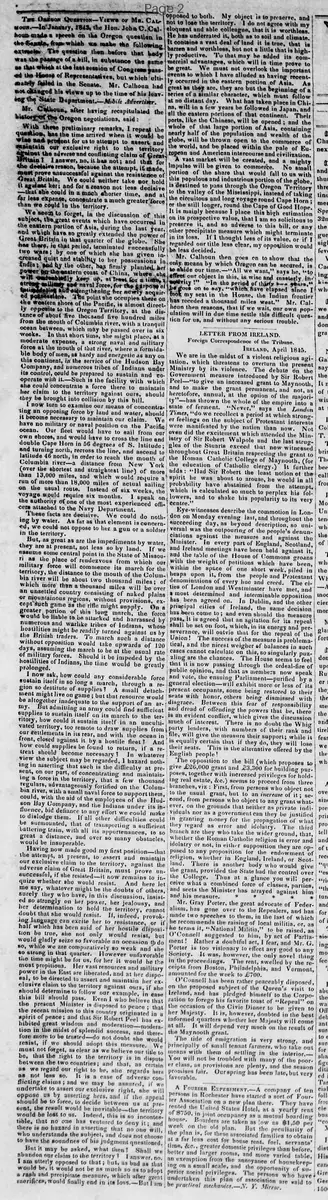
In January, 1845, the Hon. John C. Calhoun made a speech on the Oregon question in the Senate, from which we make the following extracts. The question then before that body was the passage of a bill, in substance the same as that which at the last session of Congress passed the House of Representatives, but which ultimately failed in the Senate. Mr. Calhoun had not changed his views up to the time of his leaving the State Department.—Mobile Advertiser.
Mr. Calhoun, after having recapitulated the history of the Oregon negotiations, said:
“With these preliminary remarks, I repeat the question, has the time arrived when it would be wise and prudent for us to attempt to assert and maintain our exclusive right to the territory against the adverse and conflicting claim of Great Britain? I answer, no, it has not; and that for the decisive reason, because the attempt, if made, must prove unsuccessful against the resistance of Great Britain. We could neither take nor hold it against her; and for a reason not less decisive—that she could in a much shorter time, and at far less expense, concentrate a much greater force than we could in the territory.
We seem to forget, in the discussion of this subject, the great events which have occurred in the eastern portion of Asia, during the last year, and which have so greatly extended the power of Great Britain in that quarter of the globe. She has there, in that period, terminated successfully two wars; by one of which she has given increased quiet and stability to her possessions in India; and by the other, has firmly planted her power on the eastern coast of China, where she will undoubtedly keep up, at least for a time, a strong military and naval force, for the purpose of protecting and strengthening her newly acquired possessions. The point she occupies there on the western shore of the Pacific, is almost directly opposite to the Oregon Territory, at the distance of about five thousand five hundred miles from the mouth of Columbia river, with a tranquil ocean between, which may be passed over in six weeks. In that short time, she might place, at a moderate expense, a strong naval and military force at the mouth of that river, where a formidable body of men, as hardy and energetic as any on this continent, in the service of the Hudson Bay Company, and numerous tribes of Indians under its control, could be prepared to sustain and co-operate with it.—Such is the facility with which she could concentrate a force there to maintain her claim to the territory against ours, should they be brought into collision by this bill.
I now turn to examine our means of concentrating an opposing force by land and water, should it become necessary to maintain our claim. We have no military or naval position on the Pacific ocean. Our fleet would have to sail from our own shores, and would have to cross the line and double Cape Horn in 56 degrees of S. latitude; and turning north, recross the line, and ascend to latitude 46 north, in order to reach the mouth of Columbia river—a distance from New York (over the shortest and straightest line) of more than 13,000 miles, and which would require a run of more than 18,000 miles of actual sailing on the usual route. Instead of six weeks, the voyage would require six months. I speak on the authority of one of the most experienced officers attached to the Navy Department.
These facts are decisive. We could do nothing by water. As far as that element is concerned, we could not oppose to her a gun or a soldier in the territory.
But, as great as are the impediments by water, they are at present, not less so by land. If we assume some central point in the State of Missouri as the place of rendezvous from which our military force will commence its march for the territory, the distance to the mouth of the Columbia river will be about two thousand miles; of which more than a thousand miles will be over an unsettled country consisting of naked plains or mountainous regions, without provisions, except such game as the rifle might supply. On a greater portion of this long march, the force would be liable to be attacked and harassed by numerous and warlike tribes of Indians, whose hostilities might be readily turned against us by the British traders. To march such a distance without opposition would take upwards of 120 days, assuming the march to be at the usual rate of military forces. Should it be impeded by the hostilities of Indians, the time would be greatly prolonged.
I now ask, how could any considerable force sustain itself in so long a march, through a region so destitute of supplies? A small detachment might live on game; but that resource would be altogether inadequate to the support of an army. But admitting an army could find sufficient supplies to sustain itself on its march to the territory, how could it sustain itself in an uncultivated territory, too remote to draw supplies from our settlements in its rear, and with the ocean in front, closed against it by a hostile fleet? And how could supplies be found to return, if a retreat should become necessary? In whatever view the subject may be regarded, I hazard nothing in asserting that such is the difficulty at present, on our part, of concentrating and maintaining a force in the territory, that a few thousand regulars, advantageously fortified on the Columbia river, with a small naval force to support them, could, with the aid of the employees of the Hudson Bay Company, and the Indians under its influence, bid defiance to any effort we could make to dislodge them. If all other difficulties could be surmounted, that of transporting a sufficient battering train, with all its appurtenances, to so great a distance, and over so many obstacles, would be insuperable.
Having now made good my first position—that the attempt, at present, to assert and maintain our exclusive claim to the territory, against the adverse claim of Great Britain, must prove unsuccessful, if she resisted—it now remains to inquire whether she would resist. And here let me say, whatever might be the doubts of others, surely they who have, in this discussion, insisted so strongly on her power, her jealousy, and her determination to hold the territory, cannot doubt that she would resist. If, indeed, provoking language can excite her to resistance, or if half which has been said of her hostile disposition be true, she not only would resist, but would gladly seize so favorable an occasion to do so, while we are comparatively so weak and she so strong in that quarter. However unfavorable the time might be for us, for her it would be the most propitious. Her vast resources and military power in the East are liberated, and at her disposal, to be directed to assert and maintain her exclusive claim to the territory against ours, if she should determine to follow our example, in case this bill should pass. Even I who believe that the present Minister is disposed to peace; that the recent mission to this country originated in a spirit of peace; and that Sir Robert Peel has exhibited great wisdom and moderation—moderation in the midst of splendid success, and therefore more to be trusted—do not doubt she would resist, if we should adopt this measure. We must not forget, as clear as we believe our title to be, that the right to the territory is in dispute between the two countries; and that, as certain as we regard our right to be, she regards hers as not less so. It is a case of adverse conflicting claims; and we may be assured, if we undertake to assert our exclusive right, she will oppose us by asserting hers, and if the appeal should be to force, to decide between us at present, the result would be inevitable—the territory would be lost to us. Indeed, this is so incontestable, that no one has ventured to deny it; and there is no hazard in asserting that no one will, who understands the subject, and does not choose to have the soundness of his judgment questioned.
But it may be asked, what then? Shall we abandon our claim to the territory? I answer, no. I am utterly opposed to that; but, as bad as that would be, it would not be as much so as to adopt a rash and precipitate measure, which after great sacrifices, would finally end in its loss.—But I am opposed to both. My object is to preserve, and not to lose the territory. I do not agree with my eloquent and able colleague, that it is worthless. He has underrated it, both as to soil and climate. It contains a vast deal of land it is true, that is barren and worthless, but not a little that is highly productive. To that may be added its commercial advantages, which will in time prove to be great. We must not overlook the important events to which I have alluded as having recently occurred in the eastern portion of Asia. As great as they are, they are but the beginning of a series of a similar character, which must follow at no distant day. What has taken place in China, will in a few years be followed in Japan, and all the eastern portions of that continent. Their ports, like the Chinese, will be opened; and the whole of that large portion of Asia, containing nearly half of the population and wealth of the globe, will be thrown open to the commerce of the world, and be placed within the pale of European and American intercourse and civilization. A vast market will be created, and a mighty impulse will be given to commerce. No small portion of the share that would fall to us with this populous and industrious portion of the globe, is destined to pass through the Oregon Territory to the valley of the Mississippi, instead of taking the circuitous and long voyage round Cape Horn; or the still longer, round the Cape of Good Hope. It is mainly because I place this high estimation on its prospective value, that I am so solicitous to preserve it, and so adverse to this bill, or any other precipitate measure which might terminate in its loss. If I thought less of its value, or if I regarded our title less clear, my opposition would be less decided.
Mr. Calhoun then goes on to show that the only means by which Oregon can be secured, is to bide our time.—'All we want,' says he, 'to effect our object in this, is wise and masterly inactivity!' 'In the period of thirty three years,' he goes on to say, 'which have elapsed since I took my seat in the House, the Indian frontier has receded a thousand miles west.' Mr. Calhoun then reasons, that if we wait, our own population will in due time settle this difficult question for us, and without any serious trouble.
What sub-type of article is it?
What keywords are associated?
What entities or persons were involved?
Where did it happen?
Foreign News Details
Primary Location
Oregon Territory
Event Date
January 1845
Key Persons
Outcome
opposition to bill asserting us exclusive rights; advocacy for patient settlement to avoid conflict and loss to britain.
Event Details
John C. Calhoun's Senate speech argues against passing a bill to assert US exclusive claim to Oregon Territory due to Britain's superior ability to reinforce via Pacific from Asia, US logistical challenges by sea and land, and potential British resistance. He highlights Oregon's future commercial value with Asian trade and urges 'wise and masterly inactivity' for natural US population expansion to resolve the dispute.