Thank you for visiting SNEWPapers!
Sign up free
The Wichita Daily Eagle
Wichita, Sedgwick County, Kansas
What is this article about?
At a New York Presbyterian foreign missions meeting on Nov. 15, ex-President Harrison praised the church's doctrine and missionary spirit. Ex-Secretary Foster detailed progress in Asian missions from Japan to Armenia, highlighting reforms in India, hopeful prospects in China and Japan, war impacts in Corea, and Armenian atrocities.
Clipping
OCR Quality
Full Text
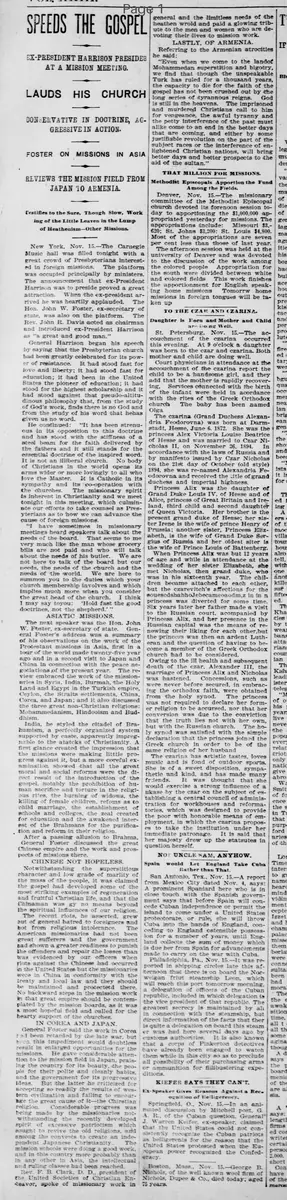
AT A MISSION MEETING.
LAUDS HIS CHURCH
CONSERVATIVE IN DOCTRINE, AGGRESSIVE IN ACTION.
FOSTER ON MISSIONS IN ASIA
REVIEWS THE MISSION FIELD FROM JAPAN TO ARMENIA.
Testifies to the Sure, Though Slow, Working of the Little Leaven in the Lump of Heathenism—Other Missions.
New York, Nov. 15.—The Carnegie Music hall was filled tonight with a great crowd of Presbyterians interested in foreign missions. The platform was occupied principally by ministers. The announcement that ex-President Harrison was to preside proved a great attraction. When the ex-president arrived he was heartily applauded. The Hon. John W. Foster, ex-secretary of state, was also on the platform. The Rev. John R. Davis acted as chairman and introduced ex-President Harrison as "a great and good man."
General Harrison began his speech by saying that the Presbyterian church had been greatly celebrated for its power of resistance. It had stood fast for love and liberty; it had stood fast for education: it had been in the United States the pioneer of education: it had stood for the highest scholarship and it had stood against that pseudo-altitudinous philosophy that, from the study of God's work, finds there is no God and from the study of his word that he has given us no word.
He continued: "It has been strenuous in its opposition to this doctrine and has stood with the stiffness of a steel beam for the faith delivered by the fathers and it still stands for the essential doctrine of the inspired word. It is not an illiberal church. No body of Christians in the world opens its arms wider or more lovingly to all who love the Master. It is Catholic in its sympathy and its co-operation with the churches. The missionary spirit is inherent in Christianity and we meet tonight in this meeting, which culminates our efforts to take counsel as Presbyterians as to how we can advance the cause of foreign missions.
"I have sometimes in missionary meetings heard speakers talk about the needs of the board. That seems to me very much like the man whose grocery bills are not paid and who will talk about the needs of his butler. We are not here to talk of the board but our needs, the needs of the church and the needs of the world. We are here to summon you to the duties which your church membership involves and which implies much more when you consider the great head of the church. I think I may say to you: 'Hold fast the good doctrines, not the shepherd.'"
ASIATIC MISSIONS.
The next speaker was the Hon. John W. Foster, ex-secretary of state. General Foster's address was a summary of his observations on the work of the Protestant missions in Asia, first in a tour of the world made twenty-five years ago and in a second visit to Japan and China in connection with the peace negotiations of the present year. The review embraced the work of the missionaries in Syria, India, Burmah, the Holy Land and Egypt in the Turkish empire, Ceylon, the Straits settlements, China, Corea, and Japan; and it also discussed the three great non-Christian religions: Mohammedanism, Hindooism and Buddhism.
India, he styled the citadel of Brahminism, a perfectly organized system supported by caste, apparently impregnable to the attacks of Christianity. A first glance created the impression that the missions were making little progress against it, but a more careful examination showed that all the great moral and social reforms were the direct result of the introduction of the gospel, notably the prohibition of human sacrifice and torture in the religious rites, the burning of widows, the killing of female children, reforms as to child marriage, the establishment of schools and colleges, the zeal created for education and the awakened interest of the Brahmans for the purification and reform in their religion.
After a passing allusion to Brahma, General Foster discussed the great Chinese empire and the work and prospects of missions there.
CHINESE NOT HOPELESS.
Notwithstanding the superstitious character and low grade of morality of the mass of the people, it was claimed the gospel had developed some of the most striking examples of regeneration and fruitful Christian life, and that the Chinaman was by no means beyond the spiritual influences of our religion. The recent riots, he asserted, grew out of general hatred to foreigners and not from religious intolerance.
The American missionaries had not been great sufferers and the government had shown a greater readiness to punish the offenders and repair the losses than was evidenced by our officers when riots against the Chinese had occurred in the United States but the missionaries were in China in conformity with the treaty and local law and they should be maintained and protected there. No backward steps in the mission work in that great empire should be contemplated by the mission boards, as it was a most hopeful field and called for the hearty support of the churches.
IN COREA AND JAPAN.
General Foster said the work in Corea had been retarded by the late war, but even this impediment would doubtless result in enlarged opportunities for the missions. He gave considerable attention to the mission field in Japan, praising the country for its beauty, the people for their polite and cleanly habits, and the government for its progressive ideas. But the latter he criticized for accepting so readily the results of western civilization and failing to encourage the great cause of it—the Christian religion. Considerable progress was being made by the missionaries notwithstanding the recently developed spirit of excessive patriotism which sought to revive the old religions, even among the converts to create an independent Japanese Christianity. The mission schools were doing a good work, and in this country more probably than in any other in Asia, the intellectual and ruling classes had been reached.
Rev. F. B. Clark, D. D., president of the United Societies of Christian Endeavor, spoke of missionary work in general and the limitless needs of the heathen world and paid a glowing tribute to the men and women who are devoting their lives to mission work.
LASTLY, OF ARMENIA.
Referring to the Armenian atrocities he said:
"Even when we come to the land of Mohammedan superstition and bigotry, we find that though the unspeakable Turk has ruled for a thousand years, the capacity to die for the faith of the gospel has not been crushed out by the long series of tyrannous reigns. God is still in the heavens. The imprisoned and murdered Christians call to him for vengeance, the awful tyranny and the petty interference of the past must alike come to an end in the better days that are coming, and either by some justifiable revolution on the part of the subject races or the interference of enlightened Christian nations, will bring better days and better prospects to the aid of the sultan."
What sub-type of article is it?
What keywords are associated?
What entities or persons were involved?
Where did it happen?
Foreign News Details
Primary Location
Asia
Event Date
Nov. 15
Key Persons
Outcome
progress in missionary work including moral and social reforms in india, regeneration in china, enlarged opportunities in corea post-war, advancement in japan among intellectual classes, ongoing atrocities in armenia calling for intervention
Event Details
Ex-President Harrison presided over a Presbyterian foreign missions meeting in New York, lauding the church's conservative doctrine and aggressive action. Hon. John W. Foster reviewed Protestant missions in Asia from Japan to Armenia, discussing challenges and progress against non-Christian religions in India, China, Corea, Japan, and the Turkish empire, emphasizing reforms and hopeful prospects. Rev. F. B. Clark praised missionaries and addressed Armenian atrocities.