Thank you for visiting SNEWPapers!
Sign up free
Kansas Weekly Herald
Leavenworth, Leavenworth County, Kansas
What is this article about?
In 1854, Kansas Territory Governor A.H. Reeder publishes correspondence rejecting a Leavenworth meeting committee's push for an immediate territorial legislature election, citing the meeting's composition mainly of Missouri residents and affirming local self-governance rights.
Clipping
OCR Quality
Full Text
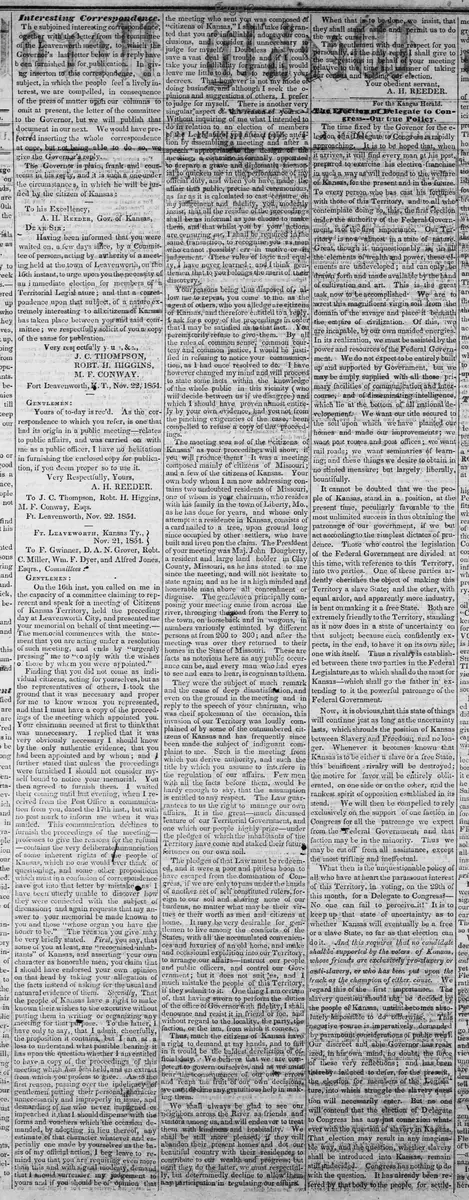
The subjoined interesting correspondence, together with the letter from the committee of the Leavenworth meeting, to which the Governor's last letter below is a reply have been furnished us for publication. In giving insertion to this correspondence, on a subject, in which the people feel a lively interest, we are compelled, in consequence of the press of matter upon our columns to omit at present, the letter of the committee to the Governor, but we will publish that document in our next. We would have preferred inserting the whole correspondence at once, but not being able to do so, we give the Governor's reply on which volumes might be written.
The Governor is plain, frank and courteous in his reply, and it is such a one under the circumstances, in which he will be justified by the citizens of Kansas.
To his Excellency,
A. H. Reeder, Gov. of Kansas,
DEAR SIR:
Having been informed that you were waited on, a few days since, by a Committee of persons, acting by authority of a meeting held at the town of Leavenworth, on the 15th instant, to urge upon you the necessity of an immediate election for members of a Territorial Legislature: and that a correspondence upon that subject, of a nature extremely interesting to all citizens of Kansas has taken place between you and said committee; we respectfully solicit of you a copy of the same for publication.
Very respectfully yours, &c.,
J. C. THOMPSON,
ROBT. H. HIGGINS,
M. F. CONWAY.
Fort Leavenworth, K. T., Nov. 22, 1854.
Gentlemen:
Yours of to-day is rec'd. As the correspondence to which you refer, is one that had its origin in a public meeting—relates to public affairs, and was carried on with me as a public officer, I have no hesitation in furnishing the enclosed copy for publication, if you deem proper so to use it.
Very Respectfully, Yours,
A. H. REEDER.
To J. C. Thompson, Robt. H. Higgins,
M. F. Conway, Esqs.
Ft. Leavenworth, Nov. 22. 1854.
FT. LEAVENWORTH, Kansas Ty.,
Nov. 21, 1854.
To F. Gwinner, D.A. N. Grover, Robt.
C. Miller, Wm. F. Dyer, and Alfred Jones,
Esqrs., Committee:
Gentlemen:
On the 16th inst. you called on me in the capacity of a committee claiming to represent and speak for a meeting of Citizens of Kansas Territory, held the preceding day at Leavenworth City, and presented me your memorial on behalf of that meeting.
The memorial commences with the statement that you are acting under a resolution of such meeting, and ends by "urgently pressing" me to "comply with the wishes of those by whom you were appointed."
Finding that you did not come as individual citizens, acting for yourselves, but as the representatives of others, I took the ground that it was necessary and proper for me to know whom you represented, and that I must have a copy of the proceedings of the meeting which appointed you.
Your chairman seemed at first to think that was unnecessary.
I replied that it was very obviously necessary I should know by the only authentic evidence; that you had been appointed and by whom; and I further stated that unless the proceedings were furnished I should not consider myself bound to notice your memorial. You then agreed to furnish them. I waited their coming until last evening, when I received from the Post Office a communication from you, dated the 17th inst., but with no post mark to inform me when it was mailed. This communication declines to furnish the proceedings of the meeting—professes to give the reasons for the refusal—contains the very deliberate annunciation of some inherent rights of the people of Kansas, which no one would ever think of questioning, and some other propositions which must in a confusion of correspondence have got into that letter by mistake as I have been utterly unable to discover how they were connected with the subject of discussion; and again requests that my answer to your memorial be made known to you and those "whose organ you have the honor to be." The reasons you give may be very briefly stated. First, you say, that some of you at least, are "recognised inhabitants" of Kansas, and asserting your own character as honorable men, you claim that I should have endorsed your own opinion on that head by taking your allegation of the facts instead of asking for the usual and natural evidence of them. Secondly, That the people of Kansas have a right to make known their wishes to the executive without putting them in writing or organizing any meeting for that purpose. To the latter, I have only to say, that I admit, cheerfully, the proposition it contains, but I am at a loss to understand what possible bearing it has upon the question whether I am entitled to have a copy of the proceedings of this meeting which has been held, and an extract from which you profess to give. As to the first reason, passing over the indelicacy of gentlemen putting their personal character unnecessarily and improperly in issue, and demanding of me who never impugned or impeached it, that I should dispense with the forms and vouchers which the occasion demanded, by adopting in lieu thereof, any estimate of that character whatever and especially one made by yourselves as the basis of my official action, I beg leave to remind you that you are requiring even more than this and with signal modesty, demand that I should surrender my judgement to yours and if you should be of opinion that the meeting who sent you was composed of "citizens of Kansas," I should take for granted that you are infallible adopt your conclusions, and consider it unnecessary to judge for myself. Doubtless this would save a vast deal of trouble and if I could take your infallibility for granted it would leave me little to do, but to register your decrees. That however is not my mode of doing business, and although I seek the opinions and suggestions of others, I prefer to judge for myself. There is another very singular aspect of this reason of yours. Without inquiring of me what I intended to do in relation to an election of members of the Legislature you attract public attention by assembling a meeting and after a speech appropriate to the designs of the meeting, a committee is formally appointed to prepare a grave and diplomatic memorial to quicken me in the performance of my official duty, and when you have made the affair thus public, precise and ceremonious, as far as it is calculated to cast discredit on my judgement and fidelity, you modestly insist, that all the residue of the proceedings shall be as informal as you choose to make them, and that whilst you by your actions are censuring me, I shall be required in the same transaction, to recognise you as men who cannot possibly err in motive or judgement. These rules of logic and equity, I have never learned; and I think gentlemen that, to you belongs the merit of their discovery.
Your reasons being thus disposed of, allow me to repeat; you come to me, as the agent of others, who you allege are citizens of Kansas, "and therefore entitled to a reply" I ask for a copy of the proceedings in order that I may be satisfied as to that fact. You peremptorily refuse to give them. By all the rules of common sense, common courtesy and common justice, I would be justified in refusing to notice your communication, as I had once resolved to do. I have however changed my mind and will proceed to state some facts within the knowledge of the whole public in this vicinity (who will decide between us if we disagree) and which I should have proven almost entirely by your own evidence, had you not from the pinching exigencies of the case been compelled to refuse a copy of the proceedings.
The meeting was not of the "citizens of Kansas" as your proceedings will show; if you will produce them It was a meeting composed mainly of citizens of Missouri; and a few of the citizens of Kansas. Your own body whom I am now addressing contains two undoubted residents of Missouri. one of whom is your chairman, who resides with his family in the town of Liberty, Mo., as he has done for years, and whose only attempt at a residence in Kansas, consists of a card nailed to a tree, upon ground long since occupied by other settlers, who have built and live upon the claim. The President of your meeting was Maj. John Dougherty, a resident and large land holder in Clay County, Missouri, as he has stated to me since the meeting, and will not hesitate to state again; and as he is a high minded and honorable man above all concealment or disguise. The gentlemen principally composing your meeting came from across the river, thronging the road from the Ferry to the town, on horseback and in wagons, in numbers variously estimated by different persons at from 200 to 300; and after the meeting was over they returned to their homes in the State of Missouri. These are facts as notorious here as any public occurrence can be, and every man who had eyes to see and ears to hear, is cognisant to them. They were the subject of much remark and the cause of deep dissatisfaction, and even on the ground in the meeting and in reply to the speech of your chairman, who was chief spokesman of the occasion, this invasion of our Territory was loudly complained of by some of the outnumbered citizens of Kansas and has frequently since been made the subject of indignant complaint to me. Such is the meeting from which you derive authority, and such the title by which you assume to interfere in the regulation of our affairs. Few men with all the facts before them, would be hardy enough to say, that the assumption is entitled to any respect. The Law guarantees to us the right to manage our own affairs. It is the great—much discussed feature of our Territorial Government, and one which our people highly prize—under the pledges of which the inhabitants of the Territory have come and staked their future fortunes on our own soil.
The pledges of that Law must be redeemed, and it were a poor and pitiless boon to have escaped from the domination of Congress, if we are only to pass under the hands of another set of self constituted rulers, foreign to our soil and sharing none of our burdens, no matter what may be their virtues or their worth as men and citizens at home. It may be very desirable for gentlemen to live among the comforts of the States, with all the accumulated conveniences and luxuries of an old home, and make and occasional expedition into our Territory, to arrange our affairs—instruct our people and public officers, and control our Government; but it does not suit us, and I much mistake the people of this Territory, if they submit to it. One thing I am certain of, that having sworn to perform the duties of the office of Governor with fidelity, I shall denounce and resist it in friend or foe, and without regard to the locality, the party, the faction, or the ism, from which it comes.
Thus, much the citizens of Kansas have a right to demand at my hands, and to fail in it would be the baldest dereliction of official duty. We believe that we are competent to govern ourselves, and as we must bear the consequences of our own errors and reap the fruit of our own decisions. we must decline any gratuitous help in making them.
We shall always be glad to see our neighbors across the River as friends and visitors among us, and will endeavor to treat them with kindness and hospitality. We shall be still more pleased, if they will abandon their present homes and dot our beautiful country with their residences to contribute to our wealth and progress; but until they do the latter, we must respectfully, but determinedly decline to allow them a participation in regulating our affairs
When that is to be done, we insist, that they shall stand aside and permit us to do the work ourselves.
This gentlemen with due respect for you personally, is the only reply I shall give to the suggestions in behalf of your meeting relative to the time and manner of taking our census and holding our election.
Your obedient servant,
A. H. REEDER.
What sub-type of article is it?
What keywords are associated?
What entities or persons were involved?
Where did it happen?
Domestic News Details
Primary Location
Leavenworth, Kansas Territory
Event Date
November 21, 1854
Key Persons
Outcome
governor reeder refuses to act on the committee's memorial urging an immediate legislative election, citing the meeting's illegitimate composition primarily of missouri residents and emphasizing kansas citizens' right to self-governance without external interference.
Event Details
Publication of correspondence where Kansas Territory Governor A.H. Reeder responds to a committee from a November 15, 1854, Leavenworth meeting, rejecting their demand for an immediate territorial legislature election due to the meeting being dominated by Missouri citizens rather than Kansas residents, and asserting the territory's right to manage its own affairs.