Thank you for visiting SNEWPapers!
Sign up free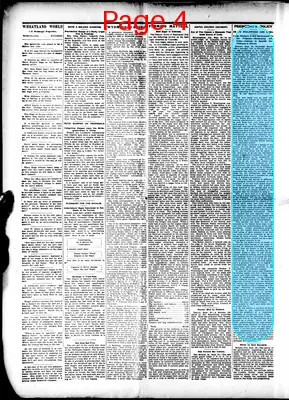
Story
September 26, 1902
The Wheatland World
Wheatland, Platte County, Laramie County, Wyoming
What is this article about?
President Roosevelt delivers an address to Spanish War Veterans in Detroit on U.S. policies: granting self-government to the Philippines after conflict, administrative success in Porto Rico, and advocating reciprocity with independent Cuba to foster economic ties and support its development.
Clipping

OCR Quality
98%
Excellent
Full Text
President's Policy
As To Philippines and Cuba.
Large Measure of Self Government for the Filipinos.—Reciprocity with Cuba. Address to Spanish War Veterans in Detroit.
Detroit, Sept. 23.—President Roosevelt's two-day visit to Detroit came to an end yesterday at the conclusion of a banquet tendered him in Light Guard armory by the Spanish war veterans, the opening of whose third annual reunion he attended this morning. It was a brilliant event. Nearly 800 men sat at the tables on the floor of the big armory, and the galleries were crowded to their utmost capacity by brilliantly gowned women and their escorts. The armory was decorated in green and white maple branches, and electric lights were everywhere.
When the President arose to begin his address, which was the first of the evening, he received an ovation. The men on the floor stood up and cheered again and again, while the clapping of hands from the gallery was like the crackle of musketry. The President, after speaking of Michigan's important part in the Spanish-American war, said:
"The war itself was an easy one. The tasks left behind us, though glorious, have been hard. You, the men of the Spanish war, you and your comrades in arms who fought in Cuba and Porto Rico and in the Philippines, won renown for the country, added to its moral grandeur and to its material prosperity, but you also left duties to be done by those who came after you.
"In Porto Rico the duty has been merely administrative and it has been so well done that very little need be said about it. In the Philippines the problem was one of extreme difficulty. But after three years of bitter fighting peace has been won by the valor of our soldiers and civil government has been introduced, so that the islanders have now greater opportunities for life, liberty and the pursuit of happiness than ever they have enjoyed before during their recorded history.
"Last week I ordered a taking of the census of the islands and two years hence, according to the law of Congress, the first steps will be taken in the direction of giving the Philippine people a legislative assembly. No other Oriental country in the possession of an alien power—indeed, no Oriental country at all, save only Japan—has been given any such measure of self-government and personal freedom as we have already given to the Filipinos.
"One of the most important recent measures has been the providing of a cable for the Philippines, this being necessary both from a commercial and from a military standpoint.
"With Cuba the matter is different. We pledged ourselves solemnly at the outbreak of the war with Spain to give to Cuba independence. The world at large sneered at the pledge and even some of our own people scoffed at the thought that we intended to keep it.
"But we have kept it in good faith and with a keen regard for the welfare of the Cubans. We did not turn Cuba loose to sink into a welter of anarchy. We first administered the affairs of the island until order had been brought out of chaos, until the cities had been cleaned, the courts purified, an educational system started and a just and efficient government introduced. Then we turned the new republic over to the hands of those whom its people had elected as its servants and bade it god-speed in its journey of independence.
"But neither our duty to, nor our interest in the island have come to an end with the establishment of its independence. Cuba's immediate proximity to the United States rendered its well being of such interest to us that we were forced to interfere in its interest by force of arms. For the same reason its future cannot but be a matter of grave concern to us.
"We do not desire Cuba to stand toward any other nation in the same relations of intimate friendship and alliance that we desire to see it adopt toward us. It must therefore be in a certain sense a part of our international political system, and it accepted this position when it accepted the Platt amendment. But it is out of the question for us to expect that it will assume such a position toward us in regard to international politics without at the same time sharing somewhat in the benefit of our economic system.
"It was for this reason that President McKinley urged, and that I have since urged and shall continue to urge the need of establishing closer relations with Cuba by reciprocity. We urge reciprocity because it is for our interests to control the Cuban markets, because we are bound to place Cubans on a peculiar standing, economically when they consent to our interests, as well as their own, to assume a peculiar status internationally, and because it is fitting for a great and generous Republic to stretch out a helping hand toward her feebler sister just starting to tread the path of independence. The case stands by itself, and there can be no other like it.
"I do not believe a particle of harm will come to any American interest from the adoption of a reasonable measure of reciprocity with Cuba. I am certain that the adoption of such a measure will be in the interests of our people as a whole. Above all, while fully acknowledging the high-mindedness and moral sincerity of those of my associates with whom on this point I differ, I yet feel most strongly that by every consideration of a generous and far-sighted public policy we are bound to prove to Cuba our friendship with her in her struggle for the material well being which must underlie healthy national development."
As To Philippines and Cuba.
Large Measure of Self Government for the Filipinos.—Reciprocity with Cuba. Address to Spanish War Veterans in Detroit.
Detroit, Sept. 23.—President Roosevelt's two-day visit to Detroit came to an end yesterday at the conclusion of a banquet tendered him in Light Guard armory by the Spanish war veterans, the opening of whose third annual reunion he attended this morning. It was a brilliant event. Nearly 800 men sat at the tables on the floor of the big armory, and the galleries were crowded to their utmost capacity by brilliantly gowned women and their escorts. The armory was decorated in green and white maple branches, and electric lights were everywhere.
When the President arose to begin his address, which was the first of the evening, he received an ovation. The men on the floor stood up and cheered again and again, while the clapping of hands from the gallery was like the crackle of musketry. The President, after speaking of Michigan's important part in the Spanish-American war, said:
"The war itself was an easy one. The tasks left behind us, though glorious, have been hard. You, the men of the Spanish war, you and your comrades in arms who fought in Cuba and Porto Rico and in the Philippines, won renown for the country, added to its moral grandeur and to its material prosperity, but you also left duties to be done by those who came after you.
"In Porto Rico the duty has been merely administrative and it has been so well done that very little need be said about it. In the Philippines the problem was one of extreme difficulty. But after three years of bitter fighting peace has been won by the valor of our soldiers and civil government has been introduced, so that the islanders have now greater opportunities for life, liberty and the pursuit of happiness than ever they have enjoyed before during their recorded history.
"Last week I ordered a taking of the census of the islands and two years hence, according to the law of Congress, the first steps will be taken in the direction of giving the Philippine people a legislative assembly. No other Oriental country in the possession of an alien power—indeed, no Oriental country at all, save only Japan—has been given any such measure of self-government and personal freedom as we have already given to the Filipinos.
"One of the most important recent measures has been the providing of a cable for the Philippines, this being necessary both from a commercial and from a military standpoint.
"With Cuba the matter is different. We pledged ourselves solemnly at the outbreak of the war with Spain to give to Cuba independence. The world at large sneered at the pledge and even some of our own people scoffed at the thought that we intended to keep it.
"But we have kept it in good faith and with a keen regard for the welfare of the Cubans. We did not turn Cuba loose to sink into a welter of anarchy. We first administered the affairs of the island until order had been brought out of chaos, until the cities had been cleaned, the courts purified, an educational system started and a just and efficient government introduced. Then we turned the new republic over to the hands of those whom its people had elected as its servants and bade it god-speed in its journey of independence.
"But neither our duty to, nor our interest in the island have come to an end with the establishment of its independence. Cuba's immediate proximity to the United States rendered its well being of such interest to us that we were forced to interfere in its interest by force of arms. For the same reason its future cannot but be a matter of grave concern to us.
"We do not desire Cuba to stand toward any other nation in the same relations of intimate friendship and alliance that we desire to see it adopt toward us. It must therefore be in a certain sense a part of our international political system, and it accepted this position when it accepted the Platt amendment. But it is out of the question for us to expect that it will assume such a position toward us in regard to international politics without at the same time sharing somewhat in the benefit of our economic system.
"It was for this reason that President McKinley urged, and that I have since urged and shall continue to urge the need of establishing closer relations with Cuba by reciprocity. We urge reciprocity because it is for our interests to control the Cuban markets, because we are bound to place Cubans on a peculiar standing, economically when they consent to our interests, as well as their own, to assume a peculiar status internationally, and because it is fitting for a great and generous Republic to stretch out a helping hand toward her feebler sister just starting to tread the path of independence. The case stands by itself, and there can be no other like it.
"I do not believe a particle of harm will come to any American interest from the adoption of a reasonable measure of reciprocity with Cuba. I am certain that the adoption of such a measure will be in the interests of our people as a whole. Above all, while fully acknowledging the high-mindedness and moral sincerity of those of my associates with whom on this point I differ, I yet feel most strongly that by every consideration of a generous and far-sighted public policy we are bound to prove to Cuba our friendship with her in her struggle for the material well being which must underlie healthy national development."
What sub-type of article is it?
Historical Event
What themes does it cover?
Triumph
Justice
Moral Virtue
What keywords are associated?
Roosevelt Speech
Philippines Policy
Cuba Reciprocity
Spanish American War
Self Government
Veterans Banquet
What entities or persons were involved?
President Roosevelt
President Mckinley
Spanish War Veterans
Where did it happen?
Detroit
Story Details
Key Persons
President Roosevelt
President Mckinley
Spanish War Veterans
Location
Detroit
Event Date
Sept. 23
Story Details
President Roosevelt praises Spanish War Veterans and outlines U.S. post-war policies: administrative success in Porto Rico, self-government progress in Philippines including census and legislative assembly, and advocacy for reciprocity with Cuba to support its independence and economic ties.