Thank you for visiting SNEWPapers!
Sign up free
The Virginia Gazette
Richmond, Williamsburg, Richmond County, Virginia
What is this article about?
Extracts from letters by Major General Prevost to Lord George Germaine detail British military operations in South Carolina and Georgia during 1779, including repulsing an American attack at Stono Ferry on June 20 with 800 troops under Lt. Col. Maitland, causing heavy enemy losses, and strategic withdrawals to islands for health reasons. Includes casualty return.
Clipping
OCR Quality
Full Text
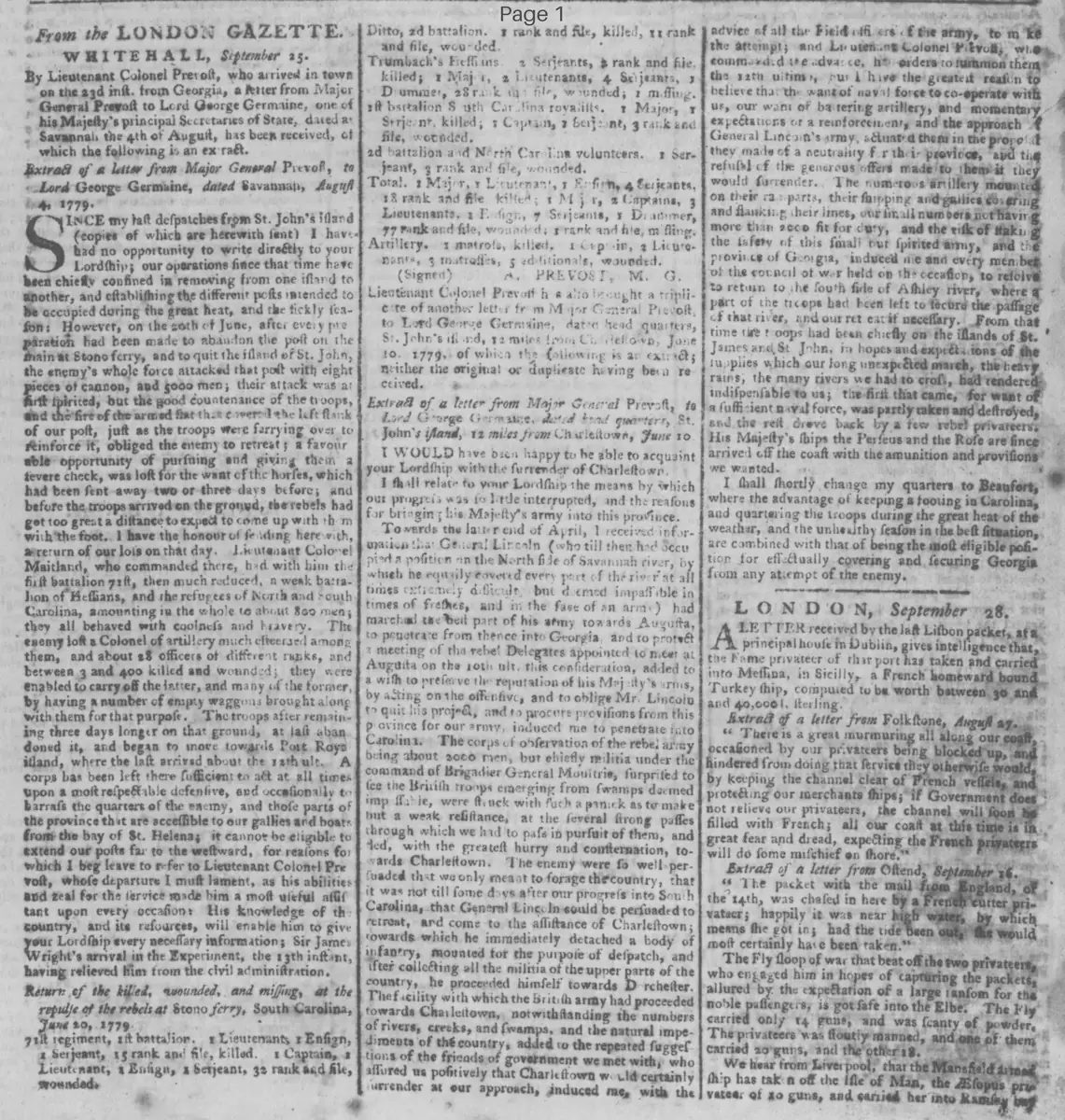
By Lieutenant Colonel Prevost, who arrived in town on the 2nd inst. from Georgia, a letter from Major General Prevost to Lord George Germaine, one of his Majesty's principal Secretaries of State, dated at Savannah the 4th of August, has been received, of which the following is an extract.
Extract of a letter from Major General Prevost, to Lord George Germaine, dated Savannah, August 1779,
SINCE my last despatches from St. John's island (copies of which are herewith sent) I have had no opportunity to write directly to your Lordship; our operations since that time have been chiefly confined in removing from one island to another, and establishing the different posts intended to be occupied during the great heat, and the sickly season: However, on the 20th of June, after every preparation had been made to abandon the post on the main at Stono ferry, and to quit the island of St. John, the enemy's whole force attacked that post with eight pieces of cannon, and 2000 men; their attack was at first spirited, but the good countenance of the troops, and the fire of the armed sloop that covered the left flank of our post, just as the troops were ferrying over to reinforce it, obliged the enemy to retreat; a favourable opportunity of pursuing and giving them a severe check, was lost for the want of the horses, which had been sent away two or three days before; and before the troops arrived on the ground, the rebels had got too great a distance to expect to come up with them with the foot. I have the honour of enclosing herewith, a return of our loss on that day, Lieutenant Colonel Maitland, who commanded there, had with him the 71st battalion, then much reduced, a weak battalion of Hessians, and the refugees of North and South Carolina, amounting in the whole to about 800 men; they all behaved with coolness and bravery. The enemy left a Colonel of artillery much esteemed among them, and about 28 officers of different ranks, and between 300 and 400 killed and wounded; they were enabled to carry off the latter, and many of the former, by having a number of empty waggons brought along with them for that purpose. The troops after remaining three days longer on that ground, at last abandoned it, and began to move towards Port Royal island, where the last arrived about the 4th ult. A corps has been left there sufficient to act at all times upon a most respectable defensive, and occasionally to harass the quarters of the enemy, and those parts of the province that are accessible to our galleys and boats from the bay of St. Helena; it cannot be eligible to extend our posts far to the westward, for reasons for which I beg leave to refer to Lieutenant Colonel Prevost, whose departure I must lament, as his abilities and zeal for the service made him a most useful assistant upon every occasion: His knowledge of the country, and its resources, will enable him to give your Lordship every necessary information; Sir James Wright's arrival in the Experiment, the 12th instant, having relieved him from the civil administration.
Return of the killed, wounded, and missing, at the repulse of the rebels at Stono ferry, South Carolina, June 20, 1779
71st regiment, 1st battalion. 1 Lieutenant 1 Ensign, 1 Serjeant, 15 rank and file, killed.
1 Captain, 1 Lieutenant, 1 Ensign, 1 Serjeant, 32 rank and file, wounded.
Ditto, 2d battalion. 1 rank and file, killed, 11 rank and file, wounded.
Trumbach's Hessians 2 Serjeants, rank and file, killed; 1 Major, 2 Lieutenants, 4 Serjeants, Drummer, 28 rank and file, wounded; 1 missing.
1st battalion South Carolina royalists. 1 Major, 1 Serjeant, killed; 5 Captain, 7 Serjeant, 3 rank and file, wounded.
2d battalion 2nd North Carolina volunteers. 1 Serjeant, 2 rank and file, wounded.
Total. 1 Major, 2 Lieutenants, 1 Ensign, 4 Serjeants, 18 rank and file killed; 1 Major, 2 Captains, 3 Lieutenants, 1 Ensign, 7 Serjeants, 1 Drummer, 77 rank and file, wounded: 1 rank and file, missing.
Artillery. 1 matross, killed, 1 Captain, 2 Lieutenants, 3 matrosses, 5 privates, wounded.
(Signed) PREVOST, M. G.
Lieutenant Colonel Prevost has also brought a triplicate of another letter from Major General Prevost, to Lord George Germaine, dated head quarters, St. John's island, 12 miles from Charleston, June 10, 1779. of which the following is an extract; neither the original or duplicate having been received.
Extract of a letter from Major General Prevost, to Lord George Germaine, dated head quarters, St. John's island, 12 miles from Charleston, June 10, 1779.
I WOULD have been happy to have been able to acquaint your Lordship with the surrender of Charleston. I shall relate to your Lordship the means by which our progress was so far interrupted, and the reasons for bringing his Majesty's army into this province. Towards the latter end of April, I received information that General Lincoln (who till then had occupied a position on the North side of Savannah river, by which he equally covered every part of the river at all times extremely difficult, but deemed impassible in times of freshes, and in the face of an army) had marched the best part of his army towards Augusta, to penetrate from thence into Georgia and to protect meeting of the rebel Delegates appointed to meet at Augusta on the 10th ult. this consideration, added to a wish to preserve the reputation of his Majesty's arms, by acting on the offensive, and to oblige Mr. Lincoln to quit his post, and to procure provisions from this province for our army, induced me to penetrate into Carolina. The corps of observation of the rebel army being about 5000 men, but chiefly militia under the command of Brigadier General Moultrie, surprised to see the British troops emerging from swamps deemed impassable, were struck with such a panic as to make but a weak resistance, at the several strong passes through which we had to pass in pursuit of them, and fled, with the greatest hurry and consternation, towards Charleston. The enemy were so well persuaded that we only meant to forage the country, that it was not till some days after our progress into South Carolina, that General Lincoln could be persuaded to retreat, and come to the assistance of Charleston; towards which he immediately detached a body of infantry, mounted for the purpose of dispatch, and after collecting all the militia of the upper parts of the country, he proceeded himself towards Dorchester. The facility with which the British army had proceeded towards Charleston, notwithstanding the numbers of rivers, creeks, and swamps, and the natural impediments of the country, added to the repeated suggestions of the friends of government we met with, who assured us positively that Charleston would certainly surrender at our approach, induced me, with the advice of all the Field officers the army, to make the attempt; and Lieutenant Colonel Prevost, who commanded the advance, orders to summon them the last ultimatum, as I have the greatest reason to believe that the want of naval force to co-operate with us, our want of battering artillery, and momentary expectators of a reinforcement, and the approach General Lincoln's army, actuated them in the proposal they made of a neutrality for this province, and the refusal of the generous offers made to them if they would surrender. The numerous artillery mounted on their ramparts, their shipping and galleys covering and flanking their lines, our small numbers not having more than 2000 fit for duty, and the risk of taking the safety of this small but spirited army, and the province of Georgia, induced me and every member of the council of war held on the occasion, to resolve to return to the south side of Ashley river, where part of the troops had been left to secure the passage of that river, and our retreat if necessary. From that time the troops had been chiefly on the islands of St. James and St. John, in hopes and expectations of the supplies which our long unexpected march, the heavy rains, the many rivers we had to cross, had rendered indispensable to us; the first that came, for want of a sufficient naval force, was partly taken and destroyed, and the rest drove back by a few rebel privateers. His Majesty's ships the Perseus and the Roe are since arrived off the coast with the ammunition and provisions we wanted. I shall shortly change my quarters to Beaufort, where the advantage of keeping a footing in Carolina, and quartering the troops during the great heat of the weather, and the unhealthy season in the best situation, are combined with that of being the most eligible position for effectually covering and securing Georgia from any attempt of the enemy.
What sub-type of article is it?
What themes does it cover?
What keywords are associated?
What entities or persons were involved?
Where did it happen?
Story Details
Key Persons
Location
Stono Ferry, South Carolina; St. John's Island; Savannah, Georgia; Charleston
Event Date
June 20, 1779; August 4, 1779; June 10, 1779
Story Details
British forces under Prevost repulse American attack at Stono Ferry with 800 men, inflicting 300-400 casualties; strategic movements to islands for health; failed attempt on Charleston due to lack of artillery and naval support; provisions secured.