Thank you for visiting SNEWPapers!
Sign up free
Literary
July 11, 1890
The Iola Register
Iola, Allen County, Kansas
What is this article about?
Essay by Amelia Gere Mason explores women's influence on modern literature, emphasizing their contributions to moral purity, human sympathy, and compassion, contrasting with masculine Greek literature's focus on passion and fate. Highlights evolution in sentiment and spiritual depth over two centuries.
Clipping
OCR Quality
95%
Excellent
Full Text
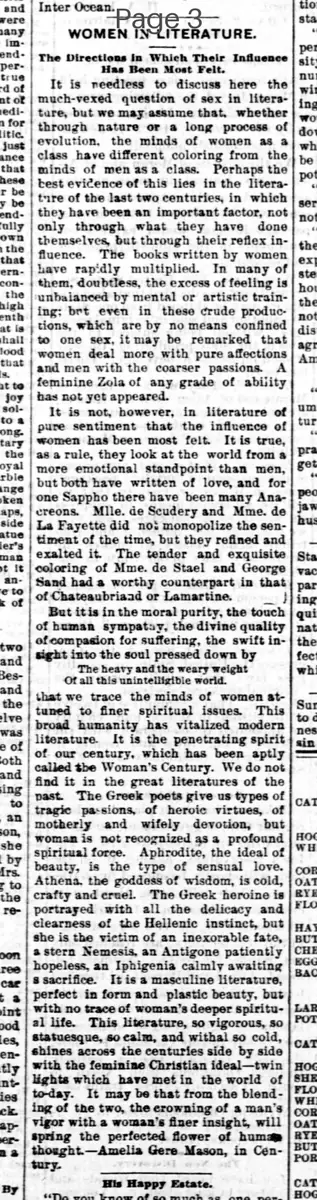
WOMEN IN LITERATURE,
The Directions in Which Their Influence Has Been Most Felt.
It is needless to discuss here the much-vexed question of sex in literature, but we may assume that, whether through nature or a long process of evolution, the minds of women as a class have different coloring from the minds of men as a class. Perhaps the best evidence of this lies in the literature of the last two centuries, in which they have been an important factor, not only through what they have done themselves but through their reflex influence. The books written by women have rapidly multiplied. In many of them, doubtless, the excess of feeling is unbalanced by mental or artistic training; but even in these crude productions, which are by no means confined to one sex, it may be remarked that women deal more with pure affections and men with the coarser passions. A feminine Zola of any grade of ability has not yet appeared.
It is not, however, in literature of pure sentiment that the influence of women has been most felt. It is true, as a rule, they look at the world from a more emotional standpoint than men, but both have written of love, and for one Sappho there have been many Anacreons. Mlle. de Scudery and Mme. de La Fayette did not monopolize the sentiment of the time, but they refined and exalted it. The tender and exquisite coloring of Mme. de Stael and George Sand had a worthy counterpart in that of Chateaubriand or Lamartine.
But it is in the moral purity, the touch of human sympathy, the divine quality of compassion for suffering, the swift insight into the soul pressed down by
The heavy and the weary weight
Of all this unintelligible world.
that we trace the minds of women attuned to finer spiritual issues. This broad humanity has vitalized modern literature. It is the penetrating spirit of our century, which has been aptly called the Woman's Century. We do not find it in the great literatures of the past. The Greek poets give us types of tragic passions, of heroic virtues, of motherly and wifely devotion, but woman is not recognized as a profound spiritual force. Aphrodite, the ideal of beauty, is the type of sensual love. Athena, the goddess of wisdom, is cold, crafty and cruel. The Greek heroine is portrayed with all the delicacy and clearness of the Hellenic instinct, but she is the victim of an inexorable fate, a stern Nemesis, an Antigone patiently hopeless, an Iphigenia calmly awaiting sacrifice. It is a masculine literature, perfect in form and plastic beauty, but with no trace of woman's deeper spiritual life. This literature, so vigorous, so statuesque, so calm, and withal so cold, shines across the centuries side by side with the feminine Christian ideal—twin lights which have met in the world of to-day. It may be that from the blending of the two, the crowning of a man's vigor with a woman's finer insight, will spring the perfected flower of human thought.—Amelia Gere Mason, in Century.
The Directions in Which Their Influence Has Been Most Felt.
It is needless to discuss here the much-vexed question of sex in literature, but we may assume that, whether through nature or a long process of evolution, the minds of women as a class have different coloring from the minds of men as a class. Perhaps the best evidence of this lies in the literature of the last two centuries, in which they have been an important factor, not only through what they have done themselves but through their reflex influence. The books written by women have rapidly multiplied. In many of them, doubtless, the excess of feeling is unbalanced by mental or artistic training; but even in these crude productions, which are by no means confined to one sex, it may be remarked that women deal more with pure affections and men with the coarser passions. A feminine Zola of any grade of ability has not yet appeared.
It is not, however, in literature of pure sentiment that the influence of women has been most felt. It is true, as a rule, they look at the world from a more emotional standpoint than men, but both have written of love, and for one Sappho there have been many Anacreons. Mlle. de Scudery and Mme. de La Fayette did not monopolize the sentiment of the time, but they refined and exalted it. The tender and exquisite coloring of Mme. de Stael and George Sand had a worthy counterpart in that of Chateaubriand or Lamartine.
But it is in the moral purity, the touch of human sympathy, the divine quality of compassion for suffering, the swift insight into the soul pressed down by
The heavy and the weary weight
Of all this unintelligible world.
that we trace the minds of women attuned to finer spiritual issues. This broad humanity has vitalized modern literature. It is the penetrating spirit of our century, which has been aptly called the Woman's Century. We do not find it in the great literatures of the past. The Greek poets give us types of tragic passions, of heroic virtues, of motherly and wifely devotion, but woman is not recognized as a profound spiritual force. Aphrodite, the ideal of beauty, is the type of sensual love. Athena, the goddess of wisdom, is cold, crafty and cruel. The Greek heroine is portrayed with all the delicacy and clearness of the Hellenic instinct, but she is the victim of an inexorable fate, a stern Nemesis, an Antigone patiently hopeless, an Iphigenia calmly awaiting sacrifice. It is a masculine literature, perfect in form and plastic beauty, but with no trace of woman's deeper spiritual life. This literature, so vigorous, so statuesque, so calm, and withal so cold, shines across the centuries side by side with the feminine Christian ideal—twin lights which have met in the world of to-day. It may be that from the blending of the two, the crowning of a man's vigor with a woman's finer insight, will spring the perfected flower of human thought.—Amelia Gere Mason, in Century.
What sub-type of article is it?
Essay
What themes does it cover?
Moral Virtue
Social Manners
What keywords are associated?
Women In Literature
Feminine Influence
Moral Purity
Human Sympathy
Greek Literature
Modern Literature
Spiritual Issues
What entities or persons were involved?
Amelia Gere Mason, In Century.
Literary Details
Title
Women In Literature, The Directions In Which Their Influence Has Been Most Felt.
Author
Amelia Gere Mason, In Century.
Subject
Women's Influence On Literature
Key Lines
The Heavy And The Weary Weight Of All This Unintelligible World.
This Broad Humanity Has Vitalized Modern Literature. It Is The Penetrating Spirit Of Our Century, Which Has Been Aptly Called The Woman's Century.
It May Be That From The Blending Of The Two, The Crowning Of A Man's Vigor With A Woman's Finer Insight, Will Spring The Perfected Flower Of Human Thought.