Thank you for visiting SNEWPapers!
Sign up free
Editorial
July 21, 1815
Daily National Intelligencer
Washington, District Of Columbia
What is this article about?
Editorial praises Mr. Gleason's geography lectures and laments the lack of support for geographical science in the U.S., criticizing Congress for disbanding the Topographical Engineers. Advocates integrating topography into military education and government promotion of the field for merchants, statesmen, and military.
Clipping
OCR Quality
98%
Excellent
Full Text
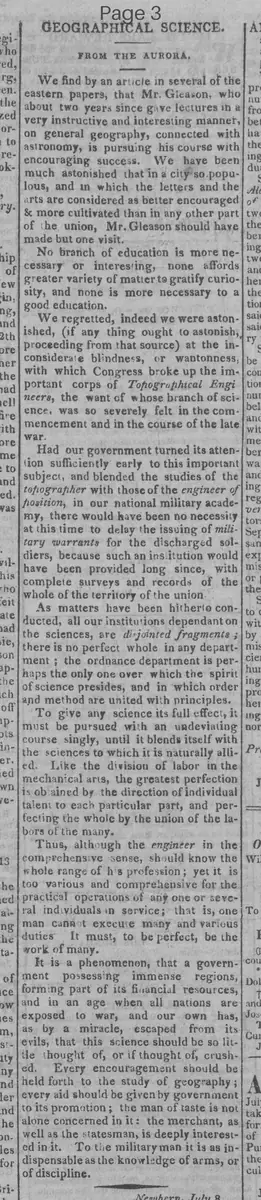
GEOGRAPHICAL SCIENCE.
FROM THE AURORA.
We find by an article in several of the eastern papers, that Mr. Gleason, who about two years since gave lectures in a very instructive and interesting manner, on general geography, connected with astronomy, is pursuing his course with encouraging success. We have been much astonished that in a city so populous, and in which the letters and the arts are considered as better encouraged & more cultivated than in any other part of the union, Mr. Gleason should have made but one visit.
No branch of education is more necessary or interesting, none affords greater variety of matter to gratify curiosity, and none is more necessary to a good education.
We regretted, indeed we were astonished, (if any thing ought to astonish, proceeding from that source) at the inconsiderate blindness, or wantonness, with which Congress broke up the important corps of Topographical Engineers, the want of whose branch of science, was so severely felt in the commencement and in the course of the late war.
Had our government turned its attention sufficiently early to this important subject, and blended the studies of the topographer with those of the engineer of position, in our national military academy, there would have been no necessity at this time to delay the issuing of military warrants for the discharged soldiers, because such an institution would have been provided long since, with complete surveys and records of the whole of the territory of the union.
As matters have been hitherto conducted, all our institutions dependent on the sciences, are disjointed fragments; there is no perfect whole in any department: the ordnance department is perhaps the only one over which the spirit of science presides, and in which order and method are united with principles.
To give any science its full effect, it must be pursued with an undeviating course singly, until it blends itself with the sciences to which it is naturally allied. Like the division of labor in the mechanical arts, the greatest perfection is obtained by the direction of individual talent to each particular part, and perfecting the whole by the union of the labors of the many.
Thus, although the engineer in the comprehensive sense, should know the whole range of his profession; yet it is too various and comprehensive for the practical operations of any one or several individuals in service; that is, one man cannot execute many and various duties. It must, to be perfect, be the work of many.
It is a phenomenon, that a government possessing immense regions, forming part of its financial resources, and in an age when all nations are exposed to war, and our own has, as by a miracle, escaped from its evils, that this science should be so little thought of, or if thought of, crushed. Every encouragement should be held forth to the study of geography; every aid should be given by government to its promotion; the man of taste is not alone concerned in it: the merchant, as well as the statesman, is deeply interested in it. To the military man it is as indispensable as the knowledge of arms, or of discipline.
FROM THE AURORA.
We find by an article in several of the eastern papers, that Mr. Gleason, who about two years since gave lectures in a very instructive and interesting manner, on general geography, connected with astronomy, is pursuing his course with encouraging success. We have been much astonished that in a city so populous, and in which the letters and the arts are considered as better encouraged & more cultivated than in any other part of the union, Mr. Gleason should have made but one visit.
No branch of education is more necessary or interesting, none affords greater variety of matter to gratify curiosity, and none is more necessary to a good education.
We regretted, indeed we were astonished, (if any thing ought to astonish, proceeding from that source) at the inconsiderate blindness, or wantonness, with which Congress broke up the important corps of Topographical Engineers, the want of whose branch of science, was so severely felt in the commencement and in the course of the late war.
Had our government turned its attention sufficiently early to this important subject, and blended the studies of the topographer with those of the engineer of position, in our national military academy, there would have been no necessity at this time to delay the issuing of military warrants for the discharged soldiers, because such an institution would have been provided long since, with complete surveys and records of the whole of the territory of the union.
As matters have been hitherto conducted, all our institutions dependent on the sciences, are disjointed fragments; there is no perfect whole in any department: the ordnance department is perhaps the only one over which the spirit of science presides, and in which order and method are united with principles.
To give any science its full effect, it must be pursued with an undeviating course singly, until it blends itself with the sciences to which it is naturally allied. Like the division of labor in the mechanical arts, the greatest perfection is obtained by the direction of individual talent to each particular part, and perfecting the whole by the union of the labors of the many.
Thus, although the engineer in the comprehensive sense, should know the whole range of his profession; yet it is too various and comprehensive for the practical operations of any one or several individuals in service; that is, one man cannot execute many and various duties. It must, to be perfect, be the work of many.
It is a phenomenon, that a government possessing immense regions, forming part of its financial resources, and in an age when all nations are exposed to war, and our own has, as by a miracle, escaped from its evils, that this science should be so little thought of, or if thought of, crushed. Every encouragement should be held forth to the study of geography; every aid should be given by government to its promotion; the man of taste is not alone concerned in it: the merchant, as well as the statesman, is deeply interested in it. To the military man it is as indispensable as the knowledge of arms, or of discipline.
What sub-type of article is it?
Science Or Medicine
Education
Military Affairs
What keywords are associated?
Geographical Science
Topographical Engineers
Education Necessity
Military Academy
Government Promotion
Scientific Institutions
What entities or persons were involved?
Mr. Gleason
Congress
Topographical Engineers
National Military Academy
Ordnance Department
Editorial Details
Primary Topic
Promotion Of Geographical Science And Topographical Engineering
Stance / Tone
Advocacy For Government Support And Educational Integration
Key Figures
Mr. Gleason
Congress
Topographical Engineers
National Military Academy
Ordnance Department
Key Arguments
Geography Is Essential And Interesting For Education
Congress Erred In Disbanding Topographical Engineers, Felt In The Late War
Government Should Integrate Topography Into Military Academy Curriculum
Scientific Institutions Are Fragmented Without Unified Approach
Specialization And Collaboration Needed For Engineering Perfection
Geography Vital For Merchants, Statesmen, And Military