Thank you for visiting SNEWPapers!
Sign up free
The Enquirer
Richmond, Henrico County, Virginia
What is this article about?
In the Virginia House of Delegates on January 8, 1805, Mr. Tazewell reported a bill to empower magistrates to apprehend deserters from foreign vessels, cover apprentices, and cancel abusive contracts, addressing impacts on commerce in ports like Norfolk. Mr. Smyth raised liberty and jurisdiction concerns; bill committed to committee of the whole.
Clipping
OCR Quality
Full Text
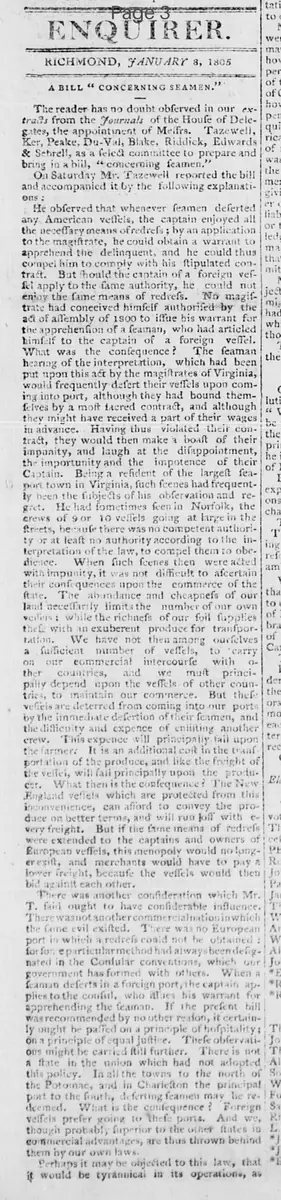
RICHMOND, JANUARY 8, 1805
A BILL "CONCERNING SEAMEN."
The reader has no doubt observed in our extracts from the Journals of the House of Delegates, the appointment of Messrs. Tazewell, Ker, Peake, Du-Val, Blake, Riddick, Edwards & Sebrell, as a select committee to prepare and bring in a bill, "concerning seamen."
On Saturday Mr. Tazewell reported the bill and accompanied it by the following explanations:
He observed that whenever seamen deserted any American vessels, the captain enjoyed all the necessary means of redress; by an application to the magistrate, he could obtain a warrant to apprehend the delinquent, and he could thus compel him to comply with his stipulated contract. But should the captain of a foreign vessel apply to the same authority, he could not enjoy the same means of redress. No magistrate had conceived himself authorized by the act of assembly of 1800 to issue his warrant for the apprehension of a seaman, who had articled himself to the captain of a foreign vessel.
What was the consequence? The seaman hearing of the interpretation, which had been put upon this act by the magistrates of Virginia, would frequently desert their vessels upon coming into port, although they had bound themselves by a most sacred contract, and although they might have received a part of their wages in advance. Having thus violated their contract, they would then make a boast of their impunity, and laugh at the disappointment, the importunity and the impotence of their Captain. Being a resident of the largest sea-port town in Virginia, such scenes had frequently been the subjects of his observation and regret. He had sometimes seen in Norfolk, the crews of 6 or 10 vessels going at large in the streets, because there was no competent authority or at least no authority according to the interpretation of the law, to compel them to obedience. When such scenes then were acted with impunity, it was not difficult to ascertain their consequences upon the commerce of the state. The abundance and cheapness of our land necessarily limits the number of our own vessels: while the richness of our soil supplies them with an exuberant produce for transportation. We have not then among ourselves a sufficient number of vessels, to carry on our commercial intercourse with other countries, and we must principally depend upon the vessels of other countries, to maintain our commerce. But these vessels are deterred from coming into our ports by the immediate desertion of their seamen, and the difficulty and expense of enlisting another crew. This expense will principally fall upon the farmer: It is an additional cost in the transportation of the produce, and like the freight of the vessel, will fall principally upon the producer. What then is the consequence? The New England vessels which are protected from this inconvenience, can afford to convey the produce on better terms, and will run off with every freight. But if the same means of redress were extended to the captains and owners of European vessels, this monopoly would no longer exist, and merchants would have to pay a lower freight, because the vessels would then bid against each other.
There was another consideration which Mr. T. said ought to have considerable influence. There was not another commercial nation in which the same evil existed. There were no European port in which a redress could not be obtained : for some particular method had always been designated in the Consular conventions, which our government has formed with others. When a seaman deserts in a foreign port, the captain applies to the consul, who issues his warrant for apprehending the seaman. If the present bill was recommended by no other reason, it certainly ought be passed on a principle of hospitality; on a principle of equal justice. These observations might be carried still further. There is not a state in the union which had not adopted this policy. In all the towns to the north of the Potomac, and in Charleston the principal port to the south, deserting seamen may be redeemed. What is the consequence? Foreign vessels prefer going to these ports. And we though probably, superior to the other states in commercial advantages, are thus thrown behind them by our own laws.
Perhaps it may be objected to this law, that it would be tyrannical in its operations, as it would throw the seamen upon the mercy of a single magistrate. But the present law already subjects the American seamen to such an authority : and shall we then put the foreign sailors upon a better footing than our own? The interpretation of our magistrates already confers upon them this tyrannical exercise of authority, if tyrannical it can be called. They have made the word "any" to mean not any seaman at all, but any American seaman : And shall we then subject our own citizens to this undue authority, without extending it to foreigners?
The 2d section of the present bill supplies a deficiency in the former law. According to the interpretation of that law, no seaman or mariner could be redeemed, unless he had contracted and could contract for himself. It had not been extended to any apprentice bound to a captain, some of whom are in almost every vessel. What is the consequence? These apprentices frequently run away from their vessels. It was to remedy this inconvenience that the 2d section was introduced into the law: for it gives a magistrate the same power over them, as over other seamen and mariners.
The 3d provision in the bill supplies a defect in the present law. It is to enable a magistrate, before whom an unfortunate and ill-used seaman has been brought, to cancel the contract. According to the existing system, a captain may have already treated his seaman with the utmost barbarity : he may threaten to continue his persecution after he leaves the bounds of the United States, and what remedy has the seaman? He may cite his captain to appear before the magistrate: he may have him bound in a recognizance to keep the peace. But this recognizance is not binding out of the United States, and even if it were, it was still necessary to try him in a court of the U. States. But in the mean time the victim would be in his power and suffering the utmost persecutions. This proviso then is introduced into the present bill: That if the magistrate is satisfied he has been ill-used or if he has any good reason to believe that he will be, he may then discharge him from his contract.
Mr. Tazewell concluded with observing, that this bill was all important to the commercial part of the commonwealth, & particularly to the borough of Norfolk, where more business is done perhaps, than in all the other parts of the state put together ; at the same time he believed that it was not altogether unimportant to the agricultural interest. Should the remote parts of the state, however, entertain a different sentiment, he trusted that the collective representatives of the country, would extend their concerns to every individual part, and that each representative would do unto others as he wished others to do unto him.
Mr. Smyth (of Wythe) observed that there were some provisions of the bill which he wished maturely to consider. He wished to enquire, how far the present bill would tend to violate the personal liberty of the people ; how far a subject of this sort was under the exclusive jurisdiction of Congress, from its controul over commerce ; how far it would encourage foreign at the expense of Virginia vessels. He wished also to enquire how far it was proper to subject the American sailors, to so extensive a power in the hands of foreign captains. He doubted whether it was correct to say, that in England or in France, the subjects of each were redeemable by an American captain. He doubted the propriety of giving up an American citizen to the commander of a foreign vessel, which would make him liable to an impressment by an armed vessel, or to a trial for any crimes which might be alleged against him. As his opinion was not made up on these different questions, he hoped that the bill would be committed to a committee of the whole.
Mr. Tazewell said he had not the least objection to an alteration of the bill, provided it might still be made to extend to foreigners. He had no objection to striking out that part of it, which subjected an American seaman to the authority of the captain of a foreign vessel.
The bill was committed to the committee of the whole on Wednesday.
What sub-type of article is it?
What keywords are associated?
What entities or persons were involved?
Where did it happen?
Domestic News Details
Primary Location
Richmond, Virginia
Event Date
Saturday, January 1805
Key Persons
Outcome
the bill was committed to the committee of the whole on wednesday.
Event Details
Mr. Tazewell reported a bill in the House of Delegates to allow magistrates to issue warrants for apprehending deserters from foreign vessels, extend authority to apprentices, and enable cancellation of contracts if seamen are ill-treated, addressing desertions impacting commerce in Virginia ports like Norfolk. Mr. Smyth expressed concerns about personal liberty, federal jurisdiction, and favoring foreign over Virginia vessels; Tazewell agreed to potential alterations while maintaining extension to foreigners.