Thank you for visiting SNEWPapers!
Sign up free
Story
October 8, 1905
Daily Press
Newport News, Virginia
What is this article about?
Anecdotes on overcoming stammering: J.H. Shorthouse credits his affliction for inspiring 'John Inglesant'; an anonymous writer describes self-curing by silently practicing syllables as a boy, eliminating public stammering.
Clipping
OCR Quality
98%
Excellent
Full Text
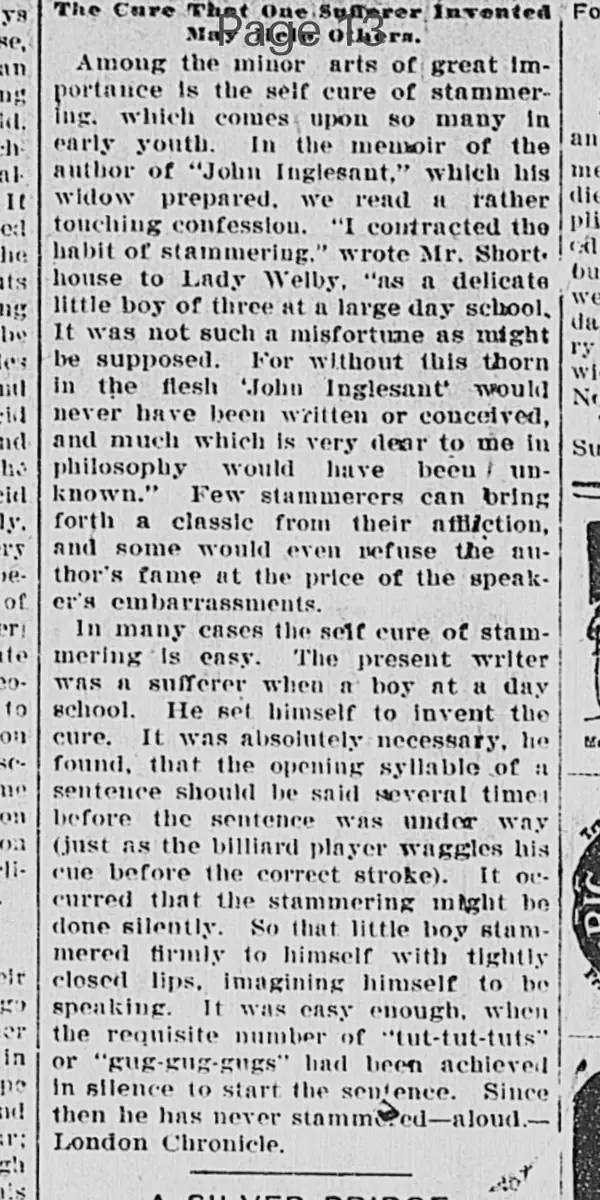
Among the minor arts of great importance is the self cure of stammer- ing, which comes upon so many in early youth. In the memoir of the author of "John Inglesant," which his widow prepared, we read a rather touching confession. "I contracted the habit of stammering," wrote Mr. Shorthouse to Lady Welby, "as a delicate little boy of three at a large day school. It was not such a misfortune as might be supposed. For without this thorn in the flesh 'John Inglesant' would never have been written or conceived, and much which is very dear to me in philosophy would have been unknown." Few stammerers can bring forth a classic from their affliction, and some would even refuse the author's fame at the price of the speaker's embarrassments.
In many cases the self cure of stammering is easy. The present writer was a sufferer when a boy at a day school. He set himself to invent the cure. It was absolutely necessary, he found, that the opening syllable of a sentence should be said several times before the sentence was under way (just as the billiard player waggles his cue before the correct stroke). It occurred that the stammering might be done silently. So that little boy stammered firmly to himself with tightly closed lips, imagining himself to be speaking. It was easy enough, when the requisite number of "tut-tut-tuts" or "gug-gug-gugs" had been achieved in silence to start the sentence. Since then he has never stammered aloud. - London Chronicle.
In many cases the self cure of stammering is easy. The present writer was a sufferer when a boy at a day school. He set himself to invent the cure. It was absolutely necessary, he found, that the opening syllable of a sentence should be said several times before the sentence was under way (just as the billiard player waggles his cue before the correct stroke). It occurred that the stammering might be done silently. So that little boy stammered firmly to himself with tightly closed lips, imagining himself to be speaking. It was easy enough, when the requisite number of "tut-tut-tuts" or "gug-gug-gugs" had been achieved in silence to start the sentence. Since then he has never stammered aloud. - London Chronicle.
What sub-type of article is it?
Medical Curiosity
Biography
Personal Triumph
What themes does it cover?
Recovery
Triumph
Misfortune
What keywords are associated?
Stammering
Self Cure
Speech Impediment
Personal Anecdote
Overcoming Adversity
John Inglesant
What entities or persons were involved?
Mr. Shorthouse
Lady Welby
Present Writer
Story Details
Key Persons
Mr. Shorthouse
Lady Welby
Present Writer
Story Details
Mr. Shorthouse attributes his stammering from age three to inspiring 'John Inglesant'; the writer self-cures by silently repeating syllables before speaking aloud, ending his stammering.