Thank you for visiting SNEWPapers!
Sign up free
Letter to Editor
January 2, 1889
The Pacific Commercial Advertiser
Honolulu, Honolulu County, Hawaii
What is this article about?
Letter from Honolulu argues for practical resolution to Chinese immigration in Hawaii, rejecting total exclusion and advocating recognition, negotiation with China for regulated numbers, and a government commission to balance labor needs with social and political integration.
Clipping
OCR Quality
98%
Excellent
Full Text
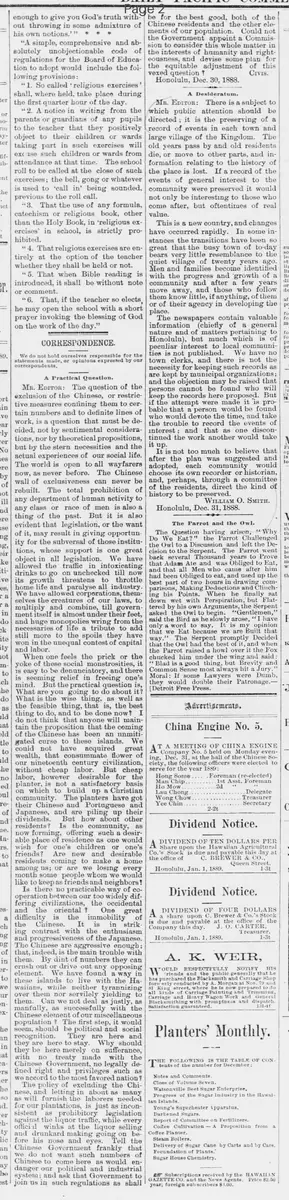
A Practical Question.
Mr. Editor: The question of the exclusion of the Chinese, or restrictive measures confining them to certain numbers and to definite lines of work, is a question that must be decided, not by sentimental considerations, nor by theoretical propositions, but by the stern necessities and the actual experiences of our social life.
The world is open to all wayfarers now, as never before. The Chinese wall of exclusiveness can never be rebuilt. The total prohibition of any department of human activity to any class or race of men is also a thing of the past. But it is also evident that legislation, or the want of it, may result in giving opportunity for the subversion of those institutions, whose support is one great object in all legislation. We have allowed the traffic in intoxicating drinks to go on unchecked till now its growth threatens to throttle home life and paralyse all industry. We have allowed corporations, themselves the creatures of our laws, to multiply and combine, till government itself is almost under their feet, and huge monopolies wring from the necessaries of life a tribute to add still more to the spoils they have won in the unequal contest of capital and labor.
When one feels the prick or the yoke of these social monstrosities, it is easy to be denunciatory, and there is seeming relief in freeing one's mind. But the practical question is, What are you going to do about it? What is the wise thing, as well as the feasible thing, that is, the best thing to do, and to be done now? I do not think that anyone will maintain the proposition that the coming of the Chinese has been an unmitigated curse to these islands. We could not have acquired great wealth, that consummate flower of our nineteenth century civilization, without cheap labor. But cheap labor, however desirable for the planter, is not a satisfactory basis on which to build up a Christian community. The planters have got their Chinese and Portuguese and Japanese, and are piling up their dividends. But how about other residents? Is the community, as now forming, offering such a desirable place of residence as one would wish for one's children or one's friends? Are new and desirable residents coming to make a home among us; or are we losing every month some people whom we would like to keep as friends and neighbors? Is there no practicable way of co-operation between our too widely differing civilizations, the occidental and the oriental? One great difficulty is the immobility of the Chinese. It is in striking contrast with the enthusiasm and progressiveness of the Japanese. The Chinese are aggressive enough; that, indeed, is the main trouble with them. By dint of numbers they can crush out or drive out any opposing element. We have found a way in these islands to live with the Hawaiians, while neither tyrannizing over them nor servilely yielding to them. Can we not deal as justly, as manfully, as successfully with the Chinese element of our miscellaneous population? The first step, it would seem, should be political and social recognition. They are here and they are here to stay. Why should they be here merely on sufferance, with no treaty made with the Chinese Government, no legally defined right and privileges such as we accord to the most favored nation? The policy of excluding the Chinese, and letting in about as many as will furnish the laborers needed for our plantations, is just as inconsistent as prohibitory legislation against the liquor traffic, while every official winks at the liquor selling and drunkard making going on before his nose and eyes. Tell the Chinese Government frankly that we do not want such numbers of Chinese to come here as would endanger our political and industrial system; and ask that Government to join us in such regulations as shall be for the best good, both of the Chinese residents and the other elements of our population. Could not the Government appoint a Commission to consider this whole matter in the interests of humanity and righteousness, and devise some plan for the equitable adjustment of this vexed question?
CIVIs.
Honolulu, Dec. 30, 1888.
Mr. Editor: The question of the exclusion of the Chinese, or restrictive measures confining them to certain numbers and to definite lines of work, is a question that must be decided, not by sentimental considerations, nor by theoretical propositions, but by the stern necessities and the actual experiences of our social life.
The world is open to all wayfarers now, as never before. The Chinese wall of exclusiveness can never be rebuilt. The total prohibition of any department of human activity to any class or race of men is also a thing of the past. But it is also evident that legislation, or the want of it, may result in giving opportunity for the subversion of those institutions, whose support is one great object in all legislation. We have allowed the traffic in intoxicating drinks to go on unchecked till now its growth threatens to throttle home life and paralyse all industry. We have allowed corporations, themselves the creatures of our laws, to multiply and combine, till government itself is almost under their feet, and huge monopolies wring from the necessaries of life a tribute to add still more to the spoils they have won in the unequal contest of capital and labor.
When one feels the prick or the yoke of these social monstrosities, it is easy to be denunciatory, and there is seeming relief in freeing one's mind. But the practical question is, What are you going to do about it? What is the wise thing, as well as the feasible thing, that is, the best thing to do, and to be done now? I do not think that anyone will maintain the proposition that the coming of the Chinese has been an unmitigated curse to these islands. We could not have acquired great wealth, that consummate flower of our nineteenth century civilization, without cheap labor. But cheap labor, however desirable for the planter, is not a satisfactory basis on which to build up a Christian community. The planters have got their Chinese and Portuguese and Japanese, and are piling up their dividends. But how about other residents? Is the community, as now forming, offering such a desirable place of residence as one would wish for one's children or one's friends? Are new and desirable residents coming to make a home among us; or are we losing every month some people whom we would like to keep as friends and neighbors? Is there no practicable way of co-operation between our too widely differing civilizations, the occidental and the oriental? One great difficulty is the immobility of the Chinese. It is in striking contrast with the enthusiasm and progressiveness of the Japanese. The Chinese are aggressive enough; that, indeed, is the main trouble with them. By dint of numbers they can crush out or drive out any opposing element. We have found a way in these islands to live with the Hawaiians, while neither tyrannizing over them nor servilely yielding to them. Can we not deal as justly, as manfully, as successfully with the Chinese element of our miscellaneous population? The first step, it would seem, should be political and social recognition. They are here and they are here to stay. Why should they be here merely on sufferance, with no treaty made with the Chinese Government, no legally defined right and privileges such as we accord to the most favored nation? The policy of excluding the Chinese, and letting in about as many as will furnish the laborers needed for our plantations, is just as inconsistent as prohibitory legislation against the liquor traffic, while every official winks at the liquor selling and drunkard making going on before his nose and eyes. Tell the Chinese Government frankly that we do not want such numbers of Chinese to come here as would endanger our political and industrial system; and ask that Government to join us in such regulations as shall be for the best good, both of the Chinese residents and the other elements of our population. Could not the Government appoint a Commission to consider this whole matter in the interests of humanity and righteousness, and devise some plan for the equitable adjustment of this vexed question?
CIVIs.
Honolulu, Dec. 30, 1888.
What sub-type of article is it?
Persuasive
Social Critique
Reflective
What themes does it cover?
Social Issues
Politics
Commerce Trade
What keywords are associated?
Chinese Immigration
Hawaii Labor
Social Integration
Exclusion Policy
Plantations
Chinese Government
Political Recognition
What entities or persons were involved?
Civis.
Mr. Editor
Letter to Editor Details
Author
Civis.
Recipient
Mr. Editor
Main Argument
advocate for political and social recognition of chinese residents in hawaii, negotiation with the chinese government for regulated immigration to meet labor needs without endangering social institutions, and appointment of a commission for equitable adjustment.
Notable Details
Compares Chinese Immigration Policy To Inconsistent Liquor Prohibition
Contrasts Chinese Immobility With Japanese Progressiveness
References Living With Hawaiians As Model For Dealing With Chinese
Mentions Cheap Labor's Role In Wealth But Unsuitability For Christian Community