Thank you for visiting SNEWPapers!
Sign up free
Editorial
July 30, 1891
The Princeton Union
Princeton, Mille Lacs County, Minnesota
What is this article about?
An editorial criticizing the practice of tipping as a form of tyranny and bribery, arguing that it harms businesses, encourages low wages, and rewards obsequiousness over hard work. It calls for employers to prohibit tips and the public to refuse them.
Clipping
OCR Quality
98%
Excellent
Full Text
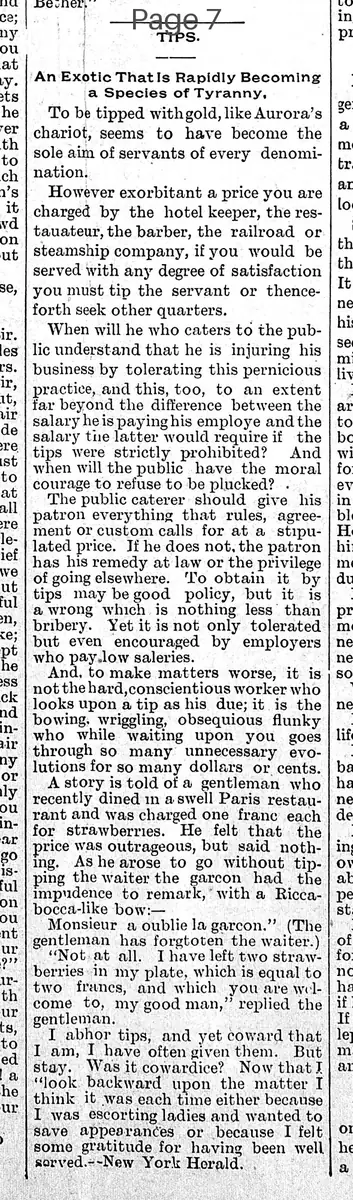
TIPS.
An Exotic That Is Rapidly Becoming a Species of Tyranny.
To be tipped with gold, like Aurora's chariot, seems to have become the sole aim of servants of every denomination.
However exorbitant a price you are charged by the hotel keeper, the restaurateur, the barber, the railroad or steamship company, if you would be served with any degree of satisfaction you must tip the servant or thenceforth seek other quarters.
When will he who caters to the public understand that he is injuring his business by tolerating this pernicious practice, and this, too, to an extent far beyond the difference between the salary he is paying his employe and the salary the latter would require if the tips were strictly prohibited? And when will the public have the moral courage to refuse to be plucked?
The public caterer should give his patron everything that rules, agreement or custom calls for at a stipulated price. If he does not, the patron has his remedy at law or the privilege of going elsewhere. To obtain it by tips may be good policy, but it is a wrong which is nothing less than bribery. Yet it is not only tolerated but even encouraged by employers who pay low salaries.
And, to make matters worse, it is not the hard, conscientious worker who looks upon a tip as his due; it is the bowing, wriggling, obsequious flunky who while waiting upon you goes through so many unnecessary evolutions for so many dollars or cents.
A story is told of a gentleman who recently dined in a swell Paris restaurant and was charged one franc each for strawberries. He felt that the price was outrageous, but said nothing. As he arose to go without tipping the waiter the garcon had the impudence to remark, with a Riccabocca-like bow: 'Monsieur a oublié la garcon.' (The gentleman has forgotten the waiter.)
'Not at all. I have left two strawberries in my plate, which is equal to two francs, and which you are welcome to, my good man,' replied the gentleman.
I abhor tips, and yet coward that I am, I have often given them. But stay. Was it cowardice? Now that I 'look backward upon the matter I think it was each time either because I was escorting ladies and wanted to save appearances or because I felt some gratitude for having been well served.—New York Herald.
An Exotic That Is Rapidly Becoming a Species of Tyranny.
To be tipped with gold, like Aurora's chariot, seems to have become the sole aim of servants of every denomination.
However exorbitant a price you are charged by the hotel keeper, the restaurateur, the barber, the railroad or steamship company, if you would be served with any degree of satisfaction you must tip the servant or thenceforth seek other quarters.
When will he who caters to the public understand that he is injuring his business by tolerating this pernicious practice, and this, too, to an extent far beyond the difference between the salary he is paying his employe and the salary the latter would require if the tips were strictly prohibited? And when will the public have the moral courage to refuse to be plucked?
The public caterer should give his patron everything that rules, agreement or custom calls for at a stipulated price. If he does not, the patron has his remedy at law or the privilege of going elsewhere. To obtain it by tips may be good policy, but it is a wrong which is nothing less than bribery. Yet it is not only tolerated but even encouraged by employers who pay low salaries.
And, to make matters worse, it is not the hard, conscientious worker who looks upon a tip as his due; it is the bowing, wriggling, obsequious flunky who while waiting upon you goes through so many unnecessary evolutions for so many dollars or cents.
A story is told of a gentleman who recently dined in a swell Paris restaurant and was charged one franc each for strawberries. He felt that the price was outrageous, but said nothing. As he arose to go without tipping the waiter the garcon had the impudence to remark, with a Riccabocca-like bow: 'Monsieur a oublié la garcon.' (The gentleman has forgotten the waiter.)
'Not at all. I have left two strawberries in my plate, which is equal to two francs, and which you are welcome to, my good man,' replied the gentleman.
I abhor tips, and yet coward that I am, I have often given them. But stay. Was it cowardice? Now that I 'look backward upon the matter I think it was each time either because I was escorting ladies and wanted to save appearances or because I felt some gratitude for having been well served.—New York Herald.
What sub-type of article is it?
Social Reform
Moral Or Religious
What keywords are associated?
Tipping
Servants
Bribery
Low Wages
Social Custom
Moral Courage
What entities or persons were involved?
Servants
Public Caterers
New York Herald
Editorial Details
Primary Topic
Criticism Of Tipping As Tyranny And Bribery
Stance / Tone
Strongly Opposed To Tipping
Key Figures
Servants
Public Caterers
New York Herald
Key Arguments
Tipping Has Become Essential For Satisfactory Service In Hotels, Restaurants, And Transport
Employers Injure Their Business By Tolerating Tipping And Paying Low Salaries
Public Should Refuse Tips To End The Practice
Tipping Is Equivalent To Bribery
Tips Reward Obsequious Flunkies, Not Conscientious Workers