Thank you for visiting SNEWPapers!
Sign up free
Story
May 19, 1879
Public Ledger
Memphis, Shelby County, Tennessee
What is this article about?
Scientist Cushing at the Smithsonian discovers the prehistoric method of making flint arrowheads using pressure flaking with sticks, replicating ancient tools without metal, revealing right-handed makers.
Clipping
OCR Quality
95%
Excellent
Full Text
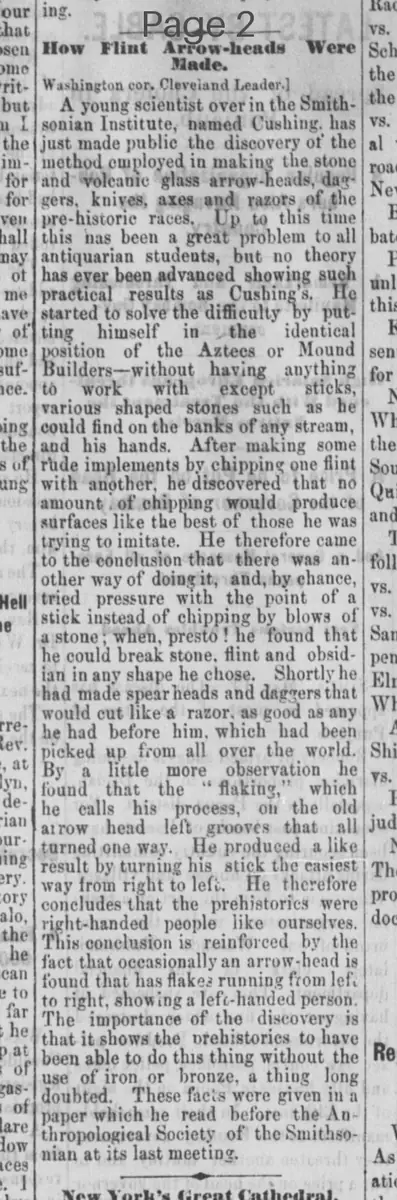
How Flint Arrow-heads Were Made.
Washington cor. Cleveland Leader.
A young scientist over in the Smithsonian Institute, named Cushing, has just made public the discovery of the method employed in making the stone and volcanic glass arrow-heads, daggers, knives, axes and razors of the pre-historic races. Up to this time this has been a great problem to all antiquarian students, but no theory has ever been advanced showing such practical results as Cushing's. He started to solve the difficulty by putting himself in the identical position of the Aztecs or Mound Builders—without having anything to work with except sticks, various shaped stones such as he could find on the banks of any stream, and his hands. After making some rude implements by chipping one flint with another, he discovered that no amount of chipping would produce surfaces like the best of those he was trying to imitate. He therefore came to the conclusion that there was another way of doing it, and, by chance, tried pressure with the point of a stick instead of chipping by blows of a stone: when, presto! he found that he could break stone, flint and obsidian in any shape he chose. Shortly he had made spear heads and daggers that would cut like a razor, as good as any he had before him, which had been picked up from all over the world. By a little more observation he found that the "flaking," which he calls his process, on the old arrow head left grooves that all turned one way. He produced a like result by turning his stick the easiest way from right to left. He therefore concludes that the prehistorics were right-handed people like ourselves. This conclusion is reinforced by the fact that occasionally an arrow-head is found that has flakes running from left to right, showing a left-handed person. The importance of the discovery is that it shows the prehistorics to have been able to do this thing without the use of iron or bronze, a thing long doubted. These facts were given in a paper which he read before the Anthropological Society of the Smithsonian at its last meeting.
Washington cor. Cleveland Leader.
A young scientist over in the Smithsonian Institute, named Cushing, has just made public the discovery of the method employed in making the stone and volcanic glass arrow-heads, daggers, knives, axes and razors of the pre-historic races. Up to this time this has been a great problem to all antiquarian students, but no theory has ever been advanced showing such practical results as Cushing's. He started to solve the difficulty by putting himself in the identical position of the Aztecs or Mound Builders—without having anything to work with except sticks, various shaped stones such as he could find on the banks of any stream, and his hands. After making some rude implements by chipping one flint with another, he discovered that no amount of chipping would produce surfaces like the best of those he was trying to imitate. He therefore came to the conclusion that there was another way of doing it, and, by chance, tried pressure with the point of a stick instead of chipping by blows of a stone: when, presto! he found that he could break stone, flint and obsidian in any shape he chose. Shortly he had made spear heads and daggers that would cut like a razor, as good as any he had before him, which had been picked up from all over the world. By a little more observation he found that the "flaking," which he calls his process, on the old arrow head left grooves that all turned one way. He produced a like result by turning his stick the easiest way from right to left. He therefore concludes that the prehistorics were right-handed people like ourselves. This conclusion is reinforced by the fact that occasionally an arrow-head is found that has flakes running from left to right, showing a left-handed person. The importance of the discovery is that it shows the prehistorics to have been able to do this thing without the use of iron or bronze, a thing long doubted. These facts were given in a paper which he read before the Anthropological Society of the Smithsonian at its last meeting.
What sub-type of article is it?
Curiosity
Historical Event
Personal Triumph
What themes does it cover?
Triumph
Exploration
What keywords are associated?
Flint Arrowheads
Prehistoric Tools
Pressure Flaking
Smithsonian Discovery
Cushing Method
Right Handed Prehistorics
What entities or persons were involved?
Cushing
Aztecs
Mound Builders
Where did it happen?
Smithsonian Institute, Washington
Story Details
Key Persons
Cushing
Aztecs
Mound Builders
Location
Smithsonian Institute, Washington
Story Details
Cushing replicates prehistoric flint tool-making by pressure flaking with sticks, solving a long-standing mystery and proving ancient peoples crafted sharp tools without metal, inferring they were mostly right-handed.