Thank you for visiting SNEWPapers!
Sign up free
The Virginia Gazette
Williamsburg, Virginia
What is this article about?
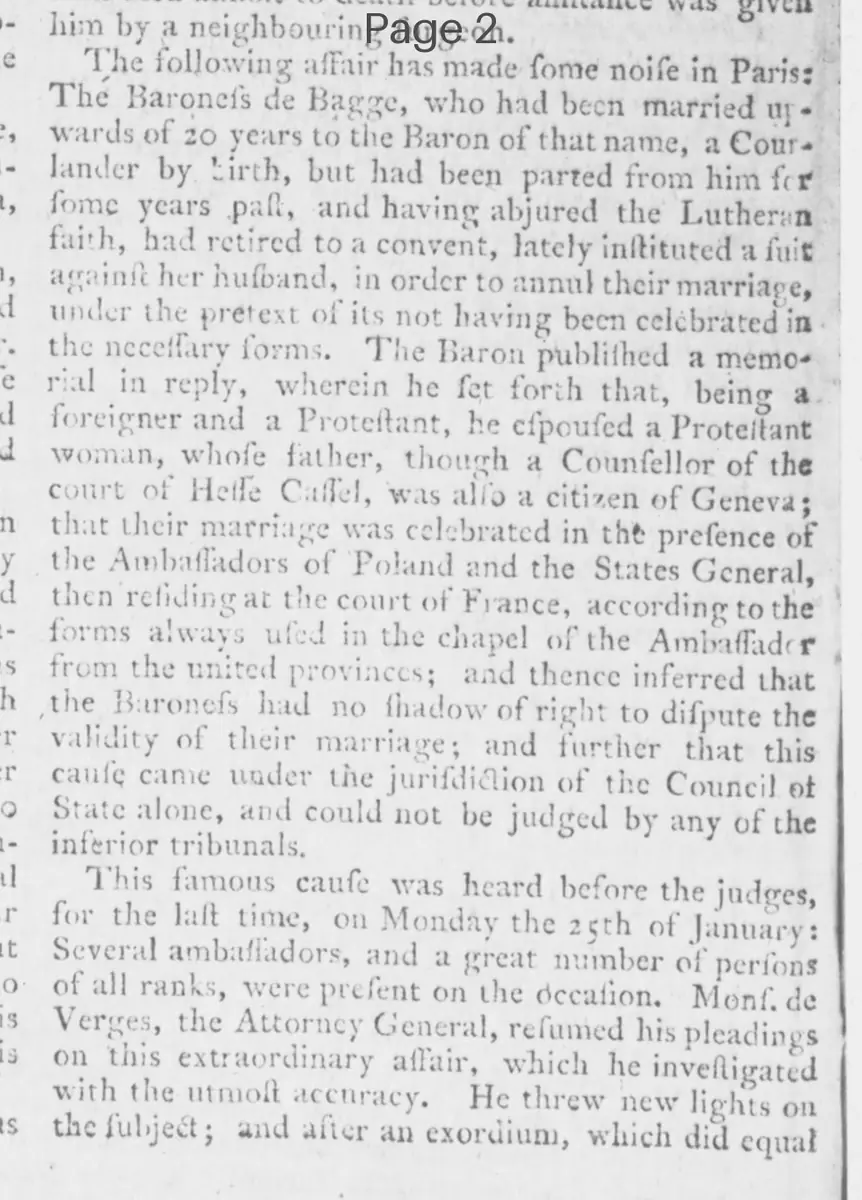
In Paris, the Baroness de Bagge sued to annul her 20-year marriage to Baron de Bagge, citing improper forms, but the Attorney General argued its validity due to their Protestant foreign status and ambassadorial ceremony. On January 25, the court ordered settlement within 8 days, effectively favoring the Baron.
Merged-components note: Merged continuation of the narrative about the Baroness de Bagge court case in Paris across pages 2 and 3; relabeled to foreign_news as it is an international report.
Clippings
1 of 2
OCR Quality
Full Text
This famous cause was heard before the judges, for the last time, on Monday the 25th of January: Several ambassadors, and a great number of persons of all ranks, were present on the occasion. Mons. de Verges, the Attorney General, resumed his pleadings on this extraordinary affair, which he investigated with the utmost accuracy. He threw new lights on the subject; and after an exordium, which did equal justice to his head and heart, he proved, by a chain of incontestable facts and authorities, that the marriage was valid, and that the Baroness had no right to sue for a separation.
honour to foreign nations and his own, he entered into the discussion of the essential point of the question with great force and energy. He demonstrated that the Baroness de Bagge was an alien, (a fact which the had endeavoured to disprove, in order to obtain a verdict in her favour) that as such she was entitled to the privilege of being married in the Dutch Ambassador's chapel, and that being, both by her religion and birth, exempted from all submission to the laws of France, both ecclesiastical and civil, she was not justified in demanding the reversal of a marriage, which she had contracted with her own free will, and upon the faith of her vows. He said that it was very plain that this Lady's father's design had always been to subject her to the laws and religion of Geneva, which he was entitled to do, by the privileges granted to the Genevese by Henry the 4th, and that she had submitted without any repugnance, as her father died in 1762, and she did not make any attempt to prove her marriage illegal till 1771. Lastly, he set forth how necessary it was for the Judges to reject all applications for such reversals, which were always hurtful to the rights of mankind and the public honour; and concluded with moving the court, "that the demand made by the Baroness de Bagge be rejected." His conclusions were supported by such powerful reasons that every one present imagined the Judges would coincide in his opinion; nevertheless they required some time to deliberate on the verdict they should pass. They remained upwards of an hour and a half, in a room adjoining to the Great Chamber, and being returned to their seats, the first president pronounced the following sentence; "The court orders that the parties shall settle the matter between themselves, and produce their agreement in writing within the space of 8 days." This decision appeared very extraordinary, but it was perceived how difficult it would be for the Parliament to pass a final determination on this question. And as the affair now stands the Baron has gained his cause. The Baroness brought her husband a fortune of upwards of 100,000 livres per annum.
What sub-type of article is it?
What keywords are associated?
What entities or persons were involved?
Where did it happen?
Foreign News Details
Primary Location
Paris
Event Date
Monday The 25th Of January
Key Persons
Outcome
the court orders that the parties shall settle the matter between themselves, and produce their agreement in writing within the space of 8 days. and as the affair now stands the baron has gained his cause. the baroness brought her husband a fortune of upwards of 100,000 livres per annum.
Event Details
The Baroness de Bagge instituted a suit to annul her marriage to the Baron de Bagge, claiming improper forms. The Baron defended with a memorial citing their Protestant foreign status and marriage in the Dutch Ambassador's chapel. On January 25, Attorney General Mons. de Verges argued for validity, but the court ordered private settlement within 8 days.