Thank you for visiting SNEWPapers!
Sign up free
Alexandria Gazette & Daily Advertiser
Alexandria, Virginia
What is this article about?
A fire broke out in a cotton press and warehouse in Mobile, Alabama, on August 11, 1820, spreading to adjacent buildings on Dauphine Street. It destroyed multiple stores and property valued at 75-80,000 dollars, including 100 bales of cotton. No lives were lost, and the fire was contained through citizens' efforts despite lacking organized fire companies.
Clipping
OCR Quality
Full Text
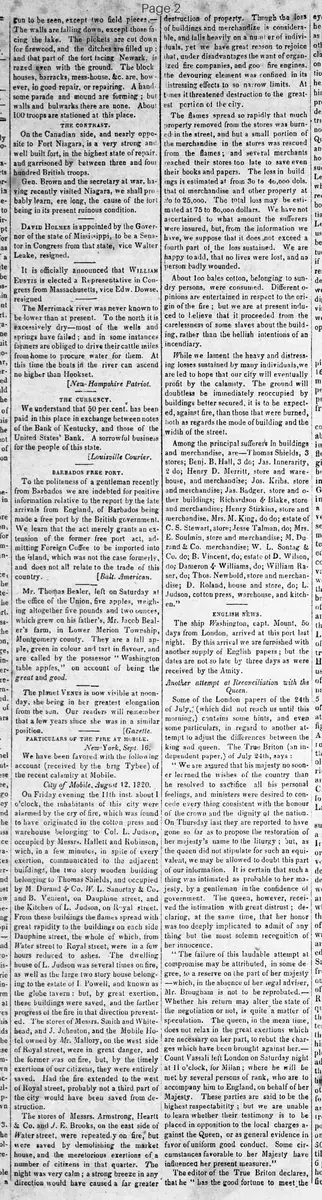
New-York, Sept. 16.
We have been favored with the following account (received by the brig Tybee) of the recent calamity at Mobile.
City of Mobile, August 12, 1820.
On Friday evening the 11th inst. about 1 o'clock, the inhabitants of this city were alarmed by the cry of fire, which was found to have originated in the cotton press and warehouse belonging to Col. L. Judson, occupied by Messrs. Hallett and Robinson, which, in a few minutes, in spite of every exertion, communicated to the adjacent buildings, the two story wooden building belonging to Thomas Shields, and occupied by M. Durand & Co. W. L. Sanortay & Co. and B. Venient, on Dauphine street, and the Kitchen of L. Judson, on Royal street. From these buildings the flames spread with great rapidity to the buildings on each side Dauphine street, the whole of which, from Water street to Royal street, were in a few hours reduced to ashes. The dwelling house of L. Judson was several times on fire, as well as the large two story house belonging to the estate of I. Powell, and known as the globe tavern: but, by great exertion, these buildings were saved, and the farther progress of the fire in that direction prevented. The stores of Messrs. Smith and Whitehead, and J. Johnston, and the Mobile Hotel owned by Mr. Mallory, on the west side of Royal street, were in great danger, and the former was on fire, but, by the timely exertions of our citizens, they were entirely saved. Had the fire extended to the west of Royal street, probably not a third part of the city would have been saved from destruction. The stores of Messrs. Armstrong, Heartt & Co. and J. E. Brooks, on the east side of Water street, were repeatedly on fire, but were saved by demolishing the market house, and the meritorious exertions of a number of citizens in that quarter. The night was very calm; a strong breeze in any direction would have caused a far greater destruction of property. Through the loss of buildings and merchandize is considerable, and falls heavily on a number of individuals, yet we have great reason to rejoice that, under disadvantages the want of organized fire companies, and good fire engines, the devouring element was confined in its distressing effects to so narrow limits. At times it threatened destruction to the greatest portion of the city. The flames spread so rapidly that much property removed from the stores was burned in the street, and but a small portion of the merchandise in the stores was rescued from the flames; and several merchants reached their stores too late to save even their books and papers. The loss in buildings is estimated at from 30 to 40,000 dols. that of merchandise and other property at 20 to 25,000. The total loss may be estimated at 75 to 80,000 dollars. We have not ascertained to what amount the sufferers were insured, but, from the information we have, we suppose that it does not exceed a fourth part of the loss sustained. We are happy to add, that no lives were lost, and no person badly wounded. About 100 bales cotton, belonging to sundry persons, were consumed. Different opinions are entertained in respect to the origin of the fire; but we are at present induced to believe that it proceeded from the carelessness of some slaves about the building, rather than the hellish intentions of an incendiary. While we lament the heavy and distressing losses sustained by many individuals, we are led to hope that our city will eventually profit by the calamity. The ground will doubtless be immediately reoccupied by buildings better secured, it is to be expected, against fire, than those that were burned, both as regards the mode of building and the width of the street. Among the principal sufferers in buildings and merchandise, are--Thomas Shields, 3 stores; Benj. B. Hall, 3 do; Jas. Innerarity, 2 do; Henry D. Merritt, store and warehouse, and merchandise; Jos. Kribs, store and merchandise; Jas. Badger, store and other buildings; Richardson & Blake, store and merchandise; Henry Stirkins, store and merchandise, Mrs. M. King, do do: estate of C. S. Stewart, store; Jesse Talman, do; Mrs. E. Soulmin, store and merchandise: M. Durand & Co. merchandise: W. L. Sontag & Co. do; B. Vincent, do; estate of D. Wilson, do; Dameron & Williams, do; William Raser, do; Thos. Newbold, store and merchandise: D. Roland, house and store, do: L. Judson, cotton press, warehouse, and kitchen.
What sub-type of article is it?
What keywords are associated?
What entities or persons were involved?
Where did it happen?
Domestic News Details
Primary Location
Mobile
Event Date
August 11, 1820
Key Persons
Outcome
no lives lost, no persons badly wounded. total loss estimated at 75 to 80,000 dollars, including buildings (30-40,000 dollars), merchandise and other property (20-25,000 dollars), and about 100 bales of cotton. insurance covers less than a fourth of the loss.
Event Details
The fire originated around 1 o'clock on Friday evening in the cotton press and warehouse of Col. L. Judson, occupied by Messrs. Hallett and Robinson. It spread rapidly to adjacent buildings on Dauphine Street, destroying all structures from Water Street to Royal Street. Citizens' exertions saved nearby buildings like L. Judson's dwelling, the Globe Tavern, stores on Royal and Water Streets, despite lacking fire companies and engines. The fire was likely caused by careless slaves, not arson. Principal sufferers include Thomas Shields, Benj. B. Hall, and others with losses in stores, warehouses, and merchandise.