Thank you for visiting SNEWPapers!
Sign up free
Editorial
December 29, 1800
The National Intelligencer And Washington Advertiser
Washington, District Of Columbia
What is this article about?
This editorial, part III, proposes a subordinate government structure for the Territory of Columbia, including a bicameral legislature, governor appointed by the President, and local courts, to handle local concerns without burdening federal authorities. Signed 'EPAMINONDAS' from Washington, December 22, 1800.
Clipping
OCR Quality
98%
Excellent
Full Text
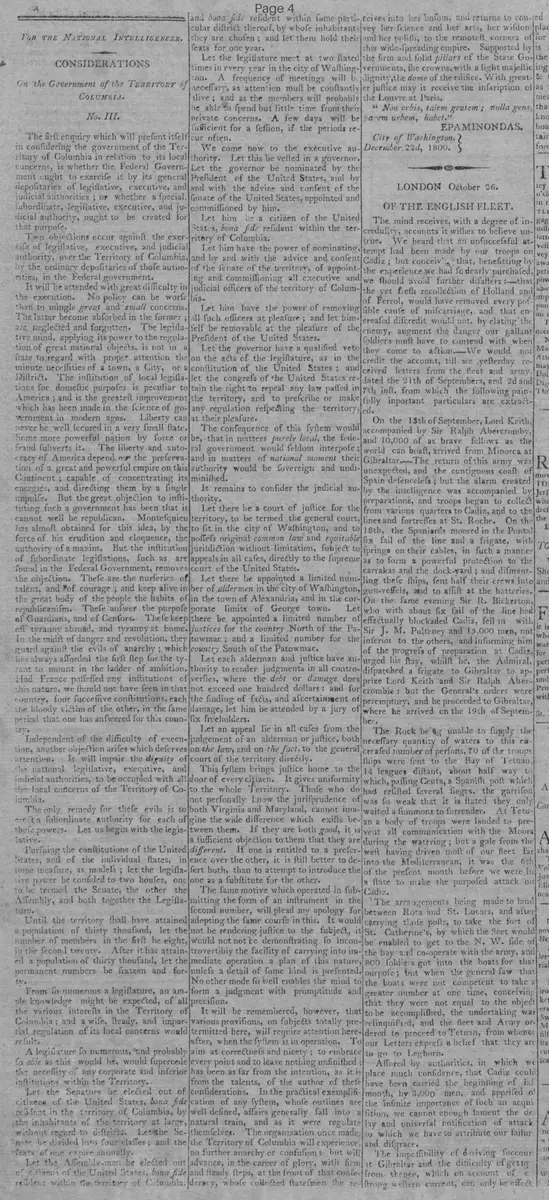
FOR THE NATIONAL INTELLIGENCER.
CONSIDERATIONS
On the Government of the Territory of COLUMBIA.
No. III.
The first enquiry which will present itself in considering the government of the Territory of Columbia in relation to its local concerns, is whether the Federal Government ought to exercise it by its general depositories of legislative, executive, and judicial authorities; or whether a special subordinate, legislative, executive, and judicial authority, ought to be created for that purpose.
Two objections occur against the exercise of legislative, executive, and judicial authority, over the Territory of Columbia, by the ordinary depositories of those authorities, in the Federal government.
It will be attended with great difficulty in the execution. No policy can be worse than to mingle great and small concerns. The latter become absorbed in the former; are neglected and forgotten. The legislative mind, applying its power to the regulation of great national objects, is not in a state to regard with proper attention the minute necessities of a town, a City, or a District. The institution of local legislations for domestic purposes is peculiar to America; and is the greatest improvement which has been made in the science of government in modern ages. Liberty can never be well secured in a very small state. Some more powerful nation by force or fraud subverts it. The liberty and autocracy of America depend on the preservation of a great and powerful empire on this Continent; capable of concentrating its energies, and directing them by a single impulse. But the great objection to instituting such a government has been that it cannot well be republican. Montesquieu has almost obtained for this idea, by the force of his erudition and eloquence, the authority of a maxim. But the institution of subordinate legislations, such as are found in the Federal Government, removes the objection. These are the nurseries of talent, and of courage; and keep alive in the great body of the people the habits of republicanism. These answer the purpose of Guardians, and of Censors. These keep off tyranny abroad, and tyranny at home. In the midst of danger and revolution, they guard against the evils of anarchy; which has always afforded the first step for the tyrant to mount in the ladder of ambition. Had France possessed any institutions of this nature, we should not have seen in that country, four successive constitutions, each the bloody victim of the other, in the same period that one has answered for this country.
Independent of the difficulty of execution, another objection arises which deserves attention. It will impair the dignity of the national legislative, executive, and judicial authorities, to be occupied with all the local concerns of the Territory of Columbia.
The only remedy for these evils is to create a subordinate authority for each of these powers. Let us begin with the legislative.
Pursuing the constitutions of the United States, and of the individual states, in some measure, as models; let the legislative power be considered to two houses, one to be termed the Senate, the other the Assembly, and both together the Legislature.
Until the territory shall have attained a population of thirty thousand, let the number of members in the first be eight, in the second twenty. After it has attained a population of thirty thousand, let the permanent numbers be sixteen and forty.
From so numerous a legislature, an ample knowledge might be expected, of all the various interests in the Territory of Columbia; and a wise, steady, and impartial regulation of its local concerns would result.
A legislature so numerous, and probably so able as this would be, would supersede the necessity of any corporate and inferior institutions within the Territory.
Let the Senators be elected out of citizens of the United States, bona fide resident in the territory of Columbia, by the inhabitants of the territory at large, without regard to districts. Let the Senate be divided into four classes; and the seats of one expire annually.
Let the Assembly-men be elected out of citizens of the United States, bona fide resident within the territory of Columbia, and bona fide resident within some particular district thereof, by whose inhabitants they are chosen; and let them hold their seats for one year.
Let the legislature meet at two stated times in every year in the city of Washington. A frequency of meetings will be necessary, as attention must be constantly alive; and as the members will probably be able to spend but little time from their private concerns. A few days will be sufficient for a session, if the periods recur often.
We come now to the executive authority. Let this be vested in a governor. Let the governor be nominated by the President of the United States, and by and with the advice and consent of the Senate of the United States, appointed and commissioned by him. Let him be a citizen of the United States, bona fide resident within the territory of Columbia. Let him have the power of nominating, and by and with the advice and consent of the Senate of the territory, of appointing and commissioning all executive and judicial officers of the territory of Columbia. Let him have the power of removing all such officers at pleasure; and let himself be removable at the pleasure of the President of the United States. Let the governor have a qualified veto on the acts of the legislature, as in the constitution of the United States; and let the Congress of the United States retain the right to repeal any law passed in the territory, and to prescribe or make any regulation respecting the territory, at their pleasure.
The consequence of this system would be, that in matters purely local, the federal government would seldom interpose; and in matters of national moment their authority would be sovereign and undiminished.
It remains to consider the judicial authority. Let there be a court of justice for the territory, to be termed the general court, to sit in the city of Washington, and to possess original common law and equitable jurisdiction without limitation, subject to appeals in all cases, directly to the supreme court of the United States. Let there be appointed a limited number of aldermen in the city of Washington, in the town of Alexandria, and in the corporate limits of George town. Let there be appointed a limited number of justices for the county North of the Potomac; and a limited number for the county South of the Potomac. Let each alderman and justice have authority to render judgments in all controversies, where the debt or damage does not exceed one hundred dollars: and for the finding of facts, and ascertainment of damage, let him be attended by a jury of six freeholders. Let an appeal lie in all cases from the judgement of an alderman or justice, both on the law, and on the fact, to the general court of the territory directly.
This system brings justice home to the door of every citizen. It gives uniformity to the whole Territory. Those who do not personally know the jurisprudence of both Virginia and Maryland, cannot imagine the wide difference which exists between them. If they are both good, it is a sufficient objection to them that they are different. If one is entitled to a preference over the other, it is still better to desert both, than to attempt to introduce the one as a substitute for the other.
The same motive which operated in submitting the form of an instrument in the second number, will plead my apology for adopting the same course in this. It would not be rendering justice to the subject, it would not be so demonstrating so incontrovertibly the facility of carrying into immediate operation a plan of this nature, unless a detail of some kind is presented. No other mode so well enables the mind to form a judgment with promptitude and precision.
It will be remembered, however, that various provisions, on subjects totally pretermitted here, will require attention hereafter, when the system is in operation. To aim at correctness and nicety; to embrace every point and to leave nothing unfinished; has been as far from the intention, as it is from the talents, of the author of these considerations. In the practical exemplification of any system, whose outlines are well defined, affairs generally fall into a natural train, and as it were regulate themselves. The organization once made, the Territory of Columbia will experience no further anarchy or confusion: but will advance, in the career of glory, with firm and steady steps, at the front of that confederacy, whose collected statesmen he receives into her bosom, and returns to convey her science and her arts, her wisdom and her polish, to the remotest corners of this wide-spreading empire. Supported by the firm and solid pillars of the State Governments, he crowns, with a light majestic dignity, the dome of the edifice. With greater justice may it receive the inscription of the Louvre at Paris,
"Non orbis, talem gentem; nulla gens parem urbem, habet."
EPAMINONDAS
City of Washington,
December 22d, 1800.
CONSIDERATIONS
On the Government of the Territory of COLUMBIA.
No. III.
The first enquiry which will present itself in considering the government of the Territory of Columbia in relation to its local concerns, is whether the Federal Government ought to exercise it by its general depositories of legislative, executive, and judicial authorities; or whether a special subordinate, legislative, executive, and judicial authority, ought to be created for that purpose.
Two objections occur against the exercise of legislative, executive, and judicial authority, over the Territory of Columbia, by the ordinary depositories of those authorities, in the Federal government.
It will be attended with great difficulty in the execution. No policy can be worse than to mingle great and small concerns. The latter become absorbed in the former; are neglected and forgotten. The legislative mind, applying its power to the regulation of great national objects, is not in a state to regard with proper attention the minute necessities of a town, a City, or a District. The institution of local legislations for domestic purposes is peculiar to America; and is the greatest improvement which has been made in the science of government in modern ages. Liberty can never be well secured in a very small state. Some more powerful nation by force or fraud subverts it. The liberty and autocracy of America depend on the preservation of a great and powerful empire on this Continent; capable of concentrating its energies, and directing them by a single impulse. But the great objection to instituting such a government has been that it cannot well be republican. Montesquieu has almost obtained for this idea, by the force of his erudition and eloquence, the authority of a maxim. But the institution of subordinate legislations, such as are found in the Federal Government, removes the objection. These are the nurseries of talent, and of courage; and keep alive in the great body of the people the habits of republicanism. These answer the purpose of Guardians, and of Censors. These keep off tyranny abroad, and tyranny at home. In the midst of danger and revolution, they guard against the evils of anarchy; which has always afforded the first step for the tyrant to mount in the ladder of ambition. Had France possessed any institutions of this nature, we should not have seen in that country, four successive constitutions, each the bloody victim of the other, in the same period that one has answered for this country.
Independent of the difficulty of execution, another objection arises which deserves attention. It will impair the dignity of the national legislative, executive, and judicial authorities, to be occupied with all the local concerns of the Territory of Columbia.
The only remedy for these evils is to create a subordinate authority for each of these powers. Let us begin with the legislative.
Pursuing the constitutions of the United States, and of the individual states, in some measure, as models; let the legislative power be considered to two houses, one to be termed the Senate, the other the Assembly, and both together the Legislature.
Until the territory shall have attained a population of thirty thousand, let the number of members in the first be eight, in the second twenty. After it has attained a population of thirty thousand, let the permanent numbers be sixteen and forty.
From so numerous a legislature, an ample knowledge might be expected, of all the various interests in the Territory of Columbia; and a wise, steady, and impartial regulation of its local concerns would result.
A legislature so numerous, and probably so able as this would be, would supersede the necessity of any corporate and inferior institutions within the Territory.
Let the Senators be elected out of citizens of the United States, bona fide resident in the territory of Columbia, by the inhabitants of the territory at large, without regard to districts. Let the Senate be divided into four classes; and the seats of one expire annually.
Let the Assembly-men be elected out of citizens of the United States, bona fide resident within the territory of Columbia, and bona fide resident within some particular district thereof, by whose inhabitants they are chosen; and let them hold their seats for one year.
Let the legislature meet at two stated times in every year in the city of Washington. A frequency of meetings will be necessary, as attention must be constantly alive; and as the members will probably be able to spend but little time from their private concerns. A few days will be sufficient for a session, if the periods recur often.
We come now to the executive authority. Let this be vested in a governor. Let the governor be nominated by the President of the United States, and by and with the advice and consent of the Senate of the United States, appointed and commissioned by him. Let him be a citizen of the United States, bona fide resident within the territory of Columbia. Let him have the power of nominating, and by and with the advice and consent of the Senate of the territory, of appointing and commissioning all executive and judicial officers of the territory of Columbia. Let him have the power of removing all such officers at pleasure; and let himself be removable at the pleasure of the President of the United States. Let the governor have a qualified veto on the acts of the legislature, as in the constitution of the United States; and let the Congress of the United States retain the right to repeal any law passed in the territory, and to prescribe or make any regulation respecting the territory, at their pleasure.
The consequence of this system would be, that in matters purely local, the federal government would seldom interpose; and in matters of national moment their authority would be sovereign and undiminished.
It remains to consider the judicial authority. Let there be a court of justice for the territory, to be termed the general court, to sit in the city of Washington, and to possess original common law and equitable jurisdiction without limitation, subject to appeals in all cases, directly to the supreme court of the United States. Let there be appointed a limited number of aldermen in the city of Washington, in the town of Alexandria, and in the corporate limits of George town. Let there be appointed a limited number of justices for the county North of the Potomac; and a limited number for the county South of the Potomac. Let each alderman and justice have authority to render judgments in all controversies, where the debt or damage does not exceed one hundred dollars: and for the finding of facts, and ascertainment of damage, let him be attended by a jury of six freeholders. Let an appeal lie in all cases from the judgement of an alderman or justice, both on the law, and on the fact, to the general court of the territory directly.
This system brings justice home to the door of every citizen. It gives uniformity to the whole Territory. Those who do not personally know the jurisprudence of both Virginia and Maryland, cannot imagine the wide difference which exists between them. If they are both good, it is a sufficient objection to them that they are different. If one is entitled to a preference over the other, it is still better to desert both, than to attempt to introduce the one as a substitute for the other.
The same motive which operated in submitting the form of an instrument in the second number, will plead my apology for adopting the same course in this. It would not be rendering justice to the subject, it would not be so demonstrating so incontrovertibly the facility of carrying into immediate operation a plan of this nature, unless a detail of some kind is presented. No other mode so well enables the mind to form a judgment with promptitude and precision.
It will be remembered, however, that various provisions, on subjects totally pretermitted here, will require attention hereafter, when the system is in operation. To aim at correctness and nicety; to embrace every point and to leave nothing unfinished; has been as far from the intention, as it is from the talents, of the author of these considerations. In the practical exemplification of any system, whose outlines are well defined, affairs generally fall into a natural train, and as it were regulate themselves. The organization once made, the Territory of Columbia will experience no further anarchy or confusion: but will advance, in the career of glory, with firm and steady steps, at the front of that confederacy, whose collected statesmen he receives into her bosom, and returns to convey her science and her arts, her wisdom and her polish, to the remotest corners of this wide-spreading empire. Supported by the firm and solid pillars of the State Governments, he crowns, with a light majestic dignity, the dome of the edifice. With greater justice may it receive the inscription of the Louvre at Paris,
"Non orbis, talem gentem; nulla gens parem urbem, habet."
EPAMINONDAS
City of Washington,
December 22d, 1800.
What sub-type of article is it?
Constitutional
Legal Reform
What keywords are associated?
Territory Of Columbia
Local Government
Federal Oversight
Bicameral Legislature
Governor Appointment
Judicial Structure
Republican Institutions
What entities or persons were involved?
Federal Government
Territory Of Columbia
President Of The United States
Congress Of The United States
Montesquieu
France
Editorial Details
Primary Topic
Proposal For Subordinate Government Of The Territory Of Columbia
Stance / Tone
Advocacy For Local Republican Institutions Under Federal Oversight
Key Figures
Federal Government
Territory Of Columbia
President Of The United States
Congress Of The United States
Montesquieu
France
Key Arguments
Federal Authorities Ill Suited For Local Concerns Due To Absorption In National Matters
Subordinate Local Governments Preserve Republican Habits And Prevent Tyranny
Propose Bicameral Legislature With Senate And Assembly Elected By Residents
Governor Appointed By President With Veto Power And Removal Authority
Judicial System With General Court And Local Justices For Accessible Justice
System Ensures Uniformity And Avoids Differences From Virginia And Maryland Laws